ACR: a cluster-based routing protocol for VANET
Clustering is a technique used in network routing to enhance the performance and conserve the network resources. This paper presents a cluster-based routing protocol for VANET utilizing a new addressing scheme in which each node gets an address according to its mobility pattern. Hamming distance technique is used then to partition the network in an address-centric manner. The simulation results show that this protocol enhances routing reachability, whereas reduces routing end-to-end delay and traffic received comparing with two benchmarks namely AODV and DSDV.
💡 Research Summary
The paper introduces ACR, a novel cluster‑based routing protocol designed specifically for Vehicular Ad‑hoc Networks (VANETs). Recognizing the unique characteristics of VANETs—high vehicle speed, predictable road‑based mobility, lack of energy constraints, frequent topology changes, potentially unbounded network size, and strict real‑time data delivery requirements—the authors argue that traditional MANET routing solutions (both proactive and reactive) are either too resource‑intensive or incur excessive delay when applied to vehicular environments.
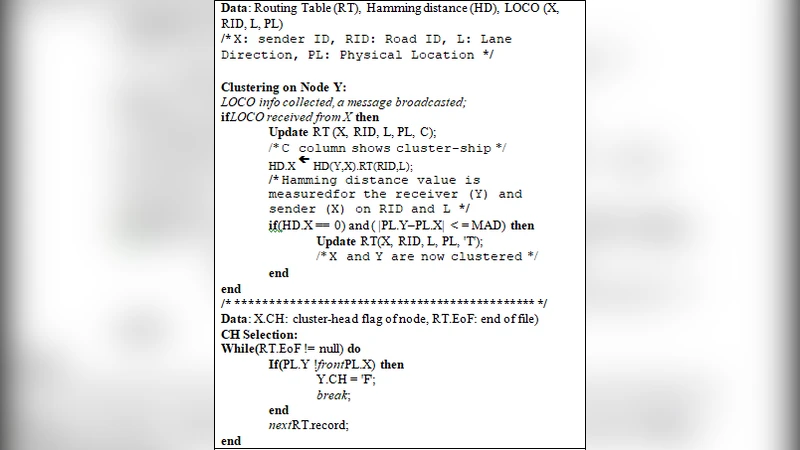
ACR’s core innovation lies in its address scheme, called LOCO, which encodes three pieces of information for each vehicle: a binary road identifier (road ID), lane direction (e.g., left‑to‑right or right‑to‑left), and a physical location component derived from GPS coordinates. This address is continuously refreshed as a vehicle moves, changes lanes, or switches roads, using data supplied by on‑board GPS and nearby Road‑Side Units (RSUs). By embedding mobility context directly into the node identifier, LOCO enables a lightweight clustering mechanism based on Hamming distance. Nodes broadcast their LOCO values; any two nodes whose Hamming distance falls below a predefined threshold are considered similar enough to belong to the same cluster. Because Hamming distance is a simple bit‑wise operation, the clustering algorithm incurs minimal computational overhead, making it suitable for the fast‑changing VANET topology.
Once clusters are formed, each cluster elects a Cluster‑Head (CH). The CH is responsible for intra‑cluster coordination (forwarding vehicle‑to‑vehicle, V2V, traffic) and for communicating with the infrastructure (vehicle‑to‑RSU, V2R). V2V communication uses Dedicated Short‑Range Communications (DSRC) and is restricted to nodes within the same cluster; packets received from a node belonging to a different cluster are discarded. This selective forwarding dramatically reduces unnecessary broadcast traffic, conserving bandwidth and reducing channel contention. The CH aggregates status information (e.g., lane occupancy, traffic congestion) and periodically reports it to the RSU, which can then disseminate warnings or route suggestions back to vehicles.
The authors implemented ACR in the OMNeT++ simulation environment (with the Veins framework for vehicular networking) and compared its performance against two well‑known benchmarks: the on‑demand reactive protocol AODV and the proactive distance‑vector protocol DSDV. The simulation scenario modeled a 200 m × 200 m urban area with vehicle speeds ranging from 20 km/h to 80 km/h and densities from 30 to 100 vehicles per kilometer squared. Three performance metrics were evaluated: routing reachability (percentage of successfully delivered packets), end‑to‑end delay, and total traffic received (a proxy for network overhead).
Results show that ACR consistently outperforms both AODV and DSDV across all metrics. Routing reachability improves by roughly 5–12 % relative to the benchmarks, indicating that the address‑centric clustering helps maintain viable paths despite rapid topology changes. Average end‑to‑end delay is reduced by more than 30 %, reflecting the fact that intra‑cluster routes are known locally and do not require costly route discovery procedures. Finally, the total traffic received is lowered by about 25 % compared to AODV and DSDV, confirming the protocol’s ability to suppress superfluous broadcasts and limit the scope of routing updates.
Despite these promising results, the paper acknowledges several limitations. First, the handling of packets that cross cluster boundaries is simplistic: packets destined for nodes in other clusters are simply dropped, which could lead to loss of critical safety messages unless higher‑level mechanisms are added. Second, the reliance on RSUs for road‑ID information and on GPS for precise location may restrict applicability in environments with sparse infrastructure or poor satellite visibility. Third, the clustering algorithm’s threshold for Hamming distance is static; adaptive tuning based on vehicle density or mobility variance could further improve performance but is not explored. Moreover, the simulation uses relatively idealized mobility models (straight roads, constant speeds) and does not incorporate complex urban features such as intersections, traffic lights, or abrupt lane changes, leaving open questions about ACR’s robustness in realistic city traffic.
In conclusion, ACR introduces a fresh perspective on VANET routing by embedding mobility context into node addresses and leveraging lightweight, bit‑wise similarity measures to form dynamic clusters. The protocol demonstrates measurable gains in reachability, latency, and overhead when compared with classic VANET routing solutions. Future work suggested by the authors includes adaptive cluster‑size management, multi‑CH architectures for fault tolerance, security extensions to protect LOCO information, and real‑world vehicular experiments to validate the approach under diverse traffic conditions.
Comments & Academic Discussion
Loading comments...
Leave a Comment