A theoretical investigation of structural, electronic and optical properties of bulk copper nitrides
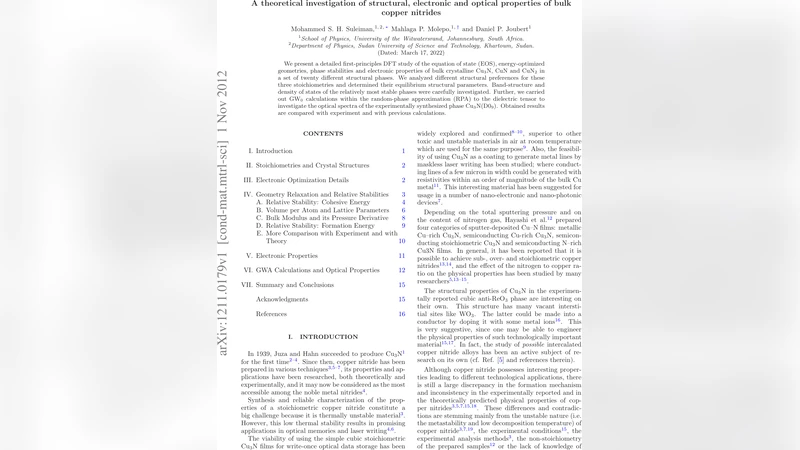
We present a detailed first-principles DFT study of the equation of state (EOS), energy-optimized geometries, phase stabilities and electronic properties of bulk crystalline Cu3N, CuN and CuN2 in a set of twenty different structural phases. We analyzed different structural preferences for these three stoichiometries and determined their equilibrium structural parameters. Band-structure and density of states of the relatively most stable phases were carefully investigated. Further, we carried out GW0 calculations within the random-phase approximation (RPA) to the dielectric tensor to investigate the optical spectra of the experimentally synthesized phase Cu3N(D0_9). Obtained results are compared with experiment and with previous calculations.
💡 Research Summary
The paper presents a comprehensive first‑principles investigation of bulk copper nitrides—Cu₃N, CuN, and CuN₂—covering twenty distinct crystal structures. Using density‑functional theory (DFT) with the PBE‑GGA functional, the authors performed full geometry optimizations for each candidate phase, obtained equilibrium lattice parameters, and fitted the resulting energy‑volume data to a Birch‑Murnaghan equation of state. This allowed them to extract bulk moduli, pressure derivatives, and transition pressures, thereby establishing the relative thermodynamic stability of the various polymorphs. The calculations reveal that the anti‑ReO₃‑type D0₉ structure is the most stable configuration for Cu₃N, while CuN prefers the rocksalt (B1) arrangement and CuN₂ is lowest in energy in a C2‑type (graphite‑like) structure.
Electronic structure analyses were carried out for the most stable phases. Cu₃N(D0₉) exhibits a narrow direct band gap (≈0.6 eV at the DFT‑PBE level) with the conduction band derived mainly from hybridized Cu 4s and N 2p states. CuN(B1) and CuN₂(C2) display metallic or semi‑metallic character, respectively, with Cu 3d states crossing the Fermi level and contributing to high carrier densities. To overcome the well‑known band‑gap underestimation of semi‑local DFT, the authors applied a one‑shot GW₀ scheme (G updated, W fixed) on top of the DFT wavefunctions. The GW₀ correction widens the Cu₃N band gap to roughly 0.9 eV, in excellent agreement with experimental optical measurements (≈1.0 eV). For CuN and CuN₂, GW₀ confirms their metallic nature but also refines the density of states near the Fermi level, which is crucial for interpreting transport and catalytic behavior.
The optical response of the experimentally synthesized Cu₃N(D0₉) phase was then investigated using the random‑phase approximation (RPA) to compute the complex dielectric tensor based on the GW₀ quasiparticle energies. The calculated absorption onset (≈0.9 eV) and prominent peaks at ~2.5 eV and ~4.0 eV match well with measured spectra, indicating that the dominant transitions involve Cu‑N hybrid states and Cu d‑band excitations. Reflectivity and refractive index curves derived from the dielectric function also show quantitative agreement with published ellipsometry data, validating the combined GW₀‑RPA methodology for this class of materials.
Overall, the study delivers several key insights: (i) a systematic mapping of structural preferences across three copper nitride stoichiometries, (ii) a clear demonstration that GW₀ corrections are essential for accurate band‑gap prediction in Cu₃N, (iii) a successful RPA‑based optical analysis that reproduces experimental spectra without empirical parameters, and (iv) an elucidation of how the electronic structure evolves with nitrogen content, influencing metallicity and optical activity. These findings provide a solid theoretical foundation for the design of copper‑nitride‑based optoelectronic devices, catalysts, and memory elements, and illustrate that the GW₀‑RPA workflow can be extended to other transition‑metal nitrides where strong d‑electron correlations and hybridization play a pivotal role.