A New Method for Epileptic Seizure Classification in EEG Using Adapted Wavelet Packets
Electroencephalography (EEG), as the most common tool for epileptic seizure classification, contains useful information about different physiological states of the brain. Seizure related features in EEG signals can be better identified when localized in time frequency basis projections. In this work, a novel method for epileptic seizure classification based on wavelet packets (WPs) is presented in which both mother wavelet function and WP bases are adapted a posteriori to improve the seizure classification. A support vector machine (SVM) as classifier is used for seizure versus non-seizure EEG segment classification. In order to evaluate the proposed algorithm, a publicly available dataset containing different groups patient with epilepsy and healthy individuals are used. The obtained results indicate that the proposed method outperforms some previously proposed algorithms in epileptic seizure classification.
💡 Research Summary
**
This paper presents a novel framework for classifying epileptic seizures from scalp electroencephalography (EEG) recordings by exploiting adaptive wavelet packet transform (WPT) techniques and a support vector machine (SVM) classifier. The authors begin by noting that EEG signals are inherently non‑stationary, and that time‑frequency representations are essential for revealing seizure‑related patterns. While many prior works have employed wavelet transforms, they typically fix the mother wavelet and decomposition basis a priori, potentially missing optimal representations for a given dataset.
To address this, the proposed method performs a two‑stage adaptation: (1) selection of the most suitable mother wavelet function, and (2) selection of the most discriminative wavelet packet (WP) bases. The authors evaluate six candidate mother wavelets (db2, sym4, rbio2.2, db6, bior2.4, bior1.1) and a set of WP bases generated by a five‑level decomposition of each EEG segment. The adaptation is performed “a posteriori,” i.e., after an initial classification trial, by choosing the wavelet and bases that yield the highest cross‑validated accuracy. Empirically, the biorthogonal wavelet bior1.1 and the packet indices (5,1), (4,1), and (4,2) emerge as the optimal configuration.
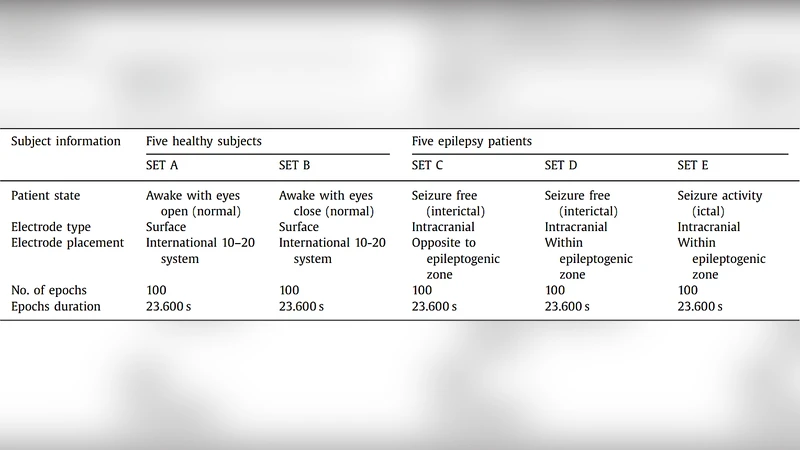
The dataset used for evaluation is the well‑known Bonn University EEG database, which contains five sets (A–E) of single‑channel recordings. Sets A and B correspond to healthy subjects (eyes open and closed), sets C and D to interictal recordings from epileptic patients, and set E to ictal (seizure) recordings. Each 23.6‑second segment is divided into 17 sub‑segments of 1.38 seconds, yielding 1 700 samples per class. For each sub‑segment, the selected WP coefficients are extracted and summarized by two statistical descriptors: standard deviation (STD) and root‑mean‑square (RMS). Consequently, each sample is represented by a six‑dimensional feature vector (STD and RMS for each of the three selected WP bases).
Classification is carried out with an SVM employing a radial basis function (RBF) kernel. Seven binary classification scenarios are examined: A vs E, B vs E, C vs E, D vs E, AB vs E, CD vs E, and ABCD vs E. Performance is assessed using k‑fold cross‑validation with k = 2, 5, 10. The results are consistently high: for A vs E, accuracy reaches 99.64 % (sensitivity = 99.70 %, specificity = 100 %); for B vs E, 98.44 %; for C vs E, 98.14 %; for D vs E, 95.15 %; for AB vs E, 98.93 %; for CD vs E, 96.48 %; and for ABCD vs E, 97.85 %. Across all experiments, the method outperforms a range of previously published approaches, including nonlinear preprocessing + neural networks (97.2 %), time‑frequency features + recurrent neural networks (99.6 %), entropy + adaptive neuro‑fuzzy inference (92.22 %), FFT‑decision tree (98.72 %), and various wavelet‑based classifiers.
The authors conclude that adaptive selection of both the mother wavelet and the WP basis substantially improves the discriminative power of time‑frequency features extracted from EEG. The simple statistical descriptors (STD, RMS) combined with an SVM provide a computationally efficient yet highly accurate seizure detection pipeline.
Nevertheless, several limitations are acknowledged. The Bonn database comprises only 100 segments per class and a single EEG channel, which may not reflect the variability and noise characteristics of clinical multi‑channel recordings. The artificial segmentation into 1.38‑second windows could affect temporal resolution, and the study does not explore the impact of alternative, more complex nonlinear features (e.g., entropy, fractal dimensions) that might further boost performance.
Future work is suggested in three directions: (i) validation on larger, multi‑channel, real‑world EEG datasets with diverse patient populations; (ii) integration of additional nonlinear descriptors or deep learning models to automatically learn optimal bases; and (iii) development of a real‑time implementation suitable for bedside monitoring. By addressing these aspects, the adaptive wavelet packet framework could become a robust component of next‑generation computer‑assisted epilepsy diagnosis systems.
Comments & Academic Discussion
Loading comments...
Leave a Comment