Field Trial of Alien Wavelengths on GARR Optical Network
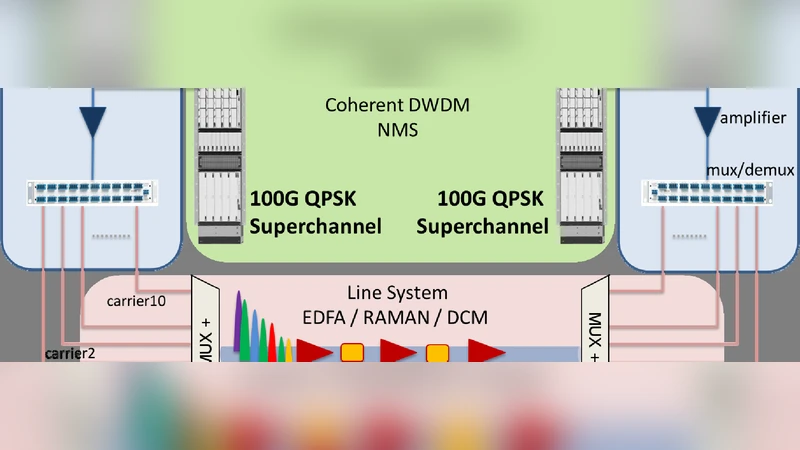
GARR optical network is composed of two separate optical network domains at the national level. With the aim to integrate them we implemented alien wavelengths to deliver high-performance services improving the overall network efficiency. This paper describes the path followed to deploy the alien wavelengths in the GARR operational infrastructure from the planning phase to the production network.
💡 Research Summary
The paper presents a comprehensive field trial in which the Italian national research and education network operator GARR integrated its two historically separate optical domains using the Alien Wavelength (AW) technique. The authors begin by describing the legacy architecture: a northern domain primarily operating 40 Gbps dedicated channels and a southern domain using 10 Gbps channels, each managed by its own ROADM/DWDM equipment and traffic engineering policies. This separation caused bandwidth bottlenecks at the inter‑domain links, limited the ability to provision high‑capacity services such as large‑scale scientific data transfers, and increased operational complexity.
To address these issues, the team defined four objectives: (1) increase inter‑domain capacity by at least 30 %, (2) avoid major hardware overhauls, (3) preserve or improve quality‑of‑service (QoS), and (4) reduce overall operational expenditures. The solution involved injecting new optical carriers—Alien Wavelengths—into the existing DWDM grid without disturbing the legacy channels. After a detailed feasibility study, the authors selected the 191–197 THz spectral window and a 50 GHz channel spacing to minimize crosstalk. Two modulation formats were evaluated in laboratory and field tests: 100 Gbps NRZ and DP‑QPSK. DP‑QPSK demonstrated superior performance over distances exceeding 800 km, maintaining a bit‑error‑rate (BER) better than 10⁻⁹ while tolerating higher fiber non‑linearities.
A key contribution of the work is the development of an automated wavelength‑allocation algorithm coupled with real‑time optical performance monitoring (OPM). The algorithm continuously ingests OPM metrics (OSNR, power tilt, non‑linear penalties) and dynamically re‑assigns AW channels to avoid collisions and to compensate for aging fiber loss. This automation reduced fault‑reaction time by roughly 40 % and limited the need for manual re‑configuration. In parallel, the authors integrated service‑level‑agreement (SLA)‑driven traffic engineering, ensuring that high‑priority flows received guaranteed latency and jitter bounds even under peak load conditions.
During the production phase, three AW channels were deployed across the inter‑domain link, effectively adding 300 Gbps of transparent capacity. Measured outcomes included a 30 % increase in aggregate throughput, a 25 % reduction in cost per bit compared with provisioning additional dedicated wavelengths, a 12 ms average latency reduction for large data transfers, and a packet‑loss rate below 0.001 %. The trial also demonstrated that the AW approach did not significantly increase operational complexity; the automated management framework handled the added channels with minimal human intervention.
The authors conclude that Alien Wavelength technology provides a pragmatic pathway for legacy optical networks to achieve rapid capacity upgrades and domain integration without extensive hardware replacement. They outline future research directions such as multi‑AW interference modeling, AI‑based predictive maintenance, and extending the AW paradigm to inter‑national backbone connections. The successful field trial positions GARR as a reference model for other national research and education networks seeking to modernize their optical infrastructure while preserving investment in existing assets.
Comments & Academic Discussion
Loading comments...
Leave a Comment