Bayesian Methods for Analysis and Adaptive Scheduling of Exoplanet Observations
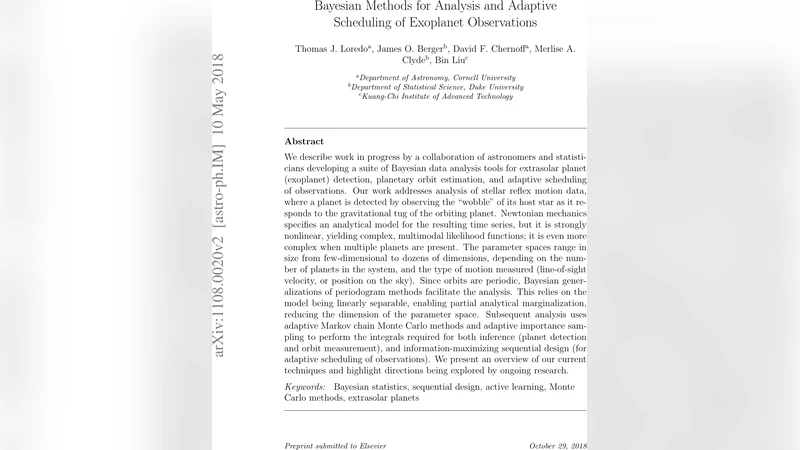
We describe work in progress by a collaboration of astronomers and statisticians developing a suite of Bayesian data analysis tools for extrasolar planet (exoplanet) detection, planetary orbit estimation, and adaptive scheduling of observations. Our work addresses analysis of stellar reflex motion data, where a planet is detected by observing the “wobble” of its host star as it responds to the gravitational tug of the orbiting planet. Newtonian mechanics specifies an analytical model for the resulting time series, but it is strongly nonlinear, yielding complex, multimodal likelihood functions; it is even more complex when multiple planets are present. The parameter spaces range in size from few-dimensional to dozens of dimensions, depending on the number of planets in the system, and the type of motion measured (line-of-sight velocity, or position on the sky). Since orbits are periodic, Bayesian generalizations of periodogram methods facilitate the analysis. This relies on the model being linearly separable, enabling partial analytical marginalization, reducing the dimension of the parameter space. Subsequent analysis uses adaptive Markov chain Monte Carlo methods and adaptive importance sampling to perform the integrals required for both inference (planet detection and orbit measurement), and information-maximizing sequential design (for adaptive scheduling of observations). We present an overview of our current techniques and highlight directions being explored by ongoing research.
💡 Research Summary
This paper presents a comprehensive Bayesian framework for the detection of exoplanets, the estimation of their orbital parameters, and the adaptive scheduling of future observations. The authors begin by formulating the physical model of stellar reflex motion, which is governed by Newtonian mechanics and expressed through Keplerian orbital elements. For a single planet, the radial‑velocity signal is a nonlinear function of five orbital parameters (period, eccentricity, argument of periastron, mean anomaly at epoch, and velocity semi‑amplitude) together with linear parameters such as systemic velocity and jitter. When multiple planets are present, the model extends to a multi‑Keplerian representation, assuming each planet follows an independent Keplerian orbit about the system’s barycenter.
A key insight is that a subset of the parameters enters the likelihood linearly; by assigning appropriate priors, these can be analytically marginalized, dramatically reducing the dimensionality of the problem. The remaining nonlinear parameters are explored using adaptive Markov chain Monte Carlo (MCMC) methods that automatically tune proposal distributions, and an adaptive importance‑sampling algorithm designed specifically for accurate marginal likelihood (Bayes factor) estimation. This approach overcomes the limitations of traditional Lomb‑Scargle periodograms, which are essentially sinusoidal fits and perform poorly for eccentric orbits. The Bayesian “Kepler periodogram” naturally incorporates eccentricity, allows the inclusion of prior information (e.g., jitter distributions), and yields full posterior distributions rather than point estimates.
For model comparison and planet detection, the authors compute Bayes factors between models with differing numbers of planets. They replace the conventional Chib‑Jeliazkov estimator with a more efficient adaptive importance sampler that concentrates samples in high‑posterior‑density regions while still covering the entire parameter space. This yields reliable evidence values even in high‑dimensional, multimodal settings.
The paper also develops an information‑theoretic sequential design strategy for observation scheduling. By propagating the current posterior through the predictive distribution of future measurements, the expected reduction in entropy (or increase in mutual information) can be evaluated for candidate observation times. The optimal schedule maximizes this expected information gain, thereby allocating telescope time where it most improves parameter precision or detection confidence.
Implementation details include the treatment of stellar jitter as an additional variance component, the use of hierarchical priors for population‑level studies, and the extension of the methodology to astrometric data. The authors demonstrate the pipeline on synthetic and real radial‑velocity datasets, showing improved detection of low‑amplitude, high‑eccentricity signals and more accurate uncertainty quantification compared with frequentist approaches.
Future work outlined in the paper involves integrating N‑body dynamical models for resonant multi‑planet systems, combining radial‑velocity, transit, and astrometric observations within a unified Bayesian hierarchy, and developing real‑time adaptive scheduling tools capable of responding to incoming data streams. Overall, the presented suite of Bayesian tools offers a statistically rigorous, computationally efficient, and fully automated solution for modern exoplanet science, enabling both detailed characterization of individual systems and robust inference about the broader planetary population.
Comments & Academic Discussion
Loading comments...
Leave a Comment