Frequency-resolved Monte Carlo
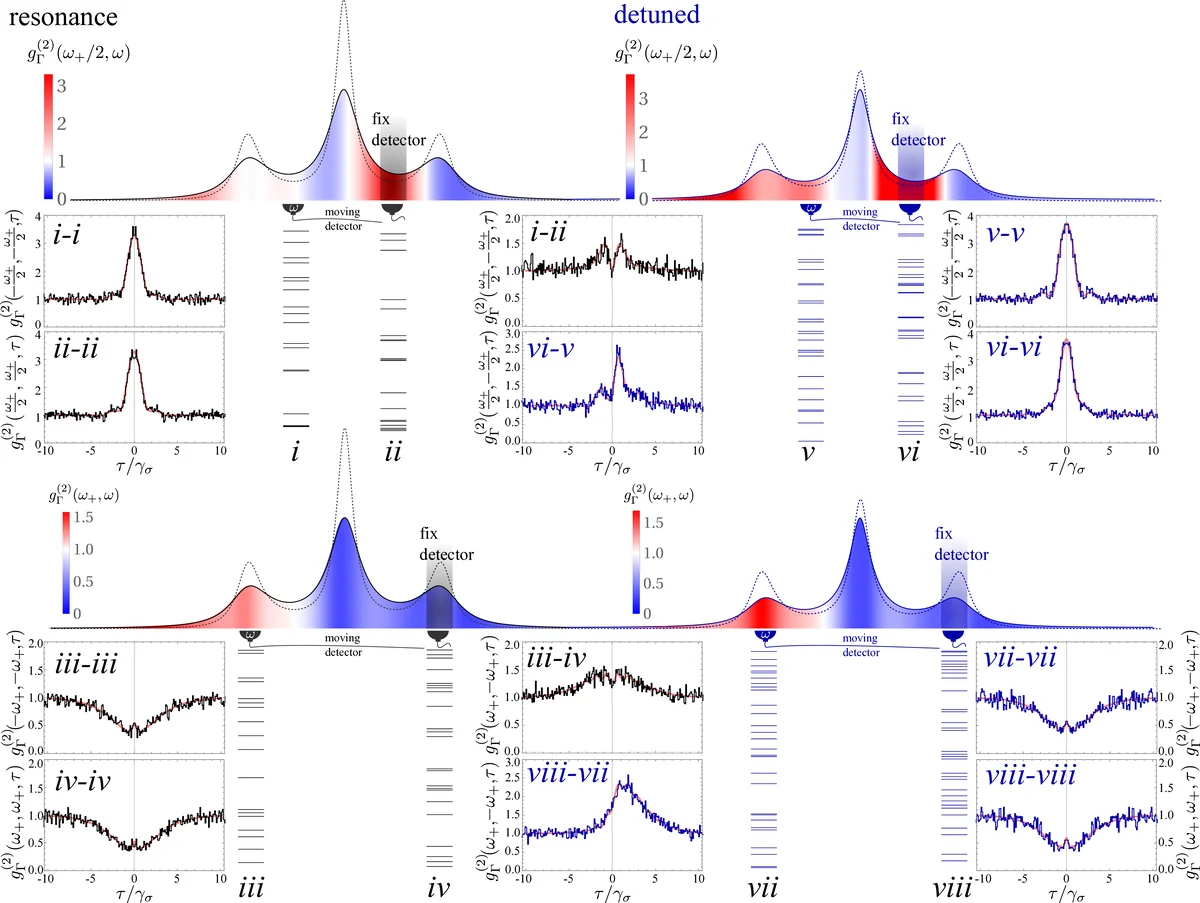
We adapt the Quantum Monte Carlo method to the cascaded formalism of quantum optics, allowing us to simulate the emission of photons of known energy. Statistical processing of the photon clicks thus collected agrees with the theory of frequency-resolved photon correlations, extending the range of applications based on correlations of photons of prescribed energy, in particular those of a photon-counting character. We apply the technique to autocorrelations of photon streams from a two-level system under coherent and incoherent pumping, including the Mollow triplet regime where we demonstrate the direct manifestation of leapfrog processes in producing an increased rate of two-photon emission events.
💡 Research Summary
The paper introduces a novel computational framework that merges the quantum‑jump Monte Carlo (QMC) technique with the cascaded formalism of quantum optics to generate time‑resolved photon “clicks” that are also resolved in frequency. Traditional QMC simulations record only the arrival times of emitted photons; any spectral filtering must be applied afterwards or via weakly coupled “sensor” models that approximate the detector. The authors overcome these limitations by treating the detector as a physical harmonic oscillator (or a two‑level system) that is asymmetrically coupled to the source through the cascaded master equation. This coupling is engineered so that the detector receives the emitted field without feeding back onto the source, thereby preserving the source dynamics while providing a well‑defined frequency window characterized by the detector’s resonance ωξ and decay rate γξ.
A central theoretical contribution is the proof of mathematical equivalence between the sensor method (vanishing coupling ε→0) and the cascaded formalism (finite coupling √α γσ γξ). Both approaches lead to identical normalized correlation functions g⁽ⁿ⁾(τ) because the coupling constants appear in numerator and denominator with the same power and cancel out. Consequently, the cascaded QMC simulation yields exact frequency‑resolved photon correlations, matching the predictions of the frequency‑resolved photon‑correlation theory previously developed by the same group.
The authors implement the quantum‑jump algorithm for a driven two‑level system under two excitation regimes: (i) incoherent (thermal) pumping and (ii) coherent resonant driving. In the coherent case, at high pump strength the system enters the Mollow triplet regime, displaying a central peak flanked by two sidebands. By tuning the detector’s central frequency, the simulation isolates photons from any of these spectral components or from the spectral region between the sidebands. The resulting click streams are processed to compute second‑order (g²(τ)) and higher‑order autocorrelations. The numerical results reproduce the analytical expressions for frequency‑resolved correlations with high fidelity.
A striking finding is the direct observation of “leapfrog” processes in the region between the Mollow sidebands. In this frequency window, two photons are emitted almost simultaneously, leading to a pronounced bunching peak (g²(0)≫1). This effect, previously inferred only from theoretical spectra, is now visible in the simulated photon‑by‑photon record, confirming that the cascaded QMC can capture rare, strongly correlated emission events.
The paper also examines how spectral filtering degrades antibunching. As the filter bandwidth widens, photons from different spectral components mix, raising g²(0) from near zero (ideal single‑photon emission) toward unity (Poissonian statistics). Conversely, narrowing the filter preserves antibunching but reduces detection efficiency, highlighting a practical trade‑off for experiments that require both high purity and reasonable count rates.
Beyond reproducing average correlation functions, the method provides full time‑frequency trajectories of individual photons. This enables a host of new analyses: (a) extraction of inter‑arrival‑time distributions conditioned on photon energy, (b) direct counting of leapfrog events for assessing two‑photon source efficiency, (c) quantum spectroscopy where the detector’s frequency response is an active part of the measurement, and (d) potential applications in quantum information processing where photons are used as frequency‑encoded qubits.
In summary, the work establishes a rigorous, exact Monte Carlo scheme that simultaneously resolves photon emission in time and frequency. By proving the equivalence of sensor and cascaded approaches and demonstrating the technique on a paradigmatic two‑level system—including the rich physics of the Mollow triplet and leapfrog processes—the authors provide a powerful tool for both theoretical investigations and the design of future experiments in quantum optics and quantum technologies.
Comments & Academic Discussion
Loading comments...
Leave a Comment