Deformation and Fabric in Compacted Clay Soils
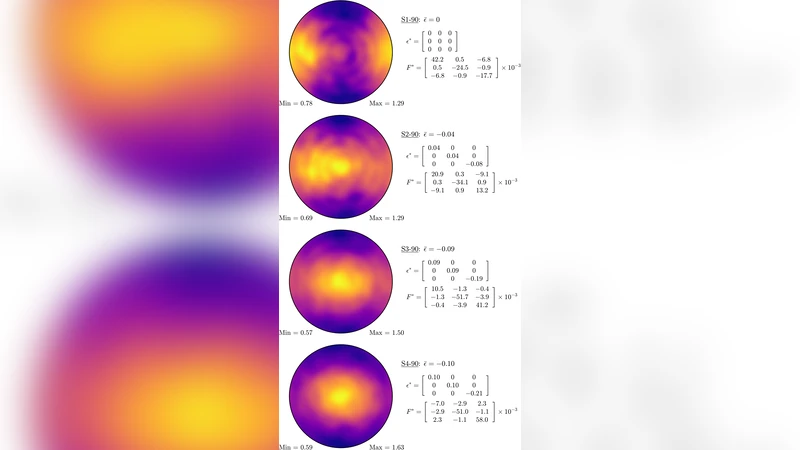
Hydro-mechanical anisotropy of clay soils in response to deformation or deposition history is related to the micromechanics of plate-like clay particles and their orientations. In this letter, we examine the relationship between microstructure, deformation and moisture content in kaolin clay using a technique based on neutron scattering. This technique allows for the direct characterisation of the microstructure within representative samples using traditional measures such as the orientation density function and soil fabric tensor. From this information, evidence for a simple relationship between components of the deviatoric strain tensor and the deviatoric fabric tensor emerged. This relationship provides a physical basis for future anisotropic constitutive models based on the micromechanics of these materials.
💡 Research Summary
The paper investigates the relationship between the micro‑structural fabric of compacted kaolin clay and its deformation history using neutron diffraction, a bulk‑sensitive technique that can probe crystallographic texture at the centimetre scale. The authors first define the orientation density O( n̂ ) as the normalized intensity of the (0002) basal‑plane diffraction peak measured over a regular grid of sample orientations (φ, ψ). By integrating O( n̂ )· n̂ i n̂ j over the unit sphere they obtain the second‑order fabric tensor Fij, whose deviatoric part Fij = Fij – (1/3)δij quantifies the departure from an isotropic random orientation (F = 0).
In the first experimental series eight cylindrical specimens (Ø 15 × 10 mm) were prepared with varying dry densities (1.30–1.85 g cm‑3) and moisture contents (2.4 %–33 %). After a 48 h equilibration the samples were uniaxially compacted, freeze‑dried, and measured on the KOWARI diffractometer at ANSTO. Pole‑figure maps show that, except for the most water‑rich sample (S8‑0), platelets tend to align with their normals perpendicular to the compression direction, i.e. the basal planes become parallel to the loading axis. The degree of alignment, expressed by the deviatoric component F11, increases monotonically with final density. Moisture exhibits a non‑monotonic effect: low (<10 %) and high (>30 %) water contents produce higher alignment, whereas intermediate moisture (≈18 %) yields a minimum in F11, which coincides with a bimodal pore‑size distribution (PSD) observed by mercury‑intrusion porosimetry. The authors interpret the bimodal PSD as evidence of clay agglomerates that deform non‑axially, reducing fabric anisotropy.
The second series explores more complex loading paths. A large reference specimen (10 % moisture, 1.3 g cm‑3) was compacted in layers to minimise axial density gradients. From this block eight sub‑cylinders (Ø 15 mm) were cored, four oriented at 90° and four at 45° relative to the initial compaction direction. Each sub‑specimen was subsequently compacted axially to target densities ranging from 1.30 to 1.84 g cm‑3, producing controlled axial strains (up to ≈0.31). Pole‑figure results show that the initial fabric, which reflects the first compaction, gradually re‑orients toward the direction of the second compaction. For the 90° specimens the peak of the orientation density migrates from the original x‑direction to the z‑direction (the second‑stage compression axis) and intensifies, while the deviatoric fabric tensor components evolve accordingly: F33 grows at the expense of F11 and F22, keeping the principal axes aligned with the strain axes. For the 45° specimens a similar trend occurs, but the final fabric is slightly off‑principal; a noticeable F13 component appears, mirroring the off‑axis strain component present in the applied deformation.
A key observation across both loading paths is that the components of the deviatoric fabric tensor change linearly with the corresponding components of the deviatoric strain tensor εij = εij – (1/3)εkk. Plotting Fij versus ε*ij yields straight lines with a slope of approximately –0.35 ± 0.01 for the second‑stage experiments (and –0.24 for the first‑stage series). Within experimental error this suggests a simple proportionality
∂Fij / ∂εij ≈ –0.35
i.e. an incremental compressive strain produces an incremental increase of fabric anisotropy of opposite sign. The relationship holds for the range of strains and loading directions examined (uniaxial compression at 90° and 45°); the authors note that other strain paths (pure shear, dilation) may lead to different behaviour.
The study demonstrates that neutron diffraction can directly quantify the bulk fabric of compacted clays and that fabric evolution follows a simple linear law with respect to deviatoric strain. This provides a physically based link between micro‑mechanics (particle orientation) and macroscopic anisotropic behaviour, opening the possibility of incorporating the measured proportionality into anisotropic constitutive models for clay soils, moving beyond purely phenomenological yield‑surface rotations.
In summary, the paper contributes (1) a validated experimental protocol for bulk texture measurement of clays, (2) evidence that moisture content influences fabric through pore‑structure changes, (3) a clear linear relationship between deviatoric strain and fabric evolution, and (4) a pathway toward micromechanically informed anisotropic constitutive modelling of compacted clay soils.
Comments & Academic Discussion
Loading comments...
Leave a Comment