Yang-Mills theory over surfaces and the Atiyah-Segal theorem
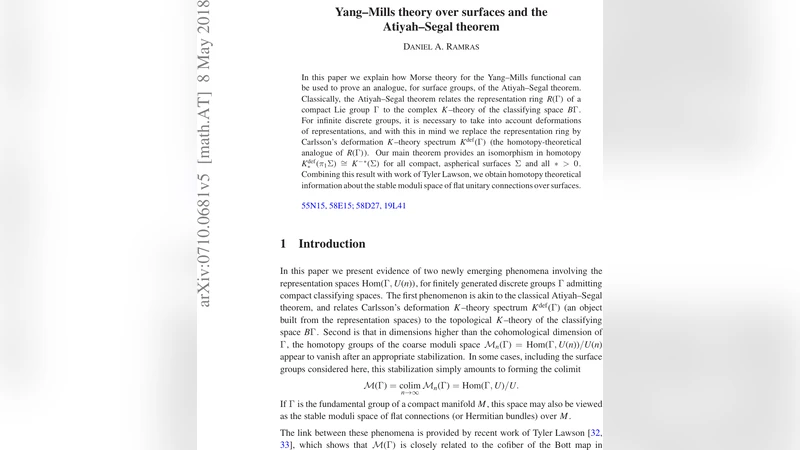
In this paper we explain how Morse theory for the Yang-Mills functional can be used to prove an analogue, for surface groups, of the Atiyah-Segal theorem. Classically, the Atiyah-Segal theorem relates the representation ring R(\Gamma) of a compact Lie group $\Gamma$ to the complex K-theory of the classifying space $B\Gamma$. For infinite discrete groups, it is necessary to take into account deformations of representations, and with this in mind we replace the representation ring by Carlsson’s deformation $K$–theory spectrum $\K (\Gamma)$ (the homotopy-theoretical analogue of $R(\Gamma)$). Our main theorem provides an isomorphism in homotopy $\K_(\pi_1 \Sigma)\isom K^{-}(\Sigma)$ for all compact, aspherical surfaces $\Sigma$ and all $*>0$. Combining this result with work of Tyler Lawson, we obtain homotopy theoretical information about the stable moduli space of flat unitary connections over surfaces.
💡 Research Summary
The paper establishes a new bridge between Morse theory for the Yang‑Mills functional on compact surfaces and the Atiyah‑Segal theorem, extending the classical correspondence between a compact Lie group’s representation ring and the K‑theory of its classifying space to the realm of infinite discrete groups. For such groups the ordinary representation ring R(Γ) is insufficient because it ignores continuous deformations of representations. Carlsson’s deformation K‑theory spectrum 𝕂(Γ) remedies this by encoding families of representations as a genuine homotopy‑theoretic object; its homotopy groups satisfy πₙ𝕂(Γ) ≅ K_{‑n}(BΓ).
The authors focus on surface groups π₁Σ, where Σ is a compact, aspherical surface (i.e., a closed surface of genus ≥1). They consider the space of unitary connections on a trivial U(n)‑bundle over Σ and the Yang‑Mills functional YM. Critical points of YM are precisely the flat (i.e., curvature‑zero) connections, and the higher critical points correspond to stable holomorphic bundles via the Narasimhan‑Seshadri correspondence. By invoking the work of Daskalopoulos, Råde, and others, the authors confirm that YM satisfies the Morse‑Smale condition on this infinite‑dimensional space, so its gradient flow yields a CW‑complex – the Yang‑Mills Morse complex – whose cells are indexed by the Morse index of each critical point.
The central theorem (Theorem 1.1) states that for every compact, aspherical surface Σ and every positive integer *, there is a natural isomorphism
\
Comments & Academic Discussion
Loading comments...
Leave a Comment