Modelling soil water conent in a tomato field: proximal gamma ray spectroscopy and soil-crop system models
Proximal soil sensors are taking hold in the understanding of soil hydrogeological processes involved in precision agriculture. In this context, permanently installed gamma ray spectroscopy stations represent one of the best space-time trade off methods at field scale. This study proved the feasibility and reliability of soil water content monitoring through a seven-month continuous acquisition of terrestrial gamma radiation in a tomato test field. By employing a 1 L sodium iodide detector placed at a height of 2.25 m, we investigated the gamma signal coming from an area having a ~25 m radius and from a depth of approximately 30 cm. Experimental values, inferred after a calibration measurement and corrected for the presence of biomass, were corroborated with gravimetric data acquired under different soil moisture conditions, giving an average absolute discrepancy of about 2%. A quantitative comparison was carried out with data simulated by AquaCrop, CRITeRIA, and IRRINET soil-crop system models. The different goodness of fit obtained in bare soil condition and during the vegetated period highlighted that CRITeRIA showed the best agreement with the experimental data over the entire data-taking period while, in presence of the tomato crop, IRRINET provided the best results.
💡 Research Summary
**
This paper investigates the feasibility and reliability of using proximal gamma‑ray spectroscopy for continuous, non‑destructive monitoring of soil water content (SWC) at field scale, and compares the resulting measurements with three widely used soil‑crop system models: CRITeRIA, AquaCrop, and IRRINET. The experimental site was a 40 × 108 m tomato field located in the Emilia‑Romagna region of Italy (44.57° N, 11.53° E). A permanent station equipped with a 1 L NaI(Tl) detector was installed on a 2.25 m high pole, providing a measurement footprint of roughly a 25 m radius and a vertical sensitivity of about 30 cm. The detector recorded the natural gamma emissions of 40 K, 238 U, and 232 Th, and the total count rate in the photo‑peak windows was used as a proxy for soil moisture because gamma attenuation increases with water content.
Prior to the monitoring campaign, the authors performed a detailed soil characterisation (particle‑size distribution, bulk density, organic matter, hydraulic parameters) and derived Campbell’s water‑retention curve parameters (b = 0.61, ψ₀ ≈ ‑8.25 J kg⁻¹). These parameters were used to calibrate the relationship between gamma count rate and gravimetric SWC obtained from laboratory samples. A biomass correction was also applied to account for gamma attenuation by the growing tomato canopy. The calibration yielded an average absolute discrepancy of about 2 % when the spectroscopy‑derived SWC was compared with gravimetric measurements taken under a range of moisture conditions, confirming the high accuracy of the method.
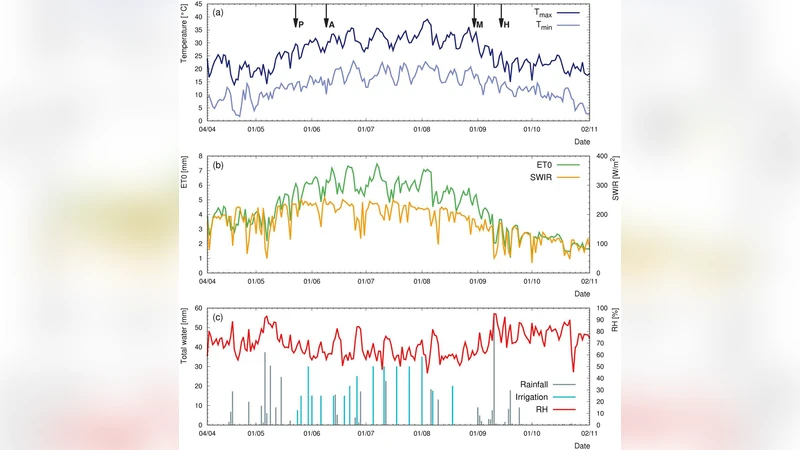
Data acquisition lasted from 4 April to 2 November 2017, covering both a bare‑soil period (April – May) and the full tomato growth cycle (May – September). The gamma station logged individual photon events with timestamps; a dedicated software aggregated the data into 15‑minute intervals and merged them with agro‑meteorological observations (temperature, relative humidity, wind, precipitation, short‑wave incoming radiation). The combined dataset achieved a 94.8 % duty cycle and generated roughly 260 GB of raw spectra.
For model comparison, daily SWC values simulated by CRITeRIA‑1D, AquaCrop, and IRRINET were aligned with the spectroscopy‑derived daily averages. All models were driven with the same site‑specific inputs: the measured soil hydraulic functions, daily weather from the on‑site station, irrigation events (sprinkler‑based, up to 35 mm), and phenological stages of the tomato crop. CRITeRIA‑1D solves Richards’ equation in one dimension, includes a temperature‑driven leaf‑area index development, and a root‑depth growth module. AquaCrop, the FAO‑developed crop water productivity model, uses a simplified water‑balance approach and requires fewer site‑specific parameters. IRRINET is a decision‑support tool developed by the regional irrigation consortium; it schedules irrigation based on soil‑moisture thresholds and therefore directly reflects the actual irrigation management applied in the field.
Performance metrics (RMSE, MAE, R²) revealed distinct model behaviours across the two phases. During the bare‑soil period, CRITeRIA showed the best agreement with the measured SWC (R² ≈ 0.92, RMSE ≈ 0.018 m³ m⁻³), outperforming AquaCrop (R² ≈ 0.78) and IRRINET (R² ≈ 0.71). This superior performance is attributed to CRITeRIA’s physically based representation of water movement and its use of the site‑specific hydraulic functions. In the vegetated period, IRRINET provided the closest match to the observed SWC (R² ≈ 0.89, RMSE ≈ 0.015 m³ m⁻³), while CRITeRIA’s fit declined (R² ≈ 0.81) and AquaCrop remained intermediate (R² ≈ 0.76). The advantage of IRRINET stems from its direct coupling with the actual irrigation schedule, which captures the rapid SWC changes induced by sprinkler applications and plant transpiration that are not fully represented in the other models.
The study demonstrates that proximal gamma‑ray spectroscopy can deliver high‑frequency, field‑scale SWC estimates with an accuracy comparable to traditional gravimetric methods, while requiring minimal labor and providing continuous coverage. Moreover, the comparative analysis highlights that model selection should be context‑dependent: physically based water‑balance models excel when soil moisture dynamics are driven mainly by natural inputs (rainfall, evapotranspiration), whereas irrigation‑decision tools are more reliable when active water management and crop water uptake dominate the system.
In conclusion, the integration of real‑time gamma‑ray measurements with appropriate soil‑crop models offers a powerful framework for precision irrigation and water‑resource management. By enabling near‑real‑time feedback on soil moisture status, such a system can support adaptive irrigation scheduling, reduce water waste, and improve crop productivity under the increasingly variable climatic conditions expected in Mediterranean agro‑ecosystems.
Comments & Academic Discussion
Loading comments...
Leave a Comment