Seasonal Goods and Spoiled Milk: Pricing for a Limited Shelf-Life
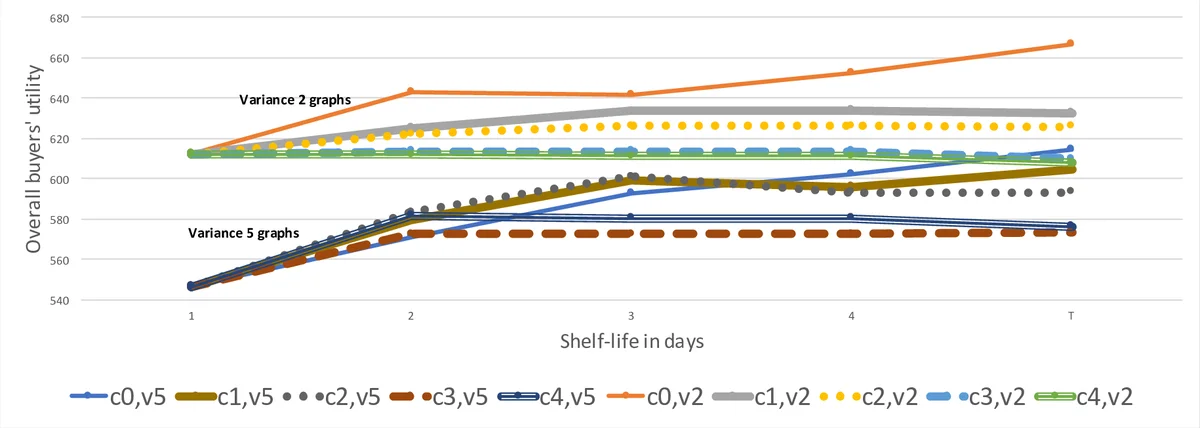
We examine the case of items with a limited shelf-life where storing an item (before consumption) may carry a cost to a buyer (or distributor). For example, eggs, milk, or Groupon coupons have a fixed expiry date, and seasonal goods can suffer a decrease in value. We show how this setting contrasts with recent results by Berbeglia et al (arXiv:1509.07330(v5)) for items with infinite shelf-life. We prove tight bounds on the seller’s profits showing how they relate to the items’ shelf-life. We show, counterintuitively, that in our limited shelf-life setting, increasing storage costs can sometimes lead to less profit for the seller which cannot happen when items have unlimited shelf-life. We also provide an algorithm that calculates optimal prices. Finally, we examine empirically the relationship between profits and buyer utility as the storage cost and shelf-life duration change, and observe properties, some of which are unique to the limited shelf-life setting.
💡 Research Summary
The paper studies optimal pricing for goods that have a limited shelf‑life, extending the “price‑commitment” model introduced by Berbeglia et al. (2015) for items with infinite durability. In the model, a monopolist announces a price vector p₁,…,p_T for T discrete days before any purchase occurs. Buyers are rational and may purchase on any day, store units for later consumption, and incur a linear per‑unit‑per‑day storage cost c. A key new parameter is the shelf‑life d: a unit stored for d or more days becomes worthless (or, in a generalized version, its value decays by a factor r(l) ≤ 1 after l days). The interaction is a Stackelberg game: the seller (leader) chooses prices to maximize revenue, anticipating the buyers’ best‑response strategies.
The authors first show that the central result of Berbeglia et al.—that there always exists an optimal price schedule under which buyers never need to store—fails when d is finite. Consequently, the analysis must directly incorporate storage decisions. The paper’s main theoretical contributions are:
-
Theorem 4.1 (Revenue vs. Shelf‑life) – The monopolist’s maximal revenue is a non‑increasing function of the shelf‑life d, and for some instances it strictly decreases as d grows. The proof constructs a price transformation that preserves or improves revenue when the allowed storage horizon is shortened, demonstrating that longer durability can only hurt or leave unchanged the seller’s profit.
-
Non‑monotonic effect of storage cost – In the unlimited‑shelf‑life setting, raising c always pushes buyers toward buying later rather than storing, allowing the seller to raise prices without losing sales. In contrast, with finite d, the authors exhibit instances where increasing c actually reduces the seller’s optimal revenue. Intuitively, high storage costs may force buyers to forgo purchases that would have been profitable for the seller, and the seller cannot compensate by simply raising prices because the limited lifetime prevents arbitrage across distant days.
-
Degradable‑value extension – The model is broadened to allow a decay function r(l) that multiplies the original valuation after l days of storage. The same structural results (revenue monotonicity in d, non‑monotonicity in c) hold, and the analysis of optimal pricing adapts with minor modifications.
On the algorithmic side, the paper presents a dynamic‑programming (DP) algorithm that computes an optimal price schedule in polynomial time. The DP state is a pair (t, k) where t is the current day and k ∈ {0,…,d‑1} is the remaining number of days a unit can still be stored. The transition considers two actions: (i) sell a unit today at price p_t and possibly have it consumed immediately, or (ii) set a price that induces buyers to purchase for future consumption, incurring storage cost c per day. The DP maximizes total revenue over the horizon, handling both the multi‑buyer case (each buyer wants at most one unit per day) and the single‑buyer case (one buyer with a bounded marginal‑value curve). The runtime is O(T·d·N), where N bounds the maximum daily demand, making it practical for realistic horizons (e.g., T ≤ 30, d ≤ 7).
The empirical section runs simulations with synthetic buyer valuation distributions (uniform, normal, exponential) to explore how revenue and social welfare (total buyer utility) vary with c and d. Key observations include:
- Revenue declines sharply as d decreases: When items must be consumed the same day they are bought (d = 1), the seller’s ability to smooth prices over time disappears, forcing lower prices and reducing profit.
- Revenue vs. storage cost is non‑monotonic: For moderate c values, revenue may rise (buyers store less, seller can raise prices), but beyond a threshold, revenue falls because the storage cost deters purchases that would have been profitable under a longer shelf‑life.
- Buyer welfare behaves differently: In many scenarios, higher c reduces buyer utility, but when d is very short, the impact of c is muted because storage is already infeasible.
The paper concludes that limited shelf‑life fundamentally changes optimal pricing strategies. The classic intuition that higher storage costs always benefit a monopolist no longer holds; instead, the interaction between c and d creates a nuanced landscape where the seller must balance immediate sales against the lost ability to shift demand across days. These insights are directly relevant to markets for perishable foods, time‑limited coupons, cloud‑service reservations, and any setting where goods degrade or expire. The provided DP algorithm offers a tractable tool for practitioners to compute optimal pre‑announced price menus under realistic constraints.
Comments & Academic Discussion
Loading comments...
Leave a Comment