Seismocardiographic Signal Timing with Myocardial Strain
Speckle Tracking Echocardiography (STE) is a relatively new method for cardiac function evaluation. In the current study, STE was used to investigate the timing of heart-induced mostly subaudible (i.e., below the frequency limit of human hearing) che…
Authors: Amirtaha Taebi, Richard H. S, ler
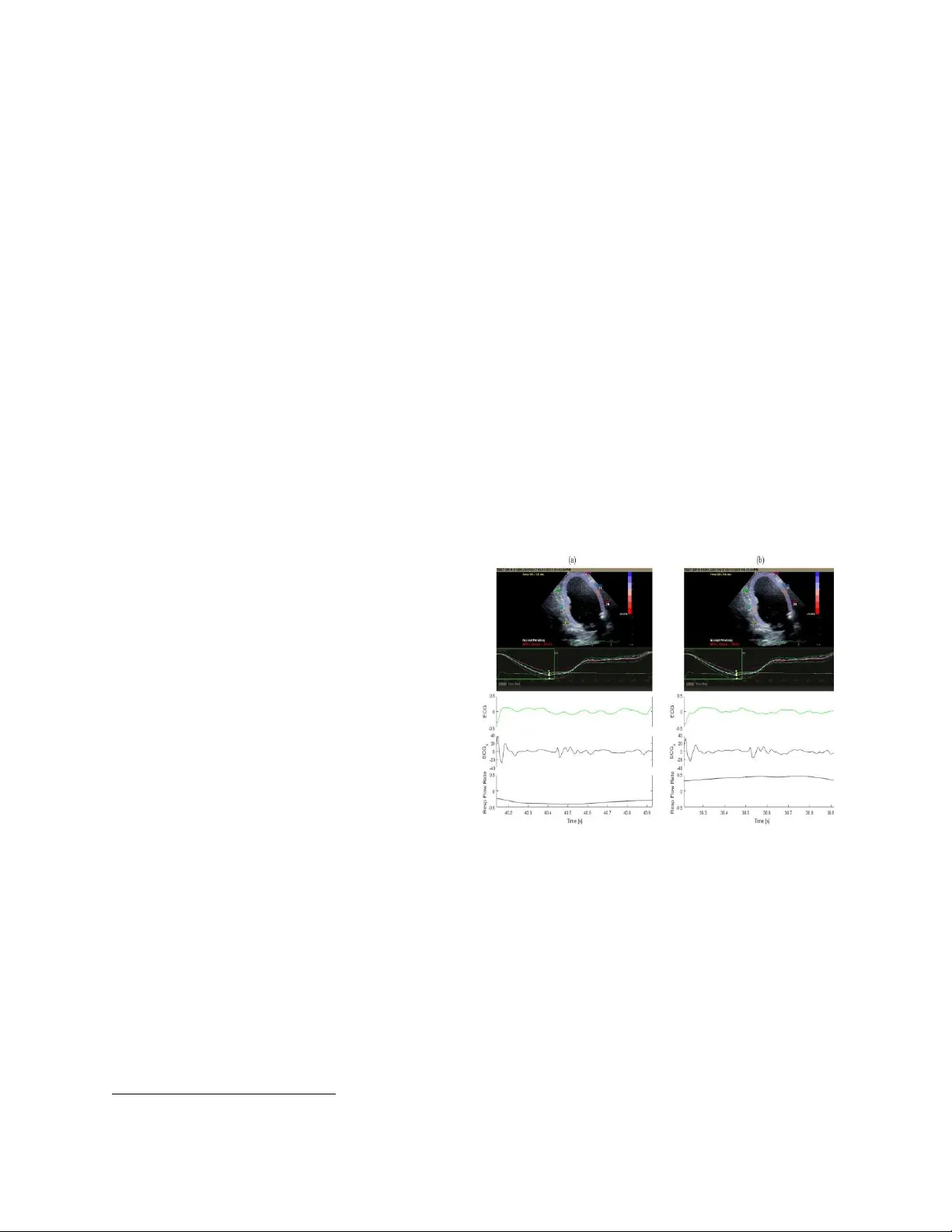
Seismocardiographic Signal Timing with Myocardial Strain 1 Amirtaha Taebi 1 , Richard H. Sandler 1,2 , Bahram Kakavand 2 , Hansen A. Mansy 1 1 Biomedical Acoustics Research Lab , University of Central Florida, Orlando, FL 32816, USA 2 Nemours Children ’s Hospital, Orlando, FL 32827, USA {taebi@knights., hansen.mansy@ }ucf.edu Abstract — Speckle Tracking Echocardiography (STE) is a relatively new meth od for cardiac function evaluation. In the curren t study, STE was used to investigate the timing of heart -induced mostly subaudible ( i.e., below the frequency limit of human hearing ) chest-wall vibrations in relation to the longitudinal myocardial strain. Such an approach may help elucidate the genesis of these vibrations, thereby improving their diagnostic value. Introduction — Seismocardiog rams (SCG) are the cardiac vibrations detected at the chest wall surface [ 1 ] – [3]. The relation between SCG waves and cardiac activity are not fully understood [4]. Ho wever, it i s believed that me chanical process es such as myocardial contraction , blood momentum chang es, and valve closure are sources of these vibrations [5] – [8]. STE was used in this study to help explain the relation ship between myocardial contraction strain and SCG chest wall vib ration signal morphology. Methods — After informed consent, the SCG signal from a healthy 18 year old male was captured using a uniaxial accelerometer (35 2C65, PCB Piezotronics, Depew, NY). The SCG sensor was placed at the lef t lower sternal bo rder at the level of the 4 th intercostal space. Electrocardiograph ic (ECG) and respiration flow rate signals were re corded simultan eously using a control module (IX - TA -220, iWorx Systems, Inc., Dover, NH). Th e STE was recorded at the same time (EPIQ 5, Philips, Netherla nds). The ECG tracing was simultaneously acquired by the echocardiography machine as well for signal synchroni zation. The SCG events were grouped into inspiratory and expiratory events (as measured by positive and negative flo w rates, respectively). These events were then aligned in time with the left ven tricular (LV) strain curve supplied by th e STE technique. Results — Fig. 1 shows the m y ocardial strain curves for a representative expiratory and inspiratory SCG cycle. Small changes in the SCG waveform were seen with respiratio n. The strain in Fig. 1 was negative and is defined as the fractional change in the heart tissu e dimension in comparison with the original tissue dimension. The SCG waveform con tained two major events, SCG1 and SC G2, which occur red close to th e first and second heart sound timing, respectively. The changes in longitudinal strain was due to the well-known LV twisting motion. The SCG signal peak (at SCG1 maxi mum) occurred shortly after the ECG R wave and during the early part of rapid ejection (RE). During ejection, the apex rotated cou nterclockwise while the base performed a clockwise rotation. This r esulted in a decrease in the longitudinal length of the LV. The myocardial strain in creased (i.e. became more negative) and reached a plateau (isovolumic relaxation) before the be ginning of SCG2. Towards the end of SCG2, the strain started to be less negat i ve and rapid filling (RF) took place. Conclusions — The SCG wave timings were compared with the myocardial strain curve for the first time . The results showed that the heart muscle experienced lowest negativ e mechanical strain around SCG1, with Research reported in this publication was supported by the National Institutes of Health under R44HL099053. Fig . 1. Simultaneously acquired ST E, ECG and SCG si gnals during (a) expiration, and (b) inspiration, from one subject. SCG1 and SCG2 starts before rapid ejection (RE) and Rapid filling (RF), respectively. SCG1 SCG2 SCG1 SCG2 RE RF RE RF the highest negative strain occurring just prior to SCG2. STE might help characterize th e LV (un -)twist patterns on the SCG waveforms which might lea d to distinguishing no rmal SCG signals from abnor mal ones. More studies are needed to investigate the diffe rences in SCG morphology based on heart muscle contractile state in both healthy subj ects and those with cardiovascular disease. R EFERENCES [1] A. Taebi and H. A. Mansy, “Time -f requency Analysis of Vibrocardiog r aphic Signals,” in 201 5 BMES Annual Meeting , 2015 . [2] A. Taebi and H. A. Mansy, “ Time - freq uency Descripti on of Vibrocardio graphic Signals,” in 38th Annual International Conference of the IEEE Engineering in Medicine and Biolo gy Society , 2016 . [3] A. Taebi an d H. A. Mansy, “Analysis of Seismocardiographic Signals Using Polyno mial Chirplet Transfo rm and Smoothed Pseudo Wigner- Ville Distribution,” in Signal Processing in Medicine and Biology Symposium (SPMB), 2017 IEEE , 2017, pp. 1 – 6. [4] A. Taebi and H. A. Mansy, “Grouping Similar Seis mocardiographic Sig nals Using Resp iratory Information,” in Signal Processing in Medicine and Biology Symposium (SPMB), 20 17 IEEE , 20 17, pp. 1 – 5. [5] A. Taebi and H. A. Mansy, “Noise Cancellation f rom Vibrocardiographic S ignals Based on the Ens emble Empirical Mode Decomposition,” J. Biotechnol. Bioen g. , vol. 2, no. 2, p. 00024, 20 17. [6] A. Taebi and H. A . Mansy, “Time - Frequency Distribution of Seismocardiographic Signals: A Comparative Study,” Bioengineering , vol. 4, no. 2, p. 32, 2017. [7] A. Taebi and H. A. Mansy, “Effect of Noise on Time - f requency Analysis of Vibrocardiographic Signals,” J. Bioen g. Biomed . Sci. , v ol. 6(202), p. 2, 2016. [8] B. E. Solar, A. Taebi, and H. A. Mansy, “Classification of Seismocardiographic Cycles into Lung Volume Phases,” in Signa l Processing in Medicine and Biology Symposiu m (SPMB), 2017 IEEE , 2017 , pp. 1 – 2.
Original Paper
Loading high-quality paper...
Comments & Academic Discussion
Loading comments...
Leave a Comment