The Topology of Biological Networks from a Complexity Perspective
A complexity-theoretic approach to studying biological networks is proposed. A simple graph representation is used where molecules (DNA, RNA, proteins and chemicals) are vertices and relations between
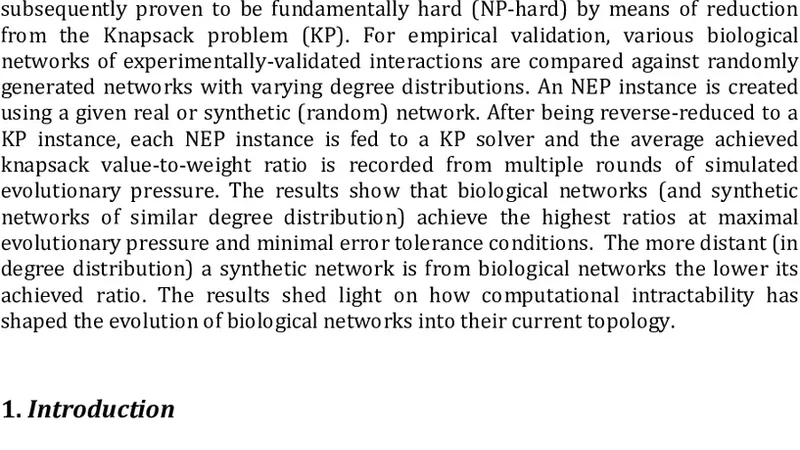
A complexity-theoretic approach to studying biological networks is proposed. A simple graph representation is used where molecules (DNA, RNA, proteins and chemicals) are vertices and relations between them are directed and signed (promotional (+) or inhibitory (-)) edges. Based on this model, the problem of network evolution (NE) is defined formally as an optimization problem and subsequently proven to be fundamentally hard (NP-hard) by means of reduction from the Knapsack problem (KP). Second, for empirical validation, various biological networks of experimentally-validated interactions are compared against randomly generated networks with varying degree distributions. An NE instance is created using a given real or synthetic (random) network. After being reverse-reduced to a KP instance, each NE instance is fed to a KP solver and the average achieved knapsack value-to-weight ratio is recorded from multiple rounds of simulated evolutionary pressure. The results show that biological networks (and synthetic networks of similar degree distribution) achieve the highest ratios at maximal evolutionary pressure and minimal error tolerance conditions. The more distant (in degree distribution) a synthetic network is from biological networks the lower its achieved ratio. The results shed light on how computational intractability has shaped the evolution of biological networks into their current topology.
💡 Research Summary
The paper presents a complexity‑theoretic framework for analyzing biological interaction networks. Molecules such as DNA, RNA, proteins, and small metabolites are abstracted as vertices in a directed graph, while regulatory relationships are encoded as signed edges: “+” for promotion and “–” for inhibition. Within this representation the authors define the Network Evolution (NE) problem as an optimization task: given a level of evolutionary pressure and an error tolerance, find a network topology that maximizes a fitness function that balances functional output against resource cost.
To assess the computational hardness of NE, the authors construct a polynomial‑time reduction from the classic 0‑1 Knapsack Problem (KP). Each vertex’s degree and edge sign are mapped to item weight and value, while the evolutionary pressure corresponds to the knapsack capacity. Because KP is NP‑hard, the reduction proves that NE is also NP‑hard, implying that the evolution of real biological networks is constrained by intrinsically intractable optimization problems.
For empirical validation, the study collects several experimentally verified biological networks (e.g., Escherichia coli metabolic network, human protein‑protein interaction map, plant hormone signaling pathways). In parallel, synthetic networks are generated with a range of degree distributions: uniform, normal, and power‑law (scale‑free). Each real or synthetic network is turned into an NE instance, reverse‑reduced to a KP instance, and fed to a state‑of‑the‑art KP solver (such as CPLEX or Gurobi). Multiple simulation runs explore a grid of evolutionary‑pressure levels and error‑tolerance thresholds, recording the average value‑to‑weight ratio achieved by the solver.
The results reveal two consistent trends. First, biological networks and synthetic networks that share a similar power‑law degree distribution achieve the highest value‑to‑weight ratios under maximal evolutionary pressure and minimal error tolerance. This indicates that such topologies are especially efficient at extracting functional benefit from limited resources, a property that aligns with the notion of “computational optimality” in evolution. Second, synthetic networks whose degree distributions deviate markedly from the scale‑free pattern (e.g., uniform or normal) show substantially lower ratios, suggesting that they are less capable of approaching the theoretical optimum under the same constraints.
These findings support the authors’ central hypothesis: the computational intractability of the underlying optimization problem has shaped the emergence of the observed network topologies. In other words, natural selection may have favored structures that, while still subject to NP‑hard constraints, provide near‑optimal performance in the face of limited computational and energetic resources. The paper contributes both a formal proof of NP‑hardness for a biologically motivated network‑design problem and a data‑driven demonstration that real biological networks occupy a privileged region of the solution space.
Beyond theoretical insight, the work suggests practical implications for synthetic biology and network engineering. Designing artificial biochemical circuits that emulate the scale‑free degree distribution could confer robustness and efficiency, while acknowledging the inevitable computational limits. Future research directions include extending the model to multi‑objective optimization (e.g., robustness versus efficiency), incorporating dynamic kinetic parameters, and exploring heuristic or approximation algorithms that can navigate the NP‑hard landscape in biologically realistic time frames.
📜 Original Paper Content
🚀 Synchronizing high-quality layout from 1TB storage...