Hamiltonian distributed chaos in Arctic and Antarctic Oscillations
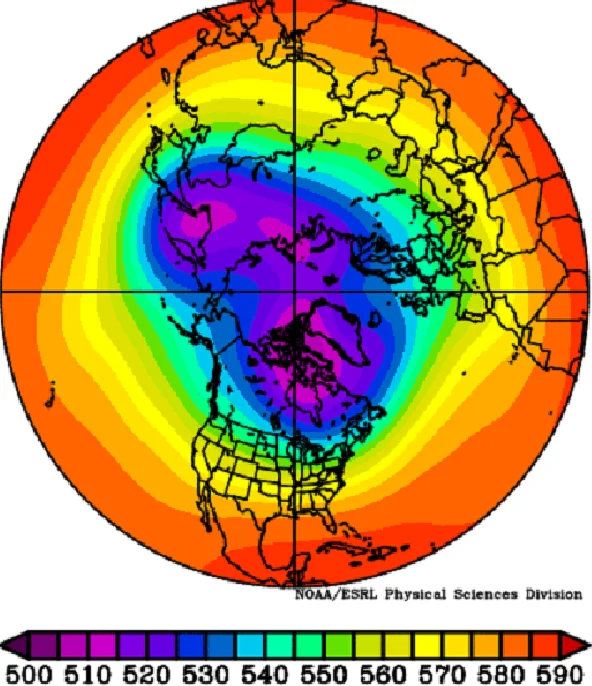
The Arctic and Antarctic Oscillations (AO and AAO indices) are studied using the Hamiltonian distributed chaos approach. Using the daily data (AO since 1950y and AAO since 1979y) it is shown that the power spectra of the both AO and AAO indices exhibit the stretched exponential behaviour $E(f) \propto \exp-(f/f_0)^{3/4}$ corresponding to the Hamiltonian distributed chaos. The characteristic time scale for the both indices $T_0=1/f_0\simeq 41$ day corresponds to the well known from the numerous extratropic observations near 40 day period.
💡 Research Summary
The paper investigates the dynamical nature of the Arctic Oscillation (AO) and the Antarctic Oscillation (AAO) by applying the concept of Hamiltonian distributed chaos to their daily index time series. AO and AAO are the leading annular modes of extratropical atmospheric circulation, representing the pressure gradient between the polar and sub‑polar regions. The authors use NOAA daily indices (AO from 1950‑2018, AAO from 1979‑2018) constructed from EOF analyses of geopotential height anomalies at 700 hPa (AAO) and 1000 hPa (AO).
Traditional chaotic systems with a single characteristic frequency exhibit exponential power spectra of the form (E(f)\propto\exp(-f/f_c)). In contrast, Hamiltonian systems with many degrees of freedom and conserved quantities generate a distribution of characteristic frequencies, leading to a stretched‑exponential spectrum (E(f)\propto\exp
Comments & Academic Discussion
Loading comments...
Leave a Comment