Exponential Time Complexity of the Permanent and the Tutte Polynomial
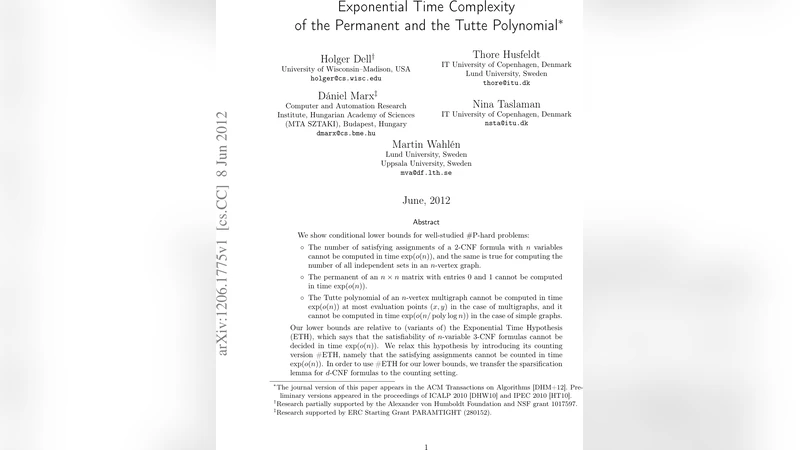
We show conditional lower bounds for well-studied #P-hard problems: (a) The number of satisfying assignments of a 2-CNF formula with n variables cannot be counted in time exp(o(n)), and the same is true for computing the number of all independent sets in an n-vertex graph. (b) The permanent of an n x n matrix with entries 0 and 1 cannot be computed in time exp(o(n)). (c) The Tutte polynomial of an n-vertex multigraph cannot be computed in time exp(o(n)) at most evaluation points (x,y) in the case of multigraphs, and it cannot be computed in time exp(o(n/polylog n)) in the case of simple graphs. Our lower bounds are relative to (variants of) the Exponential Time Hypothesis (ETH), which says that the satisfiability of n-variable 3-CNF formulas cannot be decided in time exp(o(n)). We relax this hypothesis by introducing its counting version #ETH, namely that the satisfying assignments cannot be counted in time exp(o(n)). In order to use #ETH for our lower bounds, we transfer the sparsification lemma for d-CNF formulas to the counting setting.
💡 Research Summary
The paper establishes conditional exponential‑time lower bounds for several classic #P‑hard counting problems by basing the analysis on a counting version of the Exponential Time Hypothesis, denoted #ETH. #ETH asserts that the number of satisfying assignments of an n‑variable 3‑CNF formula cannot be computed in time 2^{o(n)}. The authors first adapt the sparsification lemma—originally formulated for decision versions of d‑CNF formulas—to the counting setting. This adaptation shows that any 3‑CNF formula can be expressed as a disjunction of a sub‑exponential number of “sparse” formulas, each containing only a constant number of clauses per variable, while preserving the total number of satisfying assignments. This counting sparsification is the cornerstone that allows the transfer of #ETH lower bounds to a variety of other problems.
The first main result concerns the counting version of 2‑CNF satisfiability. By a standard reduction, a 2‑CNF formula can be turned into a graph whose independent sets correspond one‑to‑one with satisfying assignments. Consequently, under #ETH, counting independent sets in an n‑vertex graph requires time 2^{Ω(n)}; more precisely, no algorithm can run in time 2^{o(n)}. This yields a tight exponential lower bound for a problem that is polynomial‑time solvable in the decision setting but #P‑complete when counting.
The second result addresses the permanent of a 0‑1 matrix. The permanent of an n×n binary matrix equals the number of perfect matchings in the corresponding bipartite graph. Using the previous independent‑set lower bound together with a parsimonious reduction that preserves the number of vertices, the authors prove that computing the permanent cannot be done in time 2^{o(n)} unless #ETH fails. This strengthens earlier hardness results that relied on the standard ETH and only gave lower bounds for decision versions of related problems.
The third and most extensive contribution concerns the Tutte polynomial T(G; x, y). The Tutte polynomial encodes many graph invariants (chromatic polynomial, flow polynomial, number of spanning trees, etc.) and is known to be #P‑hard to evaluate at almost all points (x, y) in the plane. The authors show that, assuming #ETH, evaluating T(G; x, y) on an n‑vertex multigraph cannot be performed in time 2^{o(n)} for all points except the trivial point (1,1). For simple graphs, the bound is slightly weaker: no algorithm can run in time 2^{o(n / polylog n)}. The proof proceeds by constructing linear‑size, parameter‑preserving reductions from the permanent (or from counting independent sets) to the Tutte evaluation at the chosen point. The reductions keep the number of vertices linear, ensuring that any sub‑exponential algorithm for the Tutte evaluation would contradict the lower bound for the source problem.
A key methodological theme throughout the paper is the use of “size‑preserving” reductions: each transformation maps an instance of one counting problem to an instance of another while keeping the parameter n (variables, matrix dimension, or graph vertices) within a constant factor. This property is essential for transferring the #ETH lower bound without losing the exponential factor. Moreover, the authors emphasize that the sparsification lemma in the counting setting guarantees that the hard instances can be taken to be sparse, which simplifies the construction of the reductions.
In summary, the paper demonstrates that, under the plausible assumption #ETH, the following problems admit no sub‑exponential algorithms: (a) counting satisfying assignments of a 2‑CNF formula (equivalently, counting independent sets), (b) computing the permanent of a binary matrix, and (c) evaluating the Tutte polynomial at almost all points, both for multigraphs (exp (o(n)) lower bound) and for simple graphs (exp (o(n / polylog n)) lower bound). These results unify and extend previous conditional lower bounds, providing a clear and robust framework for understanding the inherent exponential difficulty of a broad class of counting problems.