Ontologies for Representing Relations among Political Agents
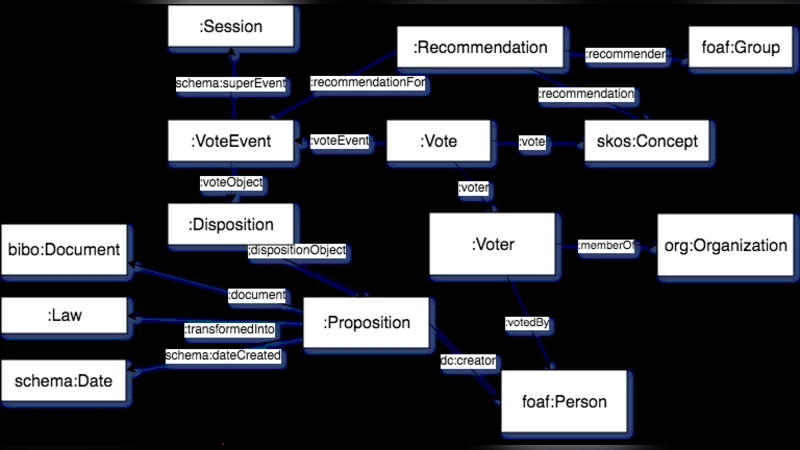
The Internet and the Web are now an integral part of the way most modern societies, and corresponding political systems, work. We regard Political systems as the formal and informal political processes by which decisions are made concerning the use, production and distribution of resources in any given society. Our focus in on the sets of agents - Persons and Organizations - that govern a society, and their relations. We present a set of ontologies aimed at characterizing different kinds of direct and indirect relations that occur within a Political System. The goal is to provide a more semantically precise basis for determining more abstract notions such as “influence”. These ontologies are being used for the “Se Liga na Politica” project, whose goal is to provide an open linked data database of Political Agents in Brazil. Whereas they are being used in a particular political system, these ontologies can be applied to different political systems.
💡 Research Summary
The paper addresses the growing need to represent political systems in a machine‑readable, semantically precise form as the Internet and the Web become integral to modern governance. It defines a political system as the set of formal and informal processes by which societies decide on the use, production, and distribution of resources, and focuses on the agents—persons and organizations—that drive these processes. The authors propose a suite of ontologies designed to capture both direct and indirect relationships among political agents, with the ultimate aim of providing a solid semantic foundation for higher‑level concepts such as “influence.”
The core of the work builds on well‑established web vocabularies: FOAF for personal attributes, ORG for organizational structures, PROV‑O for provenance, and Schema.org for generic descriptors. While reusing these standards, the authors introduce new classes (e.g., PoliticalAgent, PoliticalOffice) and properties (holdsPosition, directRelation, indirectRelation, influence, mediatedBy) that are specific to the political domain. Temporal aspects are handled through validFrom, validTo, and validDuring properties, allowing the model to record the start and end of offices, party memberships, coalition periods, and other time‑bound phenomena. Influence is modeled both quantitatively (weight) and qualitatively (description), and can be linked to mediating agents to express indirect pathways of power.
To demonstrate applicability, the ontologies are deployed in the “Se Liga na Politica” project, an open linked‑data platform that aggregates information about Brazilian political actors from multiple public sources (federal, state, and municipal legislatures, parties, NGOs, etc.). The data integration pipeline resolves identifier conflicts using owl:sameAs and skos:exactMatch, cleanses and normalizes attributes, and stores the resulting RDF triples in a triplestore exposed via a SPARQL endpoint. Validation is performed with SHACL shapes to enforce structural constraints, and reasoning is carried out with an OWL reasoner (e.g., Pellet) to infer transitive influence relationships automatically.
The paper’s contributions are threefold: (1) a comprehensive, hierarchical ontology for political agents and their relationships; (2) a method for representing direct, indirect, and mediated influence with both numeric and textual annotations; (3) practical guidelines and tooling for building an open, queryable linked‑data repository of political information. The authors also discuss how the model can be adapted to other political contexts by providing region‑specific profiles, redefining domain and range constraints, and incorporating access‑control metadata to address privacy and ethical concerns.
In conclusion, the research offers a robust semantic infrastructure that enables precise representation, integration, and analysis of political actors and their networks. By making influence and related concepts explicit in a machine‑interpretable format, the ontologies pave the way for more transparent, data‑driven political analytics, journalism, and civic engagement across diverse governance systems.
Comments & Academic Discussion
Loading comments...
Leave a Comment