Some comments on computational mechanics, complexity measures, and all that
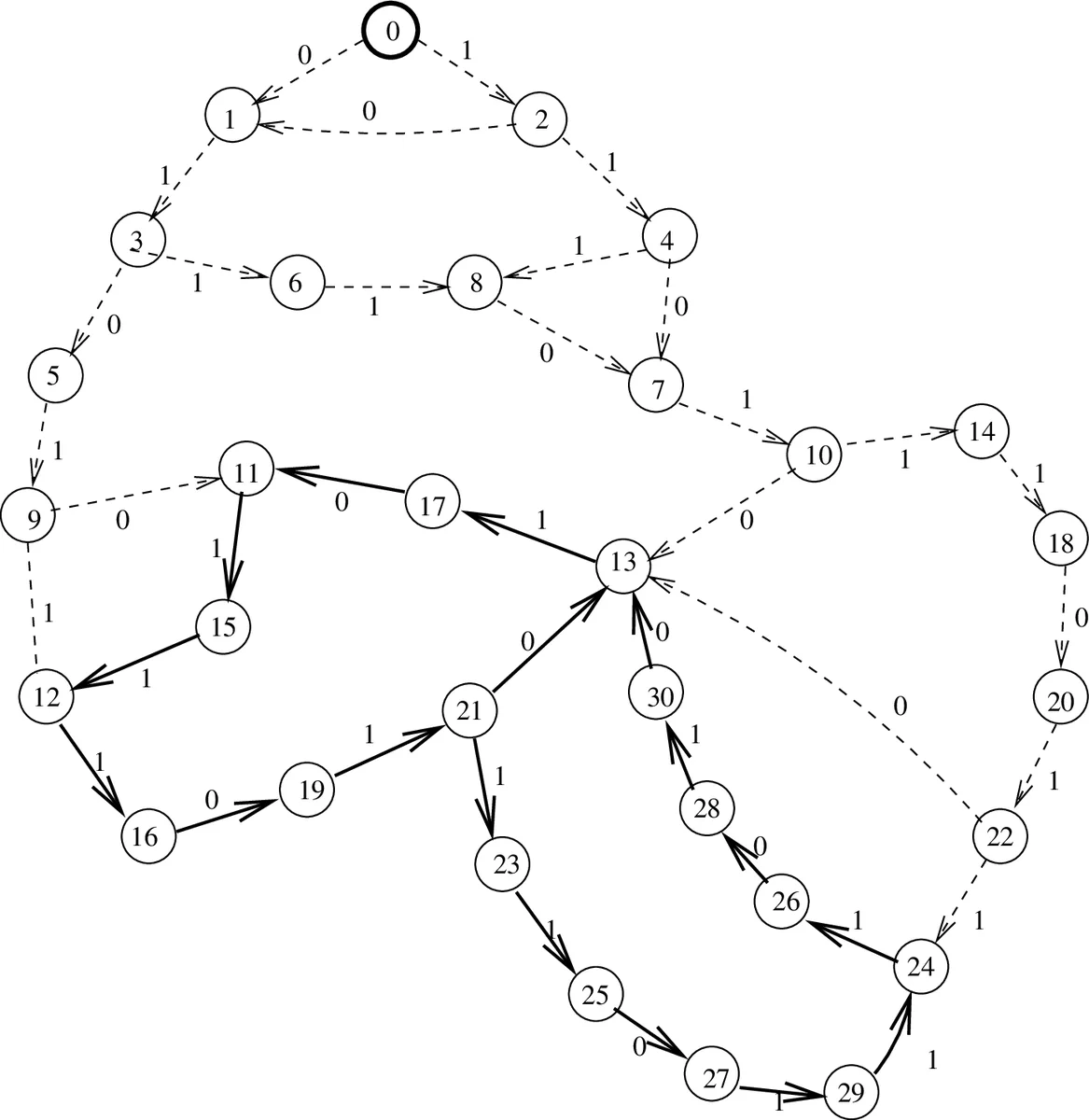
We comment on some conceptual and and technical problems related to computational mechanics, point out some errors in several papers, and straighten out some wrong priority claims. We present explicitly the correct algorithm for constructing a minimal unifilar hidden Markov model ("$\epsilon$-machine") from a list of forbidden words and (exact) word probabilities in a stationary stochastic process, and we comment on inference when these probabilities are only approximately known. In particular we propose minimization of forecasting complexity as an alternative basis for statistical inference of time series, in contrast to the traditional maximum entropy principle. We present a simple and precise way of estimating excess entropy (aka “effective measure complexity”. Most importantly, however, we clarify some basic conceptual problems. In particular, we show that there exist simple models (called “totally recurrent graphs”) where none of the nodes of the “$\epsilon$-machine” (the “causal states”) corresponds to an element of a state (or history) space partition.
💡 Research Summary
The paper is a critical commentary on the field of computational mechanics and the various complexity measures that have been popularized over the past two and a half decades. The author begins by pointing out that many of the concepts that are now attributed to Jim Crutchfield’s seminal 1993 paper—such as the ε‑machine, causal states, and statistical complexity—were already introduced earlier in the work of Peter Grassberger (references
Comments & Academic Discussion
Loading comments...
Leave a Comment