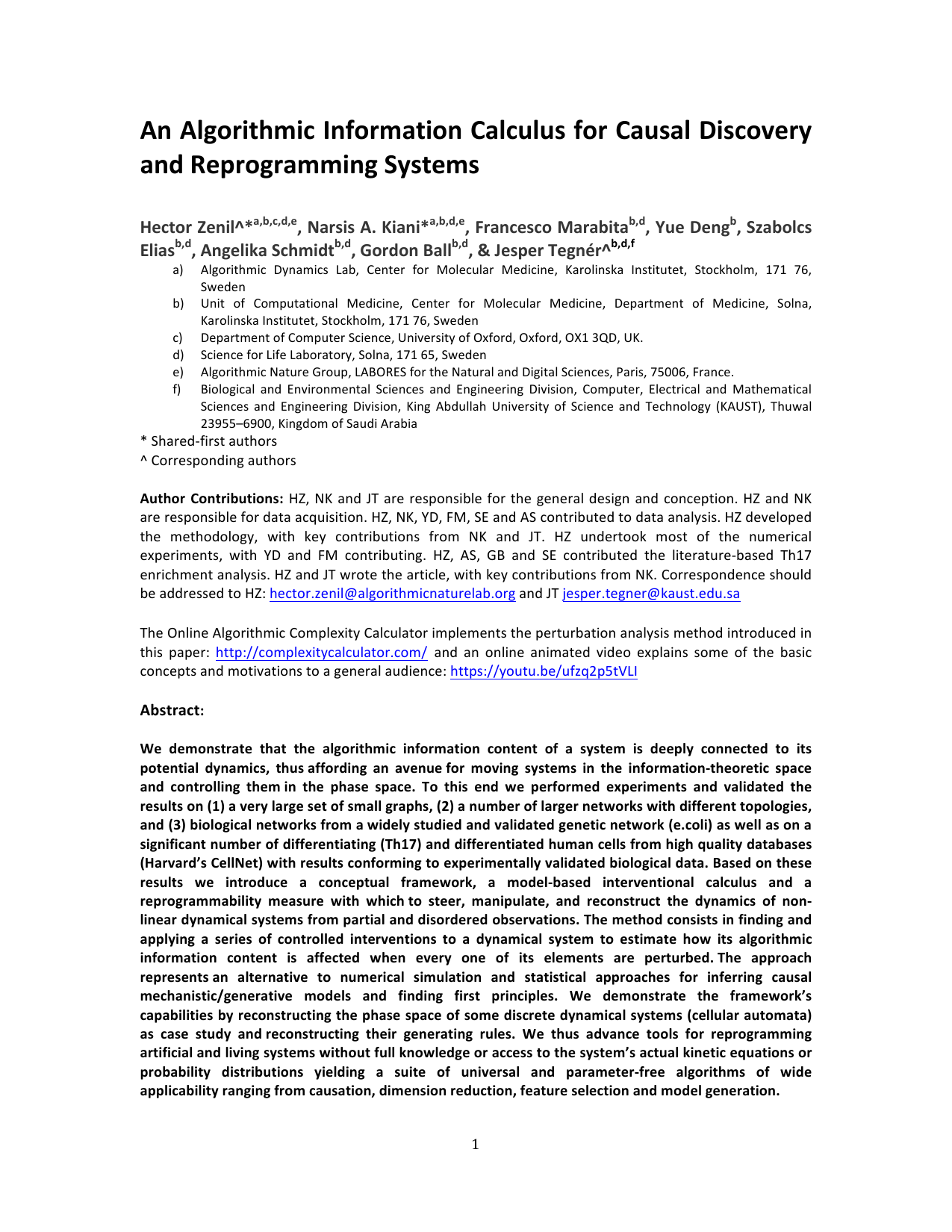
An Algorithmic Information Calculus for Causal Discovery and Reprogramming Systems

Reading time: 5 minute
...

📝 Original Info

  • Title: An Algorithmic Information Calculus for Causal Discovery and Reprogramming Systems
  • ArXiv ID: 1709.05429
  • Date: 2018-04-06
  • Authors: Researchers from original ArXiv paper

📝 Abstract

We demonstrate that the algorithmic information content of a system is deeply connected to its potential dynamics, thus affording an avenue for moving systems in the information-theoretic space and controlling them in the phase space. To this end we performed experiments and validated the results on (1) a very large set of small graphs, (2) a number of larger networks with different topologies, and (3) biological networks from a widely studied and validated genetic network (e.coli) as well as on a significant number of differentiating (Th17) and differentiated human cells from high quality databases (Harvard's CellNet) with results conforming to experimentally validated biological data. Based on these results we introduce a conceptual framework, a model-based interventional calculus and a reprogrammability measure with which to steer, manipulate, and reconstruct the dynamics of non- linear dynamical systems from partial and disordered observations. The method consists in finding and applying a series of controlled interventions to a dynamical system to estimate how its algorithmic information content is affected when every one of its elements are perturbed. The approach represents an alternative to numerical simulation and statistical approaches for inferring causal mechanistic/generative models and finding first principles. We demonstrate the framework's capabilities by reconstructing the phase space of some discrete dynamical systems (cellular automata) as case study and reconstructing their generating rules. We thus advance tools for reprogramming artificial and living systems without full knowledge or access to the system's actual kinetic equations or probability distributions yielding a suite of universal and parameter-free algorithms of wide applicability ranging from causation, dimension reduction, feature selection and model generation.

💡 Deep Analysis

Deep Dive into An Algorithmic Information Calculus for Causal Discovery and Reprogramming Systems.

We demonstrate that the algorithmic information content of a system is deeply connected to its potential dynamics, thus affording an avenue for moving systems in the information-theoretic space and controlling them in the phase space. To this end we performed experiments and validated the results on (1) a very large set of small graphs, (2) a number of larger networks with different topologies, and (3) biological networks from a widely studied and validated genetic network (e.coli) as well as on a significant number of differentiating (Th17) and differentiated human cells from high quality databases (Harvard’s CellNet) with results conforming to experimentally validated biological data. Based on these results we introduce a conceptual framework, a model-based interventional calculus and a reprogrammability measure with which to steer, manipulate, and reconstruct the dynamics of non- linear dynamical systems from partial and disordered observations. The method consists in finding and ap

📄 Full Content

1   An  Algorithmic  Information  Calculus  for  Causal  Discovery   and  Reprogramming  Systems     Hector  Zenil^*a,b,c,d,e,  Narsis  A.  Kiani*a,b,d,e,  Francesco  Marabitab,d,  Yue  Dengb,  Szabolcs   Eliasb,d,  Angelika  Schmidtb,d,  Gordon  Ballb,d,  &  Jesper  Tegnér^b,d,f   a) Algorithmic   Dynamics   Lab,   Center   for   Molecular   Medicine,   Karolinska   Institutet,   Stockholm,   171   76,   Sweden   b) Unit   of   Computational   Medicine,   Center   for   Molecular   Medicine,   Department   of   Medicine,   Solna,   Karolinska  Institutet,  Stockholm,  171  76,  Sweden     c) Department  of  Computer  Science,  University  of  Oxford,  Oxford,  OX1  3QD,  UK.   d) Science  for  Life  Laboratory,  Solna,  171  65,  Sweden   e) Algorithmic  Nature  Group,  LABORES  for  the  Natural  and  Digital  Sciences,  Paris,  75006,  France.   f) Biological   and   Environmental   Sciences   and   Engineering   Division,   Computer,   Electrical   and   Mathematical   Sciences  and  Engineering  Division,  King  Abdullah  University  of  Science  and  Technology  (KAUST),  Thuwal   23955–6900,  Kingdom  of  Saudi  Arabia   *  Shared-­‐first  authors   ^  Corresponding  authors     Author  Contributions:  HZ,  NK  and  JT  are  responsible  for  the  general  design  and  conception.  HZ  and  NK   are  responsible  for  data  acquisition.  HZ,  NK,  YD,  FM,  SE  and  AS  contributed  to  data  analysis.  HZ  developed   the   methodology,   with   key   contributions   from   NK   and   JT.   HZ   undertook   most   of   the   numerical   experiments,   with   YD   and   FM   contributing.   HZ,   AS,   GB   and   SE   contributed   the   literature-­‐based   Th17   enrichment  analysis.  HZ  and  JT  wrote  the  article,  with  key  contributions  from  NK.  Correspondence  should   be  addressed  to  HZ:  hector.zenil@algorithmicnaturelab.org  and  JT  jesper.tegner@kaust.edu.sa     The  Online  Algorithmic  Complexity  Calculator  implements  the  perturbation  analysis  method  introduced  in   this   paper:   http://complexitycalculator.com/   and   an   online   animated   video   explains   some   of   the   basic   concepts  and  motivations  to  a  general  audience:  https://youtu.be/ufzq2p5tVLI     Abstract:     We   demonstrate   that   the   algorithmic   information   content   of   a   system   is   deeply   connected   to   its   potential   dynamics,   thus  affording   an   avenue  for   moving   systems   in   the   information-­‐theoretic   space   and   controlling   them  in   the   phase   space.   To   this   end   we   performed   experiments   and   validated   the   results  on  (1)  a  very  large  set  of  small  graphs,  (2)  a  number  of  larger  networks  with  different  topologies,   and  (3)  biological  networks  from  a  widely  studied  and  validated  genetic  network  (e.coli)  as  well  as  on  a   significant  number  of  differentiating  (Th17)  and  differentiated  human  cells  from  high  quality  databases   (Harvard’s  CellNet)  with  results  conforming  to  experimentally  validated  biological  data.  Based  on  these   results   we   introduce   a   conceptual   framework,   a   model-­‐based   interventional   calculus   and   a   reprogrammability   measure   with   which  to   steer,   manipulate,   and   reconstruct   the   dynamics   of   non-­‐ linear  dynamical  systems  from  partial  and  disordered  observations.  The  method  consists  in  finding  and   applying   a   series   of   controlled   interventions   to   a   dynamical   system   to   estimate   how   its   algorithmic   information   content   is   affected   when   every   one   of   its   elements   are   perturbed.  The   approach   represents  an   alternative   to   numerical   simulation   and   statistical   approaches   for   inferring   causal   mechanistic/generative   models   and   finding   first   principles.   We   demonstrate   the   framework’s   capabilities  by  reconstructing  the  phase  space  of  some  discrete  dynamical  systems  (cell

…(Full text truncated)…

📸 Image Gallery

cover.png page_2.webp page_3.webp

Reference

This content is AI-processed based on ArXiv data.

Start searching

Enter keywords to search articles

↑↓
ESC
⌘K Shortcut