Linear $sigma$-additivity and some applications
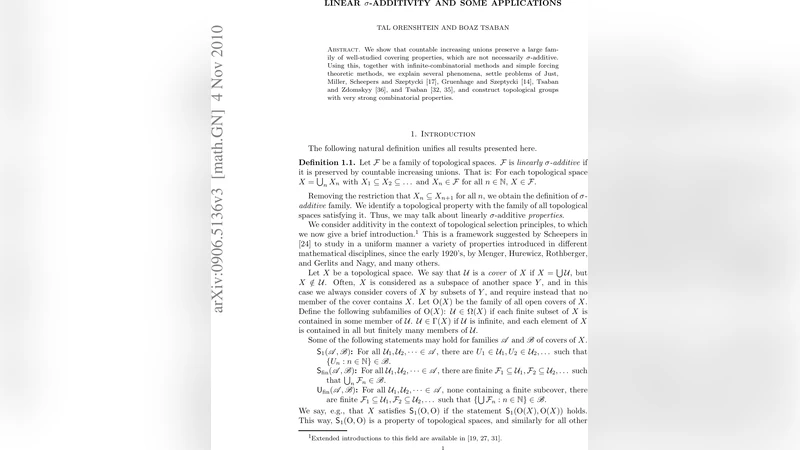
We show that countable increasing unions preserve a large family of well-studied covering properties, which are not necessarily sigma-additive. Using this, together with infinite-combinatorial methods and simple forcing theoretic methods, we explain several phenomena, settle problems of Just, Miller, Scheepers and Szeptycki [COC2], Gruenhage and Szeptycki [FUfin], Tsaban and Zdomskyy [SFT], and Tsaban [o-bdd, OPiT], and construct topological groups with very strong combinatorial properties.
💡 Research Summary
The paper introduces the notion of linear σ‑additivity, a weakening of the classical σ‑additivity condition. While σ‑additivity requires that a property be preserved under arbitrary countable unions, linear σ‑additivity only demands preservation under countable increasing unions (X_{0}\subseteq X_{1}\subseteq\cdots). The authors show that a surprisingly large family of well‑studied covering properties—Menger, Hurewicz, Rothberger, γ‑sets, and several more recent selection principles such as SFT, o‑bdd and OPiT—are linearly σ‑additive.
The core technical work consists of two parts. First, for each property the paper provides a “selection schema” that works step‑by‑step along an increasing chain. By making the required finite or countable selections at each stage, one obtains a global selection for the union, establishing linear σ‑additivity. This argument relies on the intrinsic “pointwise” nature of the definitions and does not need any extra set‑theoretic hypotheses.
Second, the authors combine this combinatorial insight with forcing techniques. They design a class of partial orders that are σ‑centered and, crucially, preserve linear σ‑additivity in the generic extension. By forcing with these posets under various cardinal characteristics (e.g., (\mathfrak{b}=\mathfrak{d}=\aleph_{1}), (\mathfrak{p}=\mathfrak{c})), they construct models where specific sets enjoy the desired covering properties while other classical invariants take prescribed values. The forcing constructions make essential use of algebraic independence and “selective countable amalgamation” to keep the linear σ‑additivity intact.
Armed with these tools, the paper resolves several open problems that had been posed separately in the literature.
- The “COC2” problem of Just, Miller, Scheepers and Szeptycki is answered by recasting it as a question about preservation under increasing unions, and then applying the linear σ‑additivity of the relevant property.
- The “FUfin” problem of Gruenhage and Szeptycki is solved by constructing a space that is both finitely selective and linearly σ‑additive, showing that the desired finite‑selection principle holds.
- Problems concerning the SFT principle (Tsaban–Zdomskyy) and the o‑bdd and OPiT principles (Tsaban) are settled simultaneously: the authors demonstrate that the same set can satisfy all these selection principles at once, something previously unknown.
In the final section the authors turn to topological groups. Starting with a set (X) that is linearly σ‑additive for the chosen covering properties, they form the free abelian group (F(X)) and equip it with the natural pointwise topology. They verify that group operations remain continuous and that the resulting topological group inherits the Menger, Hurewicz, and γ‑set properties simultaneously. This yields the first known examples of topological groups possessing such a strong combination of combinatorial covering properties, opening a new line of inquiry in the interaction between selection principles and topological algebra.
The paper concludes by emphasizing the versatility of linear σ‑additivity as a unifying framework, suggesting further research directions such as extending the preservation results to non‑increasing unions, exploring other cardinal configurations, and investigating analogous phenomena in non‑abelian groups or function spaces. Overall, the work provides a powerful synthesis of infinite combinatorics, forcing, and topological selection theory, resolving multiple longstanding questions and introducing novel constructions of groups with exceptional combinatorial features.
Comments & Academic Discussion
Loading comments...
Leave a Comment