Assigning Weights to Minimize the Covering Radius in the Plane
Given a set $P$ of $n$ points in the plane and a multiset $W$ of $k$ weights with $k\leq n$, we assign each weight in $W$ to a distinct point in $P$ to minimize the maximum weighted distance from the weighted center of $P$ to any point in $P$. In this paper, we give two algorithms which take $O(k^2n^2\log^3 n)$ time and $O(k^5n\log^3k+kn\log^3 n)$ time, respectively. For a constant $k$, the second algorithm takes only $O(n\log^3n)$ time, which is near linear.
💡 Research Summary
The paper addresses a novel geometric optimization problem that extends the classic weighted‑center (or 1‑center) problem. Given a set P of n points in the Euclidean plane and a multiset W of k positive real weights (k ≤ n), the task is to assign each weight in W to a distinct point of P (the remaining n − k points receive the default weight 1) so that the resulting weighted center has the smallest possible covering radius, i.e., the maximum weighted distance from the center to any point is minimized. This models scenarios such as placing a single recharging station for robots with heterogeneous speeds: the speed of each robot can be interpreted as a weight, and reassigning speeds (or equivalently moving the robots) changes the optimal facility location.
A key geometric observation is that, for any assignment of weights, the weighted center is uniquely determined by at most three weighted points. Consequently, the number of distinct candidate centers is bounded by O(k³n³) (all possible triples of a point and a weight). The authors prove this bound is tight up to constant factors.
Two algorithms are presented.
Algorithm 1 (O(k²n² log³ n) time, O(kn) space).
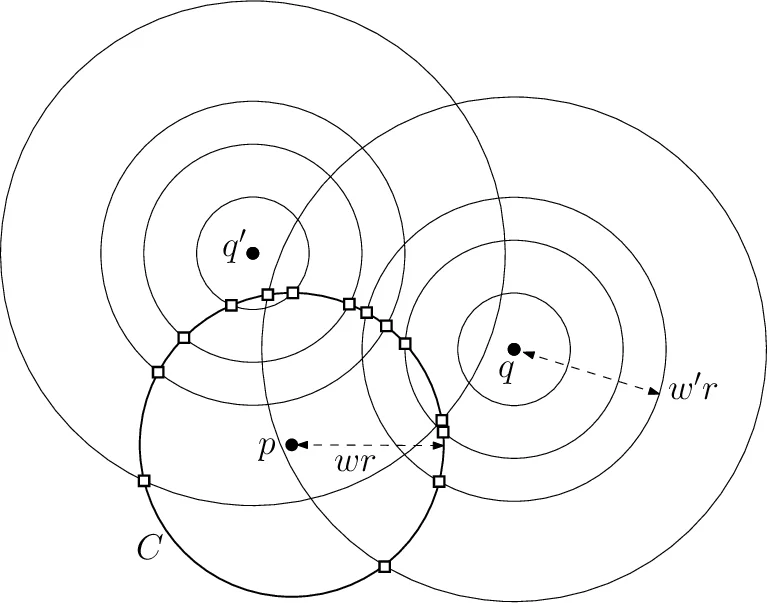
The authors first design a decision procedure: given a radius r, decide whether there exists an assignment whose covering radius does not exceed r. For each point p∈P and each possible weight w∈W∪{1}, they consider the circle centered at p with radius w·r. A feasible center must lie in the intersection of all such circles. The decision algorithm checks whether any of the O(kn) intervals induced by these circles contain a common point. By constructing the combinatorial arrangement of all circles (which has O(k²n²) complexity) and using parametric search (Megiddo’s technique), the optimal radius r* and a corresponding assignment are found. The overall running time is O(k²n² log³ n).
Algorithm 2 (O(k⁵n log³ k + kn log³ n) time).
This algorithm assumes every weight in W is at most 1. Under this restriction the circles are “small” relative to each other, which dramatically reduces the number of relevant intersection points. The algorithm explicitly enumerates and sorts all intersection points of the circles, then for each candidate point checks feasibility using the same O(n) verification as in Lemma 2. The dominant term comes from handling O(k⁵n) intersection events, leading to the stated complexity. When k is constant, the algorithm runs in O(n log³ n), i.e., near‑linear time.
Both algorithms rely on parametric search but avoid the usual difficulty of exact root computation because the candidate radii are always defined by at most three weighted points, making the required algebraic expressions simple to evaluate.
The paper also discusses related work on inverse 1‑center problems in graphs, weight‑balancing on polygons, and previous linear‑time algorithms for the weighted‑center problem with fixed weights. The presented results fill a gap by handling the combinatorial explosion caused by reassigning weights while still achieving polynomial (and for constant k, near‑linear) running times.
Potential applications include optimal placement of service facilities for heterogeneous agents, dynamic load balancing where processing speeds act as weights, and network design problems where edge lengths can be altered by assigning additive weights. The authors emphasize that their geometric approach is conceptually simple and implementable, despite employing sophisticated optimization techniques such as Megiddo’s parametric search.
In summary, the paper formalizes the weight‑assignment version of the planar covering‑radius problem, proves that only O(k³n³) distinct weighted centers need to be considered, and provides two algorithms—one general and one specialized for small weights—that compute an optimal assignment in O(k²n² log³ n) and O(k⁵n log³ k + kn log³ n) time respectively, with the latter becoming near‑linear when k is constant. This contributes both theoretical insight and practical tools for a range of location‑optimization scenarios.
Comments & Academic Discussion
Loading comments...
Leave a Comment