Numerical simulation of a temporary repository of radioactive material
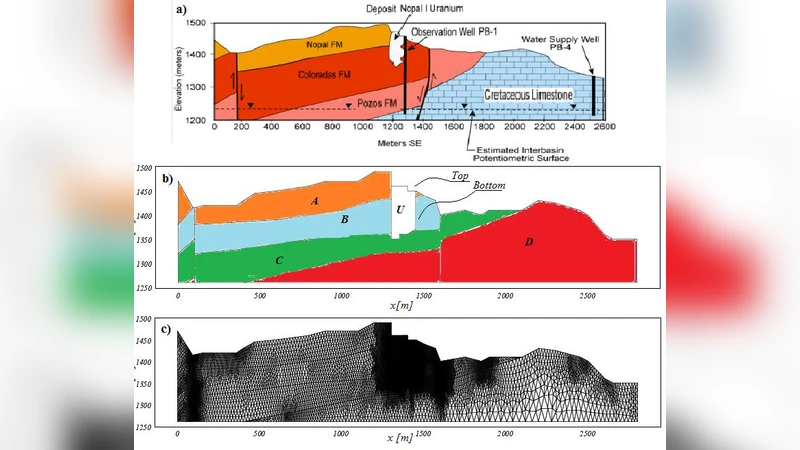
The use of computer simulations techniques is an advantageous tool in order to evaluate and select the most appropriated site for radionuclides confinement. Modelling different scenarios allow to take decisions about which is the most safety place for the final repository. In this work, a bidimensional numerical simulation model for the analysis of dispersion of contaminants trough a saturated porous media using finite element method (FEM), was applied to study the transport of radioisotopes in a temporary nuclear repository localized in the Vadose Zone at Pe~na Blanca, M'exico. The 2D model used consider the Darcy’s law for calculating the velocity field, which is the input data for in a second computation to solve the mass transport equation. Taking into account radionuclides decay the transport of long lived U-series daughters such as ${}^{238}!\text{U}$, ${}^{234}!\text{U}$, and ${}^{230}!\text{Th}$ is evaluated. The model was validated using experimental data reported in the literature obtaining good agreement between the numerical results and the available experimental data. The simulations show preferential routes that the contaminant plume follows over time. The radionuclide flow is highly irregular and it is influenced by failures in the area and its interactions in the fluid-solid matrix. The resulting radionuclide concentration distribution is as expected. The most important result of this work is the development of a validated model to describe the migration of radionuclides in saturated porous media with some fractures.
💡 Research Summary
The paper presents a two‑dimensional finite‑element simulation of radionuclide transport in a saturated porous medium for a temporary nuclear waste repository located in the Vadose Zone of Peña Blanca, Mexico. The authors first construct a hydrogeological model of the site, defining permeability, porosity, fluid density and viscosity, and compute the Darcy velocity field from the pressure gradient and gravity. This velocity field serves as the advective term in the transport equation. The transport model combines advection, molecular diffusion, and mechanical dispersion into a single dispersion tensor, and incorporates sorption–desorption equilibrium through a distribution coefficient (Kd). Radioactive decay is modeled for the long‑lived members of the 238U decay series (238U, 234U, 230Th), assuming secular equilibrium and neglecting short‑lived intermediates. Model validation is performed against experimental concentration profiles from the Nopal I uranium deposit, a well‑studied analogue site. The simulated plume shows preferential pathways along fractures, producing high‑concentration “hot spots” that match observed data. Sensitivity analyses reveal that fracture networks, sorption strength, and velocity variations critically control plume shape and migration speed. The study demonstrates that a conventional continuum approach, when coupled with detailed FEM discretization and calibrated against field data, can reliably predict radionuclide migration even in heterogeneous, fractured media. The validated model is positioned as a practical tool for safety assessments and design optimization of temporary or permanent radioactive waste repositories.
Comments & Academic Discussion
Loading comments...
Leave a Comment