Performance analysis of FSO using relays and spatial diversity under log-normal fading channel
The performance analysis of free space optical communication (FSO) system using relays and spatial diversity at the source is studied in this paper. The effect of atmospheric turbulence and attenuation, caused by different weather conditions and geom…
Authors: Pranav Kumar Jha, Nitin Kachare, K Kalyani
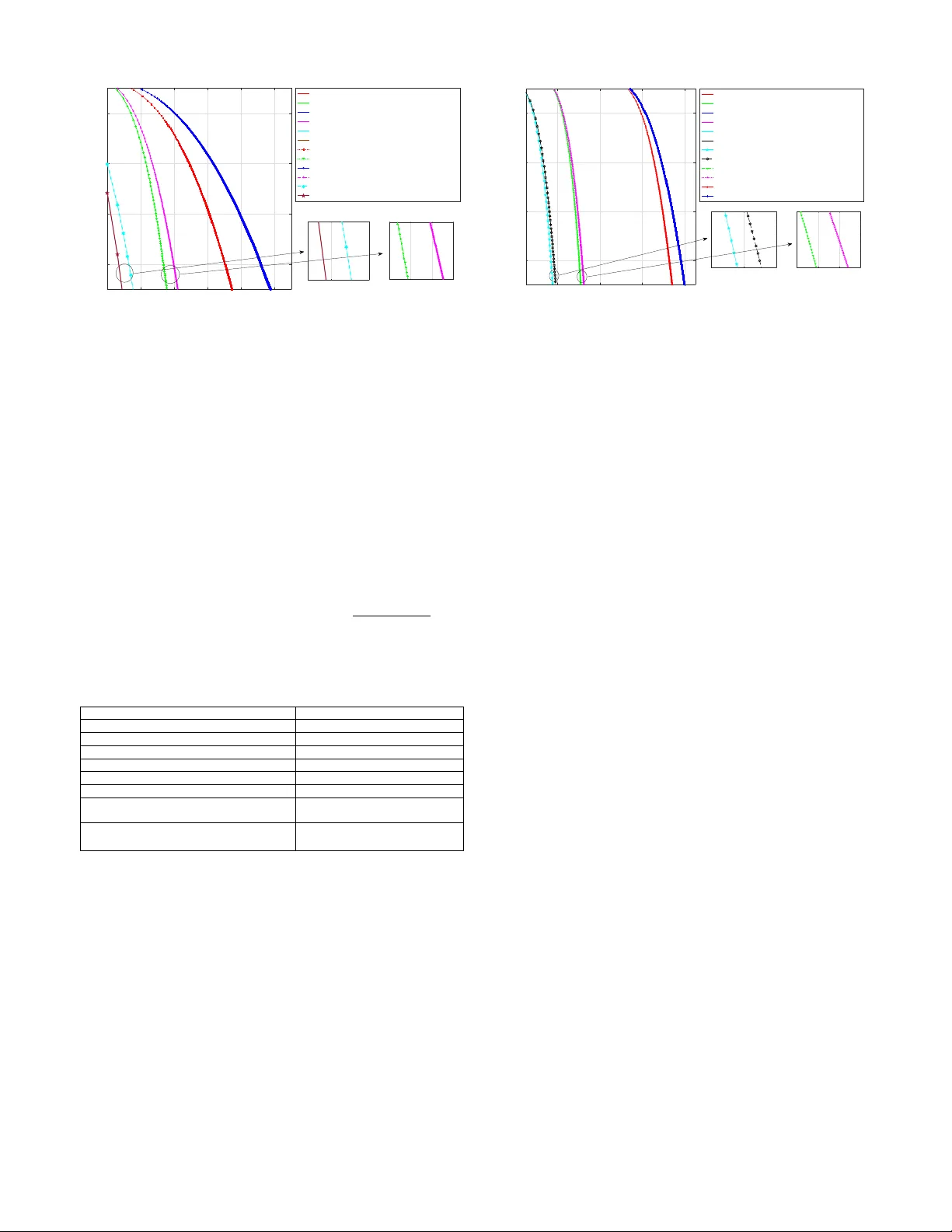
4th International Conference on Electrical Energy Systems (ICEES), Feb . 7-9, 2018, SSNCE, Chennai, TN, INDIA Performance analysis of FSO using relays and spatial di v ersity under log-normal fading channel Pranav Kumar Jha ∗ , Nitin Kachare, K. Kalyani and D. Sriram Kumar Department of Electr onics and Communication Engineering , National Institute of T echnology , T iruchirappalli, T amil Nadu 620 015, India ∗ jha k.pranav@li ve.com Abstract —The performance analysis of free space optical communication (FSO) system using relays and spatial diversity at the source is studied in this paper . The effects of atmo- spheric turb ulence and attenuation, caused by different weather conditions and geometric losses, hav e also been considered for analysis. The exact closed-f orm expressions ar e presented f or bit error rate (BER) of M-ary quadrature amplitude modulation (M-QAM) technique for multi-hop multiple-input and single- output (MISO) FSO system under log-normal fading channel. Furthermore, the link performance of multi-hop MISO and multi-hop single-input and single-output (SISO) FSO systems are compared to the different systems using on-off keying (OOK), repetition codes (RCs) and M-ary pulse amplitude modulation (M-P AM) techniques. A significant performance enhancement in terms of BER analysis and SNR gains is shown for multi-hop MISO and multi-hop SISO FSO systems with M-QAM over other existing systems with different modulation schemes. Moreov er , Monte-Carlo simulations are used to validate the accuracy and consistency of the derived analytical results. Numerical results show that M-QAM modulated multi-hop MISO and multi-hop SISO FSO system with relays and spatial diversity outperforms other systems while ha ving the same spectral efficiency for each system. Keyw ords — Free Space Optical Communications, Log-Normal F ading Channel, Quadrature Amplitude Modulation, Spatial Di- versity , Bit Error Rate, Decode and F orward Relay I . I N T RO D U C T I O N Free space optical communication (FSO) is a rapidly ev olving technology to handle high data rate and has very huge information handling capacity . FSO systems are proven an alternati ve to the fiber optics technology . In many cases, only the free space transmission is possible to establish a connection between the source and the destination o ver a line- of-sight (LOS) path. Optical signal transmission in free space has e xplored the une xplored areas in wireless communications for decades and appearing as the key of many systems for varieties of applications, such as radio frequency (RF) wireless transmission, satellite communications, long-haul connections and optical fiber back up, etc. FSO systems hav e to face man y challenges, mainly atmospheric turb ulence, beam wandering, beam attenuation, weather attenuation, geometric losses and scintillation [1]. A. Related W orks In literature, different types of channel models have been proposed to exactly model the atmospheric turbulence which matches well with the experimental results. Log-normal, gamma-gamma and negati ve exponential channel models are used for weak, strong-moderate and strong turbulence condi- tions, respectiv ely [2 – 4]. Fading and attenuation has affected the performance of FSO systems in large extent. T urbulence and weather conditions, such as snow , fog and haze also af- fecting the FSO transmission. Further , geometric loss has also lessened the performance of FSO systems. In pre vious works, varieties of spatial div ersity techniques hav e been proposed to mitigate the effect of atmospheric turbulence in FSO commu- nications [5, 6] where three primary spatial di versity schemes are more popular among the av ailable div ersity schemes, such as orthogonal space time block codes (OSTBCs), transmit laser selection (TLS) and repetition codes (RCs). Here, TLS is considered as the best spatial div ersity scheme with channel state information (CSI) at the source end, but at the cost of increased system complexity [7, 8]. W ith moderate system complexity in different channel conditions, RCs outperforms its counterpart OSTBCs. Apart from spatial di versity schemes, some other techniques have also been proposed to mitigate turbulence effects such as relay assisted techniques [8], error- correcting codes [9, 10] and maximum likelihood estimation [11], out of which relay assisted technique appears to be prominent as sev eral short links are used instead of a long communication link for efficient data transmission over FSO channels. B. Motivation and Contribution In pre vious works, most of the systems introduced are using pulse amplitude modulation (P AM) as a high level modulation technique, but very few have considered to use quadrature amplitude modulation (QAM) scheme, which is the motiv ation behind this work. In this paper, with the help of decode and forward (DF) relay for intensity modulation and direct detection (IM/DD), M-ary QAM (M-QAM) modulation is used against a log-normal fading channel to study the link performance of different architectures of FSO systems for short distance communication links under different weather conditions. Here, bit error rate (BER) is considered as a performance metric which is used to measure the performance of the FSO system. For analysis purposes, the effect of turbulence, path loss, scattering and scintillation ha ve also been taken into account. Assuming the correlation effects among the transmitters, the performance of multi-hop multi-input and single-output (MISO) and multi-hop single-input and single- output (SISO) system with M-QAM is compared with multi- hop MISO and SISO system using M-P AM, MISO with RCs and OOK and SISO with on-off keying (OOK) [12]. In all cases, it is assumed that the spectral efficienc y is same. At 978-1-5386-3695-4/18/$31.00 c 2018 IEEE 4th International Conference on Electrical Energy Systems (ICEES), Feb. 7-9, 2018, SSNCE, Chennai, TN, INDIA the receiv er, maximum lik elihood (ML) decoding technique is employed for recei ving the M-QAM signals. C. Organization The rest of the paper is organized as follows: in Section II, the DF relay FSO system is described for multi-hop MISO configurations under v arious modulation techniques and the mathematical expressions of BER hav e been presented for M- QAM and M 2 -QAM modulation schemes. Section III presents the numerical results where the parameters, considered for simulation purposes, are tabulated in T able I. Section IV concludes the work. I I . S Y S T E M D E S C R I P T I O N A. Multi-hop DF r elay System 1) M-QAM T ransmission: For transmission of signals, a MISO system is considered with M transmitters in the form of lasers and a photo detector as recei ver , which is sho wn in Fig. 1. At the source, transmission of signals is in the form of binary data, modulated by a M I × M Q electrical-QAM modulator . For the transmission through M paths, mapping of data symbols into QAM symbols is done with the help of Gray coding. In addition, to mitigate the spatial correlation effect, sufficient channel distance is considered. The probability of error of QAM signals can be easily calculated from the probability of error of P AM signals as the phase-quadrature signal components can be perfectly e xtracted at the QAM demodulator . For the M-ary QAM signals, the probability of a correct decision is written as [13] P C = ( 1 − P √ M ) 2 , (1) where P √ M is the probability of error for √ M -ary P AM with half the av erage power in each quadrature component of the signal of the corresponding QAM system. The probability of error of M-ary P AM can be written as P √ M = 2 1 − 1 √ M Q 3 l og 2 M γ M − 1 , (2) where γ represents the a verage SNR per symbol. Consequently , the probability of a symbol error for M-ary QAM signals can be written as P M = 1 − ( 1 − P √ M ) 2 , (3) which is valid for M = 2 k and ev en k . By using the optimum detector , the tightly upper bounded symbol error probability can be written as P M ≤ 1 − 1 − 2 Q r 3 γ M − 1 ≤ 4 Q r 3 l og 2 M γ M − 1 . (4) Here, introduction of relays creates some effect in FSO system for SISO and MISO configurations with the help of DF relays, which helps to achiev e significant improvement in the link performance. For the system under consideration, ( K − 1 ) DF relays are set up in between the source and the destination for K hops. The received signal at the k th hop can be written as r k ( t ) = x ( t ) η I k + n k ( t ) , k = 1 , 2 , . . . K . (5) Powered by TCPDF (www.tcpdf.org) Powered by TCPDF (www.tcpdf.org) Fig. 1. A MISO multi-hop DF relay FSO System, which is not benefited by the use of transmit div ersity . In this scheme, K time slots are required for transmission of signals from source to destination, unlike MISO and SISO systems. F or the benefit of achie ving similar spectral ef ficiency , 2 K -ary M-QAM modulation technique is employed. DF relays used in between the transcei ver pairs create shorter communi- cation links which help to reduce the effects of turbulence and path losses, significantly . The upper bound BER for multi-hop DF relay system can be written as [12] BER ≤ 1 − K ∏ k = 1 ( 1 − BER k ) . (6) As the identical statistical properties are considered for all hops, the abov e expression (6) can be approximated by BER ≈ 1 2 [ 1 − ( 1 − 2BER k ) K ] . (7) The conditional BEP of M-QAM is giv en as [14] P ( e | γ ) ≈ 2 1 − 1 √ M log 2 M " Q s 3log 2 M γ 2 ( M − 1 ) !# , (8) and the instantaneous SNR γ is given by γ = 2 P 2 σ 2 n R , (9) where P implies the signal power and R signifies the bit rate. Now , by applying the approximate Q function [12] on (8), the conditional BEP of M-QAM can be written as P ( e | γ ) ≈ 2 1 − 1 √ M log 2 M × 1 12 exp − 3log 2 M γ 4 ( M − 1 ) + 1 4 exp − log 2 M γ ( M − 1 ) , (10) which is the general e xpression of the conditional BEP for FSO system using M-QAM. Now , the BER expression of the k th hop can be deri ved using Hermite polynomial and Q -function approximation as in [12]. The closed-form expression of BER for M-QAM modulation can be written as [12] BER k ≈ G 12 N ∑ i = 1 w i exp − 3log 2 M β 2 kn γ e − 4 σ 2 k + x i q 32 σ 2 k 4 ( M − 1 ) + G 4 N ∑ i = 1 w i exp − log 2 M β 2 kn γ e − 4 σ 2 k + x i q 32 σ 2 k ( M − 1 ) , (11) 978-1-5386-3695-4/18/$31.00 c 2018 IEEE 4th International Conference on Electrical Energy Systems (ICEES), Feb. 7-9, 2018, SSNCE, Chennai, TN, INDIA where G = 2 1 − 1 √ M / ( log 2 ( M ) √ π ) , β kn represents the nor- malized path loss coefficient, x i and w i are the zeros and the weights of the Hermite polynomial, σ 2 k is the channel variance and γ is the a verage SNR. Substituting (11) in (6) and (7), the upper bound and the av erage BER expressions of multi-hop system can be obtained, respectively . The BER expressions of M-P AM, SISO with OOK, and MISO with RCs and OOK are taken from [12] for analysis and comparison purpose. 2) M 2 -QAM T ransmission: The M 2 symbols of M 2 -QAM made up of an in-phase and quadrature phase component basis function, orthogonal to each other . In each symbol duration, the two basis functions are modulated with the independent data resulting a multiplication by a series of M amplitude values to each basis function to comprise the M 2 symbols [15]. The constellation of QAM shows a two dimensional regular array of points and the minimum spacing between the points is prescribed by the amount of DC bias added by virtue of the non-negati vity constraint, which is [15] d min = P M − 1 r 2log 2 M R , where R signifies the bit rate. The probability of symbol error is estimated by using the union bound approximation [12]. By ev aluating the av erage number of neighbors d min away from ev ery constellation point, P esym is approximated as P esym = 4 M − 1 m · Q P M − 1 r 1 4 R s σ 2 ! , where R s = R / log 2 M 2 . By applying the Gray coding approxi- mation, the conditional BEP of M 2 -QAM is giv en by [15] P ( e | γ ) ≈ 2 M − 1 M log 2 M " Q s log 2 M γ 4 ( M − 1 ) 2 !# , (12) where instantaneous SNR γ = 2 P 2 σ 2 n R . Now , applying the approx- imate Q function on (12), the conditional BEP of M-QAM is giv en as P ( e | γ ) ≈ 2 M − 1 M log 2 M × 1 12 exp − log 2 M γ 8 ( M − 1 ) 2 + 1 4 exp − log 2 M γ 6 ( M − 1 ) 2 , (13) which represents the typical expression of the conditional BEP for the FSO system with M 2 -QAM. The closed form expres- sion of BER of M 2 -QAM modulation deriv ed as discussed earlier , can be written as BER k ≈ G 12 N ∑ i = 1 w i exp − log 2 M β 2 kn γ e − 4 σ 2 k + x i q 32 σ 2 k 8 ( M − 1 ) 2 + G 4 N ∑ i = 1 w i exp − log 2 M β 2 kn γ e − 4 σ 2 k + x i q 32 σ 2 k 6 ( M − 1 ) 2 , (14) where G = 2 M − 1 / M log 2 M √ π and β kn is the normalized path loss coefficient with reference to the direct link of the multi-hop system. Substituting (14) in (6) and (7), the upper bound BER expression and the average BER expression for the multi-hop system can be retriev ed, respectively . Powered by TCPDF (www.tcpdf.org) Powered by TCPDF (www.tcpdf.org) Fig. 2. A hybrid MISO multi-hop DF relay FSO System which is benefited by relays and transmit div ersity , both. B. MISO multi-hop DF r elay system This is a hybrid technique which uses the advantages of FSO systems with relays and transmit div ersity to deteriorate the channel attenuation and turb ulence effects. The block diagram of this system model is shown in Fig. 2. Here, K − 1 relays are emplo yed to recei ve the signals from N t transmitters which, simultaneously , re-transmit those signals with the help of RCs. For this system, the number of hops are considered identical with the number of transmitters per relay . The signal receiv ed at each hop can be given as r k ( t ) = x ( t ) η N t ∑ i = 1 I ki + n k ( t ) , k = 1 , 2 . . . K . (15) Similarly , using the conditional BEP expression for M-QAM, the BER expression for k th hop can be written as [12] BER k ≈ N ∑ n 1 = 1 . . . N ∑ n N t " N t ∏ i = 1 w n i √ π # F 12 exp × − 3log 2 ( M ) β 2 kn γ 4 ( M − 1 ) N t N t ∑ i = 1 " exp √ 32 N t ∑ j = 1 c 0 i j x n j − 4 σ 2 k #! + N ∑ n 1 = 1 . . . N ∑ n N t " N t ∏ i = 1 w n i √ π # F 4 exp × − log 2 ( M ) β 2 kn γ ( M − 1 ) N t N t ∑ i = 1 " exp √ 32 N t ∑ j = 1 c 0 i j x n j − 4 σ 2 k #! , (16) and using the conditional BEP equation of M 2 -QAM, the BER expression for the k th hop has been gi ven as BER k ≈ N ∑ n 1 = 1 . . . N ∑ n N t " N t ∏ i = 1 w n i √ π # F 12 exp × − log 2 ( M ) β 2 kn γ 8 ( M − 1 ) N t N t ∑ i = 1 " exp √ 32 N t ∑ j = 1 c 0 i j x n j − 4 σ 2 k #! + N ∑ n 1 = 1 . . . N ∑ n N t " N t ∏ i = 1 w n i √ π # F 4 exp × − log 2 ( M ) β 2 kn γ 6 ( M − 1 ) N t N t ∑ i = 1 " exp √ 32 N t ∑ j = 1 c 0 i j x n j − 4 σ 2 k #! , (17) where F = 2 1 − 1 √ M / log 2 ( M ) for (16) and F = 2 M − 1 / M log 2 M for (17) and c 0 i j represents the ( i , j ) th coef ficients of the spatial cov ariance matrix Γ 0 sq = Γ 0 1 / 2 . By substituting these results in (6) and (7), expressions of the upper bound 978-1-5386-3695-4/18/$31.00 c 2018 IEEE 4th International Conference on Electrical Energy Systems (ICEES), Feb. 7-9, 2018, SSNCE, Chennai, TN, INDIA 0 10 20 30 40 50 Average SNR [dB] 10 -8 10 -6 10 -4 10 -2 BER MISO 3x1 with OOK and RCS (simulated) MISO 3x1 multi-hop with 8-PAM (simulated) SISO with OOK (simulated) SISO multi-hop with 8-PAM (simulated) SISO multi-hop with 8-QAM (simulated) MISO 3x1 multi-hop with 8-QAM (simulated) MISO 3x1 with OOK and RCS (analytical) MISO 3x1 multi-hop with 8-PAM (analytical) SISO with OOK (analytical) SISO multi-hop with 8-PAM (analytical) SISO multi-hop with 8-QAM (analytical) MISO 3x1 multi-hop with 8-QAM (simulated) 5 10 10 -9 10 -8 16 18 20 22 10 -9 10 -8 Fig. 3. BER of multi-hop FSO system with 8-QAM, 8-P AM, SISO-OOK and MISO-RCs and OOK in clear weather condition. BER and the closed-form average BER of the multi-hop MISO system can be obtained, respectiv ely . The BER expressions for other configurations of FSO system are shown in [12]. I I I . N U M E R I C A L A NA L Y S I S A N D D I S C U S S I O N S Numerical results are presented in this section which verify the derived analytical results using Monte-Carlo simulations. For simulation purposes, a minimum of 10 6 bits are relayed for respectiv e SNR values and increases with increasing SNR. The parameters needed to achiev e a target BER of 10 − 9 are defined and tabulated in T able I. Further , all hops are considered equidistant with each other . The scintillation index (SI) is ≤ 0.75 for log-normal channel and σ x = p ln ( SI ) + 1 / 2 [16]. Hence, for SI = 0.75, σ x ≤ 0 . 374 is required, which represents the maximal value assumed for the analysis purpose. T ABLE I. S I MU L A T I O N P A RA M E TE R S FSO Parameters Numerical V alues Relay Spacing 400 m W avelength ( λ ) 1550 nm Link Distance ( l ) 1200 m Beam Divergence Angle ( θ T ) 2 mrad Correlation Coefficient ( ρ ) 0.3 Tx and Rx Aperture Diameter ( D R and D T ) 20 cm Attenuation Constant ( α ) 0.43 dB/km (Clear W eather) 20 dB/km (Light F og) Refractiv e Inde x Constant ( C 2 n ) 5 × 10 − 14 m − ( 2 / 3 ) (Clear W eather) 1 . 7 × 10 − 14 m − 2 / 3 (Light Fog) Fig. 3 represents the BER of multi-hop FSO system, where the number of relays is two and the number of transmit lasers is one for SISO scheme or three for MISO scheme, wherev er required with 8-QAM, 8-P AM, MISO with RCs and OOK and SISO-OOK modulation techniques. It demonstrates the effect on the performance gain of MISO and SISO multi-hop FSO systems for dif ferent modulation techniques under clear weather conditions. Further , at the target BER, SNR gains of 19.52 dB and 27.65 dB is achieved for multi-hop MISO and multi-hop SISO systems as compared to MISO with OOK and RCs and SISO with OOK, respecti vely , for 8-P AM modulation scheme, whereas with 8-QAM modulation, SNR gains of 13.21 dB and 13.44 dB is achieved for multi-hop MISO and multi- hop SISO systems over P AM modulated multi-hop MISO and multi-hop SISO systems, respectively , maintaining the same 20 40 60 80 Average SNR [dB] 10 -8 10 -6 10 -4 10 -2 BER MISO 3x1 with OOK and RCs (simulated) MISO 3x1 multi-hop with 8-PAM (simulated) SISO with OOK (simulated) SISO multi-hop with 8-PAM (simulated) MISO 3x1 multi-hop with 8-QAM (simulated) SISO multi-hop with 8-QAM (simulated) MISO 3x1 multi-hop with 8-QAM (analytical) SISO multi-hop with 8-QAM (analytical) MISO 3x1 multi-hop with 8-PAM (analytical) SISO multi-hop with 8-PAM (analytical) MISO 3x1 with OOK and RCs (analytical) SISO with OOK (analytical) 30 31 32 33 10 -9 10 -8 16 18 20 10 -9 10 -8 Fig. 4. BER of multi-hop FSO system with 8-QAM, 8-P AM, SISO-OOK and MISO-RCs and OOK in light fog condition. number of transmitters. Furthermore, results show that, multi- hop MISO system outperforms multi-hop SISO system by 3.1 dB and 3.33 dB, respectiv ely , for 8-QAM and 8-P AM. In Fig. 4, BER for multi-hop FSO system with two relays and one or three transmit lasers has been shown under light fog conditions for 8-QAM, 8-P AM, MISO with RCs and OOK and SISO with OOK modulation schemes. For two relay multi-hop system, 8-QAM modulation scheme provides an equal spectral efficienc y for SISO and MISO systems. Deriv ed analytical results show that multi-hop system still outperforms other systems and the increment in the performance of the system is significant. For 8-P AM modulation scheme, SNR gains of 43.13 dB and 47.64 dB are achie ved at the tar get BER of multi- hop MISO and multi-hop SISO systems in comparison with MISO with RCs and OOK and SISO-OOK modulated systems, whereas using 8-QAM technique, system outperforms the 8- P AM system with 13.34 dB and 13.66 dB of SNR gains for multi-hop MISO and multi-hop SISO systems, respectiv ely . In addition, 8-QAM and 8-P AM multi-hop MISO systems provide the performance gain of 1.16 dB and 1.48 dB over the 8-QAM and 8-P AM multi-hop SISO system, respecti vely . I V . C O N C L U S I O N S The effects of moderate turbulence under clear weather condition and weak turbulence under light fog conditions on the performance of different types of FSO systems are studied in this paper . It is evident from the deriv ed analytical results that div erse conditions in the atmosphere hav e a huge effect on the performance of MISO and SISO multi-hop FSO systems. Furthermore, multi-hop MISO system with M-QAM modulation outperforms other systems, such as SISO with OOK, MISO with RCs and OOK and M-P AM multi-hop SISO and MISO systems in terms of SNR gains and BER performance considering the same spectral efficienc y for all the systems. Moreo ver , the results also demonstrate that multi- hop systems are capable of mitigating the ef fects of turbulence and path losses caused by geometric losses and attenuations, whereas MISO systems can counteract turbulence effects only . Consequently , it can also be stated that the overall performance of the FSO system can be improved significantly by increasing the number of relays where the introduction of spatial div ersity could also be of great importance as well. 978-1-5386-3695-4/18/$31.00 c 2018 IEEE 4th International Conference on Electrical Energy Systems (ICEES), Feb. 7-9, 2018, SSNCE, Chennai, TN, INDIA R E F E R E N C E S [1] S. M. Navidpour , M. Uysal, and M. Kavehrad, “Ber per - formance of free-space optical transmission with spatial div ersity , ” IEEE transactions on W ireless Communica- tions , vol. 6, no. 8, 2007. [2] D. A. Luong, T . C. Thang, and A. T . Pham, “Effect of av alanche photodiode and thermal noises on the perfor- mance of binary phase-shift ke ying-subcarrier-intensity modulation/free-space optical systems over turbulence channels, ” IET Communications , vol. 7, no. 8, pp. 738– 744, 2013. [3] G. K. Rodrigues, V . G. A. Carneiro, A. R. da Cruz, and M. T . M. R. Giraldi, “Evaluation of the strong turbulence impact over free-space optical links, ” Optics Communications , vol. 305, pp. 42–47, 2013. [4] K. P . Peppas, F . Lazarakis, A. Ale xandridis, and K. Dan- gakis, “Simple, accurate formula for the av erage bit error probability of multiple-input multiple-output free- space optical links over negativ e exponential turbulence channels, ” Optics letters , vol. 37, no. 15, pp. 3243–3245, 2012. [5] M. Abaza, R. Mesleh, A. Mansour, and E.-H. M. Ag- goune, “Div ersity techniques for a free-space optical communication system in correlated log-normal chan- nels, ” Optical Engineering , vol. 53, no. 1, pp. 016 102– 016 102, 2014. [6] T . A. Tsiftsis, H. G. Sandalidis, G. K. Karagiannidis, and M. Uysal, “Optical wireless links with spatial di ver - sity ov er strong atmospheric turbulence channels, ” IEEE T ransactions on W ir eless Communications , v ol. 8, no. 2, pp. 951–957, 2009. [7] A. Garcia-Zambrana, C. Castillo-V azquez, B. Castillo- V azquez, and A. Hiniesta-Gomez, “Selection transmit div ersity for fso links over strong atmospheric turbulence channels, ” IEEE Photonics T echnology Letters , vol. 21, no. 14, pp. 1017–1019, 2009. [8] M. Safari and M. Uysal, “Relay-assisted free-space op- tical communication, ” IEEE T ransactions on W ir eless Communications , vol. 7, no. 12, pp. 5441–5449, 2008. [9] M. R. Abaza, N. A. Mohammed, and M. H. Aly , “Ber performance of m-ary ppm free-space optical communi- cations with channel fading, ” in High Capacity Optical Networks and Enabling T echnologies (HONET), 2011 . IEEE, 2011, pp. 111–115. [10] X. Zhu and J. M. Kahn, “Free-space optical communi- cation through atmospheric turbulence channels, ” IEEE T ransactions on communications , vol. 50, no. 8, pp. 1293–1300, 2002. [11] ——, “Maximum-likelihood spatial-div ersity reception on correlated turbulent free-space optical channels, ” in Global T elecommunications Conference , 2000. GLOBE- COM’00. IEEE , vol. 2. IEEE, 2000, pp. 1237–1241. [12] M. Abaza, R. Mesleh, A. Mansour et al. , “Performance analysis of miso multi-hop fso links ov er log-normal channels with fog and beam diver gence attenuations, ” Optics Communications , vol. 334, pp. 247–252, 2015. [13] J. Proakis, Digital Communications , ser . McGraw-Hill series in electrical and computer engineering : commu- nications and signal processing. McGraw-Hill, 2001. [14] H. Singh and R. Miglani, “Performance analysis of ter- restrial free space optical (fso) communication link using m-qam modulation technique, ” International J ournal of Scientific & Engineering Researc h , vol. 4, pp. 805–808, 2013. [15] S. Hranilovic, W ir eless optical communication systems . Springer Science & Business Media, 2006. [16] H. Moradi, H. H. Refai, and P . G. LoPresti, “Switched div ersity approach for multireceiving optical wireless systems, ” Applied optics , vol. 50, no. 29, pp. 5606–5614, 2011. 978-1-5386-3695-4/18/$31.00 c 2018 IEEE
Original Paper
Loading high-quality paper...
Comments & Academic Discussion
Loading comments...
Leave a Comment