The Classification of Cropping Patterns Based on Regional Climate Classification Using Decision Tree Approach
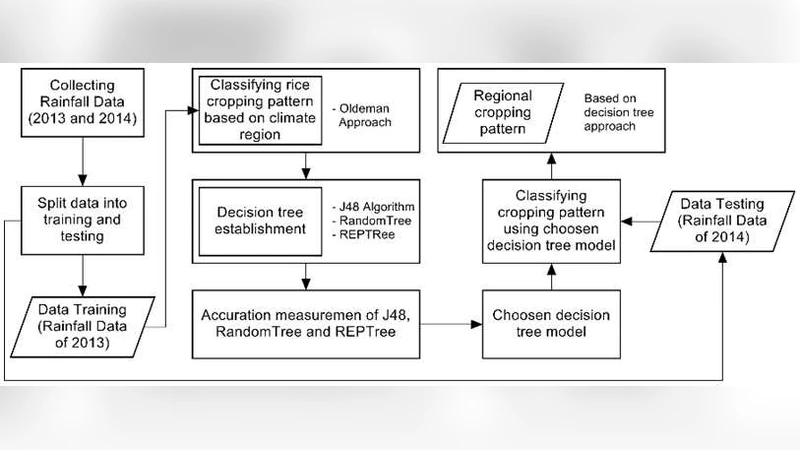
Nowadays, agricultural field is experiencing problems related to climate change that result in the changing patterns in cropping season, especially for paddy and coarse grains, pulses roots and Tuber (CGPRT/Palawija) crops. The cropping patterns of rice and CGPRT crops highly depend on the availability of rainfall throughout the year. The changing and shifting of the rainy season result in the changing cropping seasons. It is important to find out the cropping patterns of paddy and CGPRT crops based on monthly rainfall pattern in every area. The Oldeman’s method which is usually used in the classification of of cropping patterns of paddy and CGPRT crops is considered less able to determine the cropping patterns because it requires to see the rainfall data throughout the year. This research proposes an alternative solution to determine the cropping pattern of paddy and CGPRT crops based on the pattern of rainfall in the area using decision tree approach. There were three algorithms, namely, J48, RandomTree and REPTree, tested to determine the best algorithm used in the process of the classification of the cropping pattern in the area. The results showed that J48 algorithm has a higher classification accuracy than RandomTree and REPTree for 48%, 42.67% and 38.67%, respectively. Meanwhile, the results of data testing into the decision tree rule indicate that most of the areas in DKI Jakarta are suggested to apply the cropping pattern of 1 paddy cropping and 1 CGRPT cropping (1 PS + 1 PL). While in Banten, there are three cropping patterns that can be applied, they are, 1 paddy cropping and 1 CGPRT cropping (1 PS + 1 PL), 3 short-period paddy croppings or 2 paddy croppings and 1 CGPRT cropping (3 short-period PS or 2 PS + 1 PL) and 2 paddy croppings and 1 CGPRT cropping (2 PS + 1 PL).
💡 Research Summary
The paper addresses the pressing issue of climate‑induced variability in cropping seasons for rice and CGPRT (coarse grains, pulses, roots, and tubers) in Indonesia. Traditional classification of cropping patterns relies on Oldeman’s method, which requires a full year of rainfall data and is considered insufficient for rapidly changing climate conditions. To overcome this limitation, the authors propose a data‑driven approach that uses only monthly rainfall patterns to predict suitable cropping systems through decision‑tree classifiers.
Three algorithms—J48 (C4.5 implementation), RandomTree, and REPTree—were evaluated on a dataset comprising ten years (2008‑2017) of monthly precipitation records from the Jakarta Special Capital Region (DKI Jakarta) and Banten Province. Each observation was labeled with a cropping pattern derived from expert application of Oldeman’s classification, resulting in five possible classes such as “1 paddy + 1 CGPRT” (1 PS + 1 PL), “3 short‑period paddy” (3 short‑period PS), and “2 paddy + 1 CGPRT” (2 PS + 1 PL). The dataset exhibited class imbalance, with the “1 PS + 1 PL” class being the most frequent.
Using 10‑fold cross‑validation, the models were assessed on accuracy, precision, recall, and F1‑score. J48 achieved the highest overall accuracy at 48 %, outperforming RandomTree (42.67 %) and REPTree (38.67 %). While the overall performance is modest—reflecting the limited predictive power of rainfall alone and the class imbalance—the J48 tree provided interpretable rules. For instance, low rainfall in the early wet season (March‑May) strongly favored the “1 PS + 1 PL” pattern, whereas higher precipitation in the mid‑year months increased the likelihood of “3 short‑period PS” or “2 PS + 1 PL”.
Region‑specific results showed that most sites in DKI Jakarta were best suited to a single paddy and a single CGPRT cycle (1 PS + 1 PL). In Banten, three viable patterns emerged: (1) 1 PS + 1 PL, (2) three short‑period paddy cycles, and (3) two paddy cycles plus one CGPRT cycle (2 PS + 1 PL). These findings illustrate how monthly rainfall distributions can guide localized cropping decisions without the need for a full annual dataset.
The authors acknowledge several limitations. First, an accuracy below 50 % indicates that rainfall alone does not capture all determinants of cropping suitability; soil fertility, temperature, irrigation infrastructure, and market factors were omitted. Second, the class imbalance reduced the model’s ability to correctly identify less common patterns. Third, the paper lacks detailed description of missing‑value handling and outlier treatment, which hampers reproducibility.
Future work is proposed in four directions: (1) incorporation of additional environmental and socio‑economic variables, (2) application of oversampling techniques such as SMOTE to mitigate class imbalance, (3) comparison with more sophisticated ensemble methods (Random Forest, XGBoost) and deep‑learning time‑series models, and (4) field validation with farmers to refine the decision rules.
In conclusion, the study demonstrates that decision‑tree classifiers, particularly J48, can extract meaningful relationships between monthly rainfall and cropping pattern suitability, offering a faster, more flexible alternative to Oldeman’s method. While the current model’s predictive performance is limited, the approach provides a valuable foundation for developing precision‑agriculture decision‑support tools that can adapt to the uncertainties of climate change.
Comments & Academic Discussion
Loading comments...
Leave a Comment