Welfare Without Taxation - Autonomous production revenues for Universal Basic Income
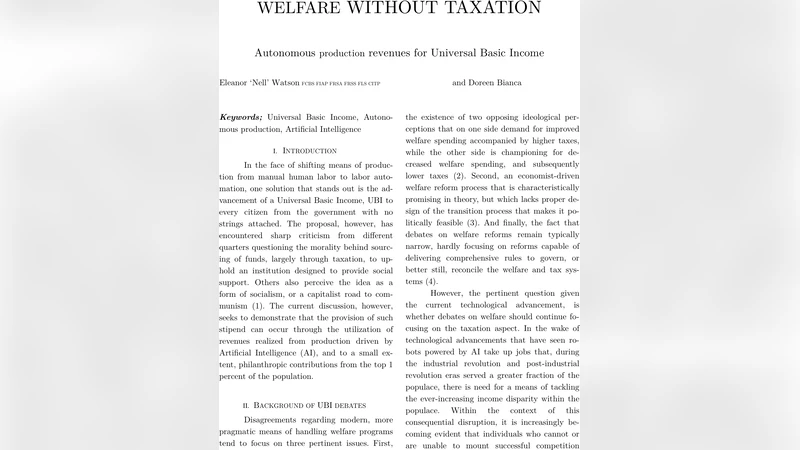
In the face of shifting means of production from manual human labor to labor automation, one solution that stands out is the advancement of a Universal Basic Income, UBI to every citizen from the government with no strings attached. The proposal, however, has encountered sharp criticism from different quarters questioning the morality behind sourcing of funds, largely through taxation, to uphold an institution designed to provide social support. Others also perceive the idea as a form of socialism, or a capitalist road to communism. The current discussion, however, seeks to demonstrate that the provision of such stipend can occur through the utilization of revenues realized from production driven by Artificial Intelligence (AI), and to a small extent, philanthropic contributions from the top 1 percent of the population.
💡 Research Summary
The paper addresses the growing gap between traditional labor‑based production and the emerging AI‑driven automation of value creation. It argues that financing a universal basic income (UBI) through conventional taxation is politically and morally contentious, and proposes an alternative revenue stream that derives directly from the surplus profits generated by AI‑enabled enterprises. The core mechanism is an “AI dividend” system: a legally mandated share of the net earnings of firms whose primary productive assets are artificial intelligence and robotics is funneled into a publicly administered AI Fund. This fund, managed via transparent blockchain‑based smart contracts, distributes equal monthly payments to every citizen, thereby providing a tax‑free basic stipend.
The authors estimate that AI‑centric firms will soon generate profits two to three times higher than those of traditional manufacturers. Capturing 15‑20 % of this excess profit could yield a fund in the multi‑trillion‑won (or multi‑billion‑dollar) range annually, sufficient to cover a modest UBI for a nation‑state. To supplement this, the paper suggests a voluntary philanthropy component: the top 1 % of wealth holders would be incentivized through tax deductions and public recognition to contribute 0.5‑1 % of their annual income to the same fund.
Economic modeling shows that a universal stipend would boost aggregate consumption, offset the demand contraction caused by automation‑induced job losses, and narrow income inequality. The resulting increase in disposable income is projected to raise domestic demand by 1‑2 % of GDP and to lift long‑run productivity growth by 0.3‑0.5 percentage points, as workers shift toward creative and non‑routine occupations.
Politically, the “no‑tax” framing reduces the perception of coercive redistribution, potentially increasing public acceptance compared with traditional welfare financed by income or corporate taxes. Nevertheless, the authors acknowledge significant implementation challenges: corporate profit‑shifting, international tax competition, and the need for robust oversight to prevent fund mismanagement. They recommend a suite of safeguards, including anti‑avoidance legislation, multinational coordination on AI‑profit reporting, and an independent audit body empowered to enforce compliance.
In conclusion, the paper contends that as AI becomes the dominant engine of production, its generated surplus can be harnessed to fund a universal basic income without resorting to conventional taxation, thereby offering a sustainable, politically palatable pathway to social security in an increasingly automated economy.
Comments & Academic Discussion
Loading comments...
Leave a Comment