Energy-Efficient Transmission of Hybrid Array with Non-Ideal Power Amplifiers and Circuitry
This paper presents a new approach to efficiently maximizing the energy efficiency (EE) of hybrid arrays under a practical setting of non-ideal power amplifiers (PAs) and non-negligible circuit power, where coherent and non-coherent beamforming are c…
Authors: Yuhao Zhang, Qimei Cui, Wei Ni
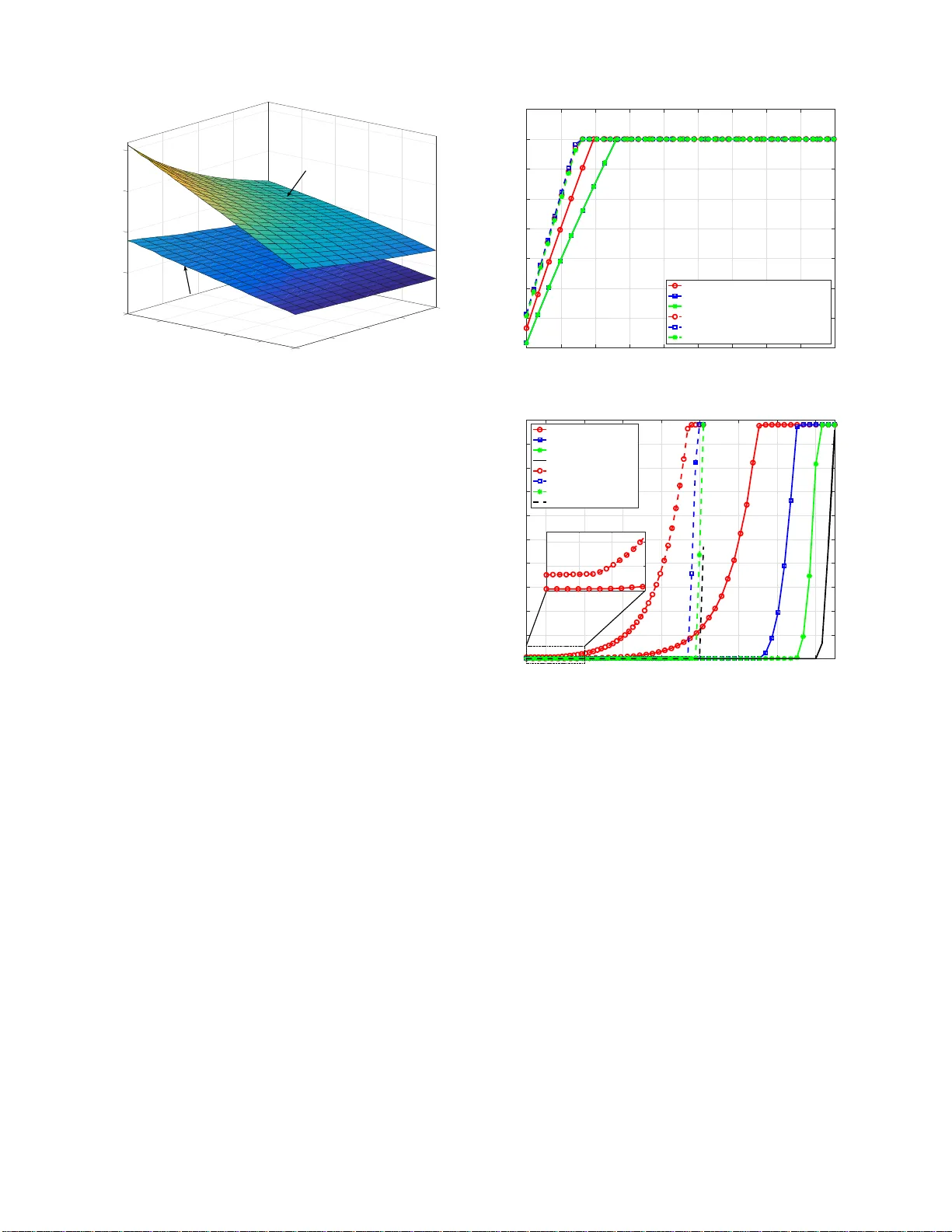
1 Ener gy-Ef ficient T ransmission of Hybrid Array with Non-Ideal Po wer Amplifiers and Circuitry Y uhao Zhang, Qimei Cui, Se n ior Member , IEEE , W ei Ni, Senior Memb er , IEEE , an d P ing Zhang Abstract —This paper presents a new approach to efficiently maximizing the energy efficiency ( E E) of hybrid arrays un der a practical setting of non-ideal power am plifiers (P As) and non-negligible circuit power , where coherent and non-coherent beamf orming ar e considered. As a key contribution, we rev eal that a bursty transmission mode can be en ergy -effi cient to achiev e steady tra n smissions o f a data stream u n der the practical setting. This is distinctively different from existin g studies under ideal circuits and P As, where conti n uous transmissions are th e most energy-efficient. Another important contribution is that the optimal transmit duration and p owers are identified to b alance energy consumptions in the non-i deal circuits and P As, and maximize the EE. Th is is achi eved by establishing th e most energy-efficient stru cture of transmit powers, g iven a trans- mit duration, and corre sp ondingly partitioning the non-conv ex feasible r egion of the transmit d uration i nto segments wi th self-contained con vexity or concavity . Evid ent from simulations, significant EE gains of the p roposed approach are d emonstrated through comparisons with the state of the art, and the sup eriority of the bursty transmission mode is confirmed especially und er low data rate demands. Index T erms —En ergy efficiency , hybrid array , massi ve MIMO, non-ideal power amplifier , non-negligible circuit power . I . I N T RO D U C T I O N Equipp e d with te n s to hundr eds o f antennas, m assi ve MIMO is one of the p romising technolog ies f o r improv- ing spectr al efficiency (SE) and saving per-antenna tr a nsmit power [1] –[3]. It is of particu lar im portance to m illim e ter- W a ve (mmW ave) communica tio ns by exploiting diversity and beamfor ming (BF) to com pensate for poo r chan nel pro p- agation [4], [5]. Massive MIMO is also well suited for mmW av e ap p lications, due to sign ificantly small antenna sizes in mmW ave [6]–[8]. Howev er, with the increasin g nu mber of anten nas, the total power consum ption an d impleme n tation complexity of massiv e MIMO would increase. Hy brid array s have be e n accep te d as a practica l implementation of massive MIMO, where a large-scale a n tenna arr ay divides into an ad- equate number of analo g p hased sub a rrays. Digital pro cessing is ca r ried ou t upon the input an d o utput of the suba r rays [9]– [11]. By this means, the requ irement of accomm odating large The work was supported in part by the Natio nal Nature Science Founda- tion of China Project under Grant 61471058, in part by the Hong Kong, Macao and T aiwan Science and T echnology Cooperatio n Projects under Grant 2016YFE0122900, in part by the Beijing Scienc e and T echnology Commission Founda tion unde r Grant 201702005, and in part by the 111 Project of China under Grant B16006. (Corre sponding author: Qimei Cui.) Y . Zhang, Q. Cui, and P . Z hang are with the National Engineering Laboratory for Mobile Network T echnol ogies, Beij ing Unive rsity of Posts and T elec omm unicat ions, Beiji ng, 100876, China (e-mail: cuiqimei@b upt.edu.cn). W . Ni is with Commonwealth Scientific and Industrial Research Or- ganisat ion (CSIR O), Marsfield, Sydney , NSW 2122, Australia (e-mail: wei.ni@csi ro. au). amounts of r adio fr equency ( RF) hardware, such a s analog- to-digital/dig ital-to-analo g con verter (ADC/D AC), in con fin ed space can be relieved, and so can the comp lexity and energy requirem ents of arr ay p rocessing. Hybrid arra y s have been demonstrated to achiev e hig h energy efficiency (EE) [9]–[12], which is a key perfo rmance index of the networks, an d is critical to massi ve MI M O due to th e use of large nu mbers of power amplifiers (P As) and RF circu its. Th is is because P As an d circu its can dra- matically con sume energy and penalize the E E of massive MIMO [13], especially in the practical case where th e P As are no n -ideal. A substantial p art of the p ower input to a P A is no t used for data transm ission, deteriorating the EE [1 4]– [17]. Moreover , non- ideal P As can rende r the optimization of the EE in tr actable, as the response functio n o f non-id e al P As is non-lin e a r and non -conv ex [ 18], [19]. On the other hand , the no n-negligible power co nsumption of transmitter circuits can also po se d ifficulties to maximizing the EE of la rge- scale antenna arrays. It n ecessitates new variable of transmit du ration to be optimized, apart fro m the transmit powers of analo g subarray s. Particularly , if a hy brid array transmits excessively long, th e circuit energy consum p tion would incr ease and redu ce the EE. On the other hand , if the arr ay tran smits too shor t, the tran smit power becomes excessi vely high, which, in the presence o f non - ideal P As, is detrimental to the EE. Moreover, th e non-negligib le circuit power can be no n-linear and non-conve x to the transmit po wer, since it is typ ically linear to the data rate an d hence logar ith mic to the transmit power [17]–[20]. This paper presents a new appro ach to efficiently opti- mize transmit p owers and duration fo r m aximizing the EE of hy brid arrays in th e pr e sence of practical non-ide a l P As and non - negligible circuit power . Coh erent and no n -coher e nt beamfor ming techniq u es are considered under d ifferent av ail- ability of chan nel state inform ation ( CSI). By deco upling the optimization of the tran smit powers from th at of the tran sm it duration , we discover the most energy-efficient structu re of the transmit powers, g i ven a transmit dur ation. The structure, in turn, c a n be used to partition the non-co n vex feasible solution region of the tran smit dura tio n into segments with self-containe d conve x ity or con cavity . Particularly , we prove that the E E is conve x in one segment and con cav e in the rest under non- c oherent beamfo rming, and is conve x in all segments un der coh erent bea m forming . Th e op timal tra n smit duration can theref ore be efficiently solved by ev aluating the bound aries an d stationary points of the segments. Ex tensiv e simulations confirm o ur discovery an d the supe r iority of our approa c h to the state o f th e art in terms of EE. 2 Another imp ortant contribution is that we r ev eal a bursty transmission mo de can be mor e energy-efficient for a data stream w ith a c onsistent average rate requirement than contin- uous transmissions in the presence of no n -negligible circuit power and non - ideal P As. This is due to the fact tha t th e hybrid array can be tur n ed o n only for par t of a timeslot and remain o ff for the rest of the slot, so as to ach ieve the average data rate while red ucing the circ u it energy consumptio n asso- ciated with tran smission. Part of non-negligib le circuit energy consump tion, such as those on ADC and up -converter , can be in creasingly sa ved with th e decrease of the transmit time. This is distinctively d ifferent from existing stud ies under ideal circuit and P As, where continuo us transmissions are the mo st energy-efficient due to the fact that the data rate is increased by either linearly incre a sin g th e transmit dura tion or exp o nentially increasing the transmit power u nder ideal circuit and/o r P As. The rest o f this paper is o rgan ized as fo llows. In Sectio n I I, the related work is p rovided. I n Section III, th e system model is described . In Sectio n IV, the op timization pro blem is formu lated. The structure of the optimal transmit powers is discovered in Section V, based on which the feasib le region of th e transmit duration is segmented and optimized in Section VI. Sim ulation results are shown in Section VII, followed by con clusions in Section VIII. I I . R E L A T E D W O R K The two state-of- th e-art de signs of hybr id ar rays, namely , localized and interleaved hybrid ar rays, were presented in [9]. In [10], consider ing two different structures where th e signal from each RF ch ain can be d eliv er ed to all anten n as an d to limited antennas r e spectiv ely , two types of hybrid arc h itecture were p r oposed in the multi-user scen ario, based o n which the tr ade-off of E E an d SE is analy zed. As fo r the EE research, most o f th e existing works are conduc te d for the precod in g and bea m formin g method. For example, in [21], the energy- efficient d e sig n of the p recoder in hy b rid array was in vestigated, and the non-conve x EE optimization problem was solved by a two-layer op timization meth od, wher e the analog and dig ital precod ers are op timized in an alternating man ner . The conver g ence o f the propo sed scheme was proved by the monoto nic boun dary theo rem an d fractional pr ogramm ing the- ory . In [2 2], hyb r id an alog-dig ital transceivers we re designed with fully and partially co nnected architectures to m aximize the EE by d eriving the pr e coding and c o mbining matrices throug h deco u pled n on-convex transmitter-receiv er o ptimiza- tion. Moreover , the EE per f ormance was also examined w .r .t the num ber of RF c h ains and antennas. Existing works on hybrid arrays have been extensi vely based on the assumption of ide a l circu itr y and P As [11], [ 22]–[24], and typica lly focused on a single-u ser scenario [11], [22]. In [25], an iterative h euristic algorith m was d ev elo ped to maximize th e EE of ren ew able powered hybrid arrays, subject to a data rate requir e ment, where an tennas are selected and transmit powers are allocated in an alternating m anner until conv ergen ce. I n [ 26], the phase shifts of hybr id array s were optimized to reduce the power con sumption and imp rove th e SE. Only a f ew works have taken m u ltiuser into account, Baseband proce ssor Digital pr oce ssor and D AC Splitter 1 (1:K) Phase s hifter 1 Power amplify 1 Splitte r M (1:K) Phase s hifter K Power amplify K Phase s hifter 1 Pow er amplify 1 Phase s hifter K Power a mplify K Subarra y 1 Subarra y M Hybrid array Digital proce ssor and D AC Fig. 1. The architect ure of the hybrid array . under the assum ption that perfect CSI is av ailable at the transmitter [23], [24]. This is du e to the fact th a t the estimation of CSI is challengin g in a h y brid array , esp e c ially a localized hybrid array . The estimation accuracy ca n either be po or due to inheren t phase am biguity of localized hy b rid arr ays [ 7], [12], [27], or necessitate lo ng training pilots, se vere estimation delay , and accur ate a-pr iori kn owledge on the num ber of multipath com ponen ts [28], [ 29]. One of the few studies o f multiuser in hybr id a rrays is [23], wh ere two bit-allo cation algorithm s were developed to minimize the qu antization d is- tortion of hybrid arrays by exploiting flexible ADC resolutions, giv en perfect CSI at the tr ansmitter . Another study is [30] which in vestigated the EE-SE trade-o ff and derived the m ost energy-efficient number of RF chains given SE. In different yet re levant co ntexts, the impact of non-id eal P As o r n on-negligib le circuit power on the EE ha s been ev aluated in many other wireless commun ication systems. In [1 4], [15], a string tau tening algo r ithm was pro posed to produ ce the m ost energy-efficient schedule for delay- limited traffic, first con sidering negligible c ir cuit power , an d then extended to no n-negligible con stan t circu it power and energy- harvesting co m munication s. In [16], the EE- delay trade-off of a prop ortionally fair downlink cellular network was studied in the case of n on-ideal P As. In [17], the power allocation was o ptimized to maxim iz e EE in co n ventio nal sin g le-hop frequen cy-selectiv e chan nels with n on-negligib le constant cir- cuit power . In [18], [19], beside the tran smit powers of all participating nodes, the tran smit dura tions were op timized jointly to m aximize the EE of two-way relay systems with non-id eal P As and non -negligible cir cuit power . However , to our b est knowledge, the compou n d effect of non -ideal P As and non-n egligib le circu it power has not been considered in hybrid arrays. I I I . S Y S T E M M O D E L W e c onsider a slotted system with slo t du ration T , where a hyb rid arr a y is employed to transmit a stream of data for transmit duratio n t per slot to a single-anten na receiver with a target a verag e data rate, den oted by r dl . As illustrated in Fig. 1, the hyb rid array co nsists of M ana lo g subarrays with K antennas p er su b array . Each antenn a ha s its own adjustable phase shifter , a D A C and a P A [ 10], [31], [ 32]. All sub arrays are co nnected with a baseb a nd pro cessor . The tran sm it power of an an alog sub array is evenly distributed amon g its antennas, 3 denoted b y p m A , at e a ch anten na at the m -th subarray . The system band width is W in Hertz. A non-id eal, non-lin ear power amp lifier , mode le d by the popular traditional power amplifier (TP A), is connecte d to ev er y antenna. The total power consump tion at the P A of each antenna at the m -th sub array can be given by [16] Ψ A ( p m A ) = q p m A P A max ,m η max ,m , m = 1 , · · · , M , (1) where P A max ,m and η max ,m are the maximum outp u t power and the maximum P A efficiency at each an te n na a t th e m -th subarray , r e spectiv ely . Apart from the power con su med by the P As, there is non-n egligible power con sumption in the rest of the tr a nsmitter circuit. The circuit co n sists o f ADC/D A C, baseband processor, up-and -down co n verter, o scillator and so on. Part o f th e circuit power consumption, such as th e energy consumed in the base- band processor, can be m o deled to explicitly depend on th e instantaneou s transmit rate R a , which can be written as a func- tion of R a [33], d enoted by f p ( R a ) . As exten si vely co nsidered in th e literature [17], [20], a line ar fu nction f p ( R a ) = ǫ m R a is adop ted in this p aper, where ǫ m is th e coefficient known in prior and specifies the energy co nsumption p er bit (in Joule per bit) at the m -th sub array . The rest o f th e circuit power co nsumption can be mode led to be indepen dent of the data rate, r emain unchang ed during transmission, an d can be turn ed off after transmission, such as the energy consumed by ADC/D AC, up -and-d own converter , and oscillator . It can be denoted by P base ,m at the m -th subarray . As a result, the total power co n sumption of the m -th subarray can be written as P tx ,m = K · Ψ A ( p m A ) + ǫ m R a + P base ,m . (2) Further, the cir cuit power of the m -th subarr ay is assumed to be constant in an idle mo de, denoted by P idle ,m . W itho u t loss of ge nerality , it is assumed that all sub arrays have ide n tical RF chains, and hence identical max imum o u tput power P A max , maximum P A efficiency η max and circuit power pa r ameters, with the subscript “ m ” suppre ssed. T wo typ e s of b eamform in g techniq ues are considered , namely , co herent beamfor ming and non -coheren t beam form- ing. Coh erent b eamform ing can be cond ucted in the case where th e CSI fro m all the a n tennas o f the hybrid a r ray to the recei ver is k nown at th e hybrid ar ray . For example , the angles-of- departur es (AoDs) are estimated b y using angu lar search [ 7], extend ing spectral analysis [2 8], o r con ducting zero knowledge beamfor ming (ZKBF) [ 34], typ ically in line-o f- slight (LoS) domin ant chan nels, prior to d ata transmission. The phase shifter connected to every antenna can be acco rdingly calibrated, so that the p hases of the signals f rom different an- tennas are aligned at the receiver and c onstructive co mbination is achieved [35]–[3 7]. Non-coh erent beamf orming can be carr ied o ut in the sce- nario where the explicit CSI o f ind i v idual anten nas is u n- av ailable to the hybrid array . Ea ch subarray needs to indepen- dently run ZKBF [3 4] to determine its own configu ration of phase shifters u ntil conver g ence. Giv en th e local o ptimality of Z KBF , the co n vergent configur ation per subarray is n ot necessarily optimal nor consistent among the subarra y s. Space- time b lock coding (STBC) [38]–[40] provides an embod im ent of non-c o herent bea mformin g amo ng subarray s. The only av ailable k nowledge of th e cha n nels is the average amplitud es on a subarray basis. Th is infor mation can assist the design of the m ost en e rgy-efficient setting of the hyb rid ar ray un der non-co herent beamf orming , as to be described in Section IV. This scenario is of particu lar interest to multipath abundant en v ironmen ts, e.g., Rayleigh channel, wher e the estimation of CSI is known to b e challeng ing and ha s yet to be addressed. In te r ms of ch a nnel m odel, the algo rithms proposed in this paper are gener a l, suitab le for different chan nel mod els, and not limited to any particu lar channel model. As extensi vely assumed in th e literature [2 4], [4 1], identical an d ind epen- dently d istributed (i.i.d . ) block Rayleigh fading channels are assumed at each an tenna, which ac c o unt for rich scattering en v ironmen ts. Let h k m denote the ch annel coefficient from the k -th antenna of the m -th subarray to the sing le-antenn a receiver . h k m stays unchange d during a slot and chang es between slots. It is assumed th a t a subset of th e M analog suba rrays, denoted by M , transmit data { s m } jointly to the receiver for t ( ≤ T ) secon d s and turn into the idle mode dur ing the r est of the slot, i.e., ( T − t ) seconds. Ther efore, th e received signal at the receiver during the active time is gi ven by y = X m ∈M K X k =1 p p m A h k m s k m + n, (3) where s k m = ω k m s m is the pr ecoded/weig hted signal that the k -th antenn a of the m -th sub a r ray transmits. E n s k m 2 o = 1 . ω k m is th e pr ecoding co efficient for th e k - th antenn a of the m - th subarray . n is the additive white Gaussian noise (A WGN) at the receiv e r , i.e ., n ∼ N (0 , σ 2 ) . Let N 0 denote the power spectral density (PSD) of the no ise, and thus σ 2 = N 0 W . The receiv e d power at th e intended receiver can be given by S = P m ∈M K P k =1 p p m A h k m 2 , non-co herent BF ; P m ∈M K P k =1 p p m A h k m 2 , coheren t BF . (4) By defining p m = K p m A and h m = 1 √ K K P k =1 h k m , non-co herent BF ; 1 √ K K P k =1 h k m , coheren t BF , the received power (4) can be re w r itten as S = P m ∈M p m h m 2 , non-co herent BF ; P m ∈M √ p m h m 2 , coheren t BF . (5) 4 Therefo re, the a verag e achievable data rate du ring e ach time slot T can be g iv en by R = t T R a = t T W log 2 1 + S σ 2 , (6) where the instantaneo us data rate R a = W log 2 1 + S σ 2 . W ith the variable rep la c e ment of { p m } , an eq uiv alent T P A model, satisfying the total power co nstraint of the m -th subarray , can be written as Ψ( p m ) = √ p m P max η max , m = 1 , · · · , M , (7) where P max = K P A max is the m aximum outpu t power of the m -th subar ray gi ven K antennas per subarr a y . Therefo re, the total power consump tion of the m -th sub array can be rewritten as P tx ,m = Ψ( p m ) + ǫ R a + P base . (8) I V . E E M A X I M I Z A T I O N W e aim to m aximize the EE o f the h ybrid array u nder non-id eal P As and no n-negligible circu it power . The EE is defined as the ratio of the target av er age data rate r dl to the av er age total energy consump tion E total [17], [42], as giv en by η E = r dl E total /T = r dl T E total . (9) where the second equ ality indicates that the EE is equiv alent to the ratio between the numb er o f bits to be transmitted within T and th e total energy required to transmit these bits. T o this end, g iv en th e numb er of data bits to be sent within T , i.e., r dl T , maximizing EE is eq u iv alent to minimizing E total . Moreover , minimizing E total facilitates maximizing the EE of the hybrid array under non-ideal P As and non -negligible circuit power . The reason is tha t maximizing E E of the hybrid array may requ ire the subarr ays to tran sm it for pa rt of a slot to balance the no n-negligible cir c uit energy and P As consump tion. Th e optima l transmit rate may switch to nu ll during a slot. The dir ect maximization of the EE, i.e., directly maximizing EE of the hy brid array , would be unsuitable, due to such chan g e of the data rate. W ith respect to { p m } ( m = 1 , · · · , M ) and t , the max i- mization of EE can b e formulated as min { p m } ,t M X m =1 I ( p m ) h P tx ,m t + P idle T − t i + M X m =1 h 1 − I ( p m ) i P idle T , s . t . r dl ≤ R, t min ≤ t ≤ T , 0 ≤ Ψ ( p m ) ≤ P max , m = 1 , · · · , M , ( P1 ) where I ( · ) is an indicator fu nction, i.e., I ( x ) = 1 if x > 0 ; otherwise, I ( x ) = 0 . Therefo r e, M = { m : I ( p i ) = 1 , i = 1 , · · · , M } , and the size of M is de n oted b y m ∗ . t min is the minimum transmit duratio n requir ed to mee t the target of r dl , given P max . In the o p timal solution for ( P1 ), r dl = R or R a = r dl T t , since { p m } can b e co ntinuou sly redu ced until this equality is taken. By d efining x m ∆ = P max η 2 max p m ≥ 0 and suppressing th e constant term, the objective of ( P1 ) can b e rewritten as X m ∈M √ x m t + P base − P idle t , (10) where, by evaluating (7), the feasible so lution region of x m is 0 ≤ x m ≤ P 2 max . (11) By substituting (5) into ( 6) and settin g r dl = R , the minimum data rate con straints of ( P1 ) can be rewritten a s P m ∈M x m κ 2 m = θ ( t ) , non-co herent BF ; P m ∈M √ x m κ m = p θ ( t ) , coheren t BF , (12) where κ m , referr e d to as “effective channel gain”, is given by κ m = η max √ P max h m > 0; (13) θ ( t ) = 2 r dl T tW − 1 σ 2 > 0 . (14) W e assume that ( P1 ) is feasible, i.e., t min ≤ T ; in o th er words, M P m =1 P 2 max κ 2 m ≥ θ ( T ) , non-co herent BF ; M P m =1 P max κ m ≥ p θ ( T ) , coherent BF . Unfortu n ately , ( P1 ) is n ot conve x d ue to the n on-convex objective (10) und e r both coh e rent and non-co herent beam- forming . Th is is due to the fact that the ( m ∗ + 1) × ( m ∗ + 1) Hessian m atrix o f (10), deno ted by H , is neithe r positive definite nor negative d efinite, as given by H = − 1 4 x − 3 2 M (1) · t · · · 0 1 2 x − 1 2 M (1) . . . . . . 0 . . . 0 0 − 1 4 x − 3 2 M ( m ∗ ) · t 1 2 x − 1 2 M ( m ∗ ) 1 2 x − 1 2 M (1) · · · 1 2 x − 1 2 M ( m ∗ ) 0 , (15) where M ( i ) den o tes the i -th subarray in M . The feasible so - lution region of ( P1 ) is also non-convex du e to the logarithm ic data rate constra in ts. V . T H E S T R U C T U R E O F O P T I M A L T R A N S M I T P O W E R S In this sectio n, we derive the c lo sed-form solution f or the most energy- efficient transmit power of each analo g subarray , giv en any t ≤ T , u nder no n-ideal P As and non-n egligible circuit power . T o do this, we first arr a n ge κ m in descend ing order, as given by κ π (1) ≥ κ π (2) ≥ · · · ≥ κ π ( m ∗ ) ≥ · · · ≥ κ π ( M ) , (16) where π ( i ) den otes the i -th place in the arr angemen t. 5 W e assume there a re m ∗ activ e analog subarray s in the hybrid array . Gi ven iden tical P As an d m aximum transmit powers of all su b arrays, we can readily have x π (1) ≥ · · · ≥ x π ( m ∗ ) ≥ x π ( m ∗ +1) = · · · = x π ( M ) = 0 . (17) This is becau se, if th e effective ch a nnel gain s are n on- consecutive, i.e., any subarray π ( m ) , m < m ∗ , is inactive, activ ating sub array π ( m ) and deactiv ating subarray π ( m ∗ ) would be more energy- efficient, given th e h igher effecti ve channel gain of the former, i.e., κ π ( m ) ≥ κ π ( m ∗ ) . For the same reason, if any two subarrays π ( i ) and π ( j ) , i, j ≤ m ∗ , do not meet (17), i.e. , κ π ( i ) ≥ κ π ( j ) and x π ( j ) > x π ( i ) , exchang in g the values o f x π ( i ) and x π ( j ) can be more energy- efficient. For details, please refer to A p pendix A Under the TP A m odel and no n-negligible circu it power , the most energy-efficient selection of subar rays is equiv alent to finding m ∗ , and the sub arrays with the highe st m ∗ consecutive effecti ve channel g ains, i. e., κ π ( i ) , fo r i = 1 , · · · , m ∗ , are selected to be active. Following this, Theorem 1 provides the criterion to identify m ∗ for b oth coher ent and n on-coh erent beamfor ming. Theorem 1: Given t , the EE of the h ybrid array o f interest can b e ma ximized b y turning on only the analog sub arrays π ( m ) , m ≤ m ∗ , with m ∗ specified by for m ∗ ≥ 2 , m ∗ − 1 P m =1 P 2 max κ 2 π ( m ) < θ ( t ) ≤ m ∗ P m =1 P 2 max κ 2 π ( m ) , n on-coh erent BF ; m ∗ − 1 P m =1 P max κ π ( m ) < p θ ( t ) ≤ m ∗ P m =1 P max κ π ( m ) , c o herent BF ; (18) for m ∗ = 1 , 0 < θ ( t ) ≤ P 2 max κ 2 π (1) , non- c oherent BF ; 0 < p θ ( t ) ≤ P max κ π (1) , coheren t BF . (19) The optimal transmit powers of th e activated subarrays a re given by p ∗ π ( m ) = P max η 2 max , m ∈ { 1 , 2 , · · · , m ∗ − 1 } , p ∗ π ( m ∗ ) = θ ( t ) − m ∗ − 1 P m =1 P 2 max κ 2 π ( m ) | h π ( m ∗ ) | 2 , n on-coh erent BF , √ θ ( t ) − m ∗ − 1 P m =1 P max κ π ( m ) ! 2 | h π ( m ∗ ) | 2 , c o herent BF , p ∗ π ( m ) = 0 , m ∈ { m ∗ + 1 , m ∗ + 2 , · · · , M } , (20) wher e m ∗ − 1 P m =1 P 2 max κ 2 π ( m ) = 0 when m ∗ = 1 . Pr oof: Please see App endix B. V I . O P T I M A L T R A N S M I T D U R AT I O N W e further optimize th e transmit duration t , b ased o n the stru c ture of the optimal tran smit powers established in Section V. W e no te that t interac ts with m ∗ and the op timal transmit powers o f th e analog subarrays in a hyb rid arra y . A. F easible Re g ion of Th e T ransmit Duration Let t m min define the m inimum tran smit dur a tion that achiev es the re q uired data rate r dl when ther e are m ( ≤ M ) active analog subarr ays with the highest chann el gains and transmit- ting the maxim u m tr ansmit powers, as dic ta ted in Theorem 1. Plugging P max into (1 2) to r eplace x m , ∀ m , t m min can be resolved, as gi ven by t m min = r dl T W lo g 2 1 + S m max σ 2 , (21) where S m max = m P i =1 P max · η 2 max | h i | 2 , non -cohere nt BF ; m P i =1 √ P max · η max | h i | 2 , coheren t BF , and t M min < t M − 1 min < · · · < t m min < · · · < t 1 min . Apparen tly , ( P1 ) is infeasible if t M min > T . W e consider th e case with a non-emp ty feasible solution region, i.e., t M min ≤ T . W e can p artition the feasible solutio n r egion in to the fo l- lowing M segments: min { t m min , T } , min { t m − 1 min , T } , m ∈ { 1 , 2 , · · · , M } , where t 0 min = T , and the feasible solution region min { t m min , T } , min { t m − 1 min , T } = ∅ if t m min ≥ T . For any non-emp ty feasible solution r egion t ∈ [ t m min , min { t m − 1 min , T } ) ⊆ [ t m min , t m − 1 min ) , m ∈ { 2 , 3 , · · · , M } , the following relatio n ship with stands: S m − 1 max < θ ( t ) ≤ S m max , (22) which, satisfying (18), indic a tes that sub a rrays π ( i ) , i = 1 , · · · , m , are turne d on. If t 1 min < T , for t ∈ [ t 1 min , min { t 0 min , T } ) = [ t 1 min , T ) , the following relatio nship withstands: 0 < θ ( T ) < θ ( t ) ≤ S 1 max , (23) which, also satisfying (18), indicates that subarry π (1) alone is turned on. B. Op timization R e formulation and Solu tion For each o f the a bove segments of the feasible solutio n region, i.e., t ∈ [ t m min , min { t m − 1 min , T } ) with t m min < T , if m = 1 , the most en ergy-efficient transmit power of subar ray π (1) is giv en b y (20) an d the rest of the suba rrays are turned off; oth e rwise, if m ≥ 2 , the most energy-efficient transmit powers of subarray s π ( i ) , i = 1 , · · · , m − 1 , ar e P max ,π ( i ) η 2 max ,π ( i ) , the transmit power of su barray π ( m ) can also be given by (2 0), and the rest of the subarray s are tu rned off, as dictated in Th e o rem 1. W ith t being the only variable to 6 be determined, o p timization problem ( P1 ) ca n be reformu lated over the segment, as given by min t E m total ( t ) = √ P max η max p p ∗ m t + m − 1 X i =1 P max t + m X i =1 ( P base − P idle ) t, s . t . t m min ≤ t < max { t m − 1 min , T } , ( P2 ) where p ∗ m is referr ed to (20), and m − 1 P i =1 P max t = 0 wh en m = 1 . Theorem 2: In the case of no n-coherent b eamforming, ( P2 ) is concave in [ t m min , min { t m − 1 min , T } ) , m ∈ { 2 , . . . , M } , and con vex in [ t 1 min , T ] if r dl W ≥ 1 . In th e case o f coher en t beamforming, ( P2 ) is conve x if r dl W ≥ 1 . Pr oof: In th e case o f no n-coh e rent beamformin g, accord- ing to ∂ 2 E m total , 1 ( t ) ∂ t 2 = 2 r dl T tW − 2 σ 2 υ r dl T W 2 (ln 2) 2 υ + m − 1 P i =1 P 2 max κ 2 i 3 / 2 h m t 3 , (24) the sign of the second- o rder deri vati ve of E m total , i.e., ∂ 2 E m total , 1 ( t ) ∂ t 2 , is determin ed b y υ = 2 r dl T tW − 2 σ 2 − 2 m − 1 X i =1 P 2 max κ 2 i . From (20), we have 2 r dl T tW − 1 σ 2 − m − 1 X i =1 P 2 max κ 2 i = x m κ 2 m > 0 , based on which υ can b e rewritten as υ = x m κ 2 m − m − 1 X i =1 P 2 max κ 2 i − σ 2 . For t ∈ [ t m min , min { t m − 1 min , T } ) , 2 ≤ m ≤ M an d t m min < T , accordin g to (16) and (17), we k now 0 < κ m ≤ κ i , i ∈ { 1 , 2 , . . . , m − 1 } , 0 < x m ≤ x i ≤ P 2 max , i ∈ { 1 , 2 , . . . , m − 1 } , from which we can h av e x m κ 2 m − m − 1 X i =1 P 2 max κ 2 i < 0 . It is conclu ded that υ < 0 , and in turn ∂ 2 E m total , 1 ( t ) ∂ t 2 < 0 . W ith the linear con straint, ( P2 ) is conc ave in [ t m min , min { t m − 1 min , T } ) , m ∈ { 2 , . . . , M } . For t ∈ [ t 1 min , T ] 6 = ∅ , t 1 min < T , acco rding to Theorem 1, m − 1 P i =1 P 2 max ,i κ 2 i = 0 f or m = 1 , based on which υ can be rewritten as υ = 2 r dl T tW − 2 σ 2 . Clearly , υ is positiv e if r dl W ≥ 1 . There f ore, ∂ 2 E m total , 1 ( t ) ∂ t 2 > 0 and ( P2 ) is conve x in [ t 1 min , T ] if r dl W ≥ 1 . In the case of co herent beamfor m ing, accord ing to ∂ 2 E m total , 2 ( t ) ∂ t 2 = 2 r dl T tW − 2 2 r dl T tW − 2 σ 4 r dl T W 2 (ln 2 ) 2 h 2 r dl T tW − 1 σ 2 i 3 / 2 h m t 3 , (25) like the case o f t ∈ [ t 1 min , T ] under n on-coh erent beamf orming , it c an be readily concluded that ∂ 2 E m total , 2 ( t ) ∂ t 2 > 0 if r dl W ≥ 1 is satisfied. As a result, ( P2 ) is p roved to be conve x in the case of coheren t beam forming if r dl W ≥ 1 . 1) Op timization u n der Non- c oher en t Beamformin g: By Theorem 2, the optimal solution for ( P 1 ) can be a chieved by comparin g the solu tions for ( P2 ) in different segments of th e feasible so lution region of t . The op timal solutio n for ( P2 ) in each of the segments can be readily solved, as follows. In the case that t 1 min > T , i.e., [ t 1 min , T ] = ∅ , the globa l optimal solution for ( P1 ) can b e gi ven by t ∗ tpa =arg min t { E m total ( t m min ) , E ¯ m total ( T ) } , m = ¯ m, · · · , M , (26) since ( P2 ) has its o ptimum on the boun d ary of th e feasible solution region min { t m min , T } , min { t m − 1 min , T } . Here, ¯ m depend s on the first n on-emp ty feasible solution r egion : min { t ¯ m min , T } , min { t ¯ m − 1 min , T } 6 = ∅ and min { t m min , T } , min { t m − 1 min , T } = ∅ if m = 1 , 2 , · · · , ¯ m − 1 . In the case that t 1 min ≤ T , i. e ., [ t 1 min , T ] 6 = ∅ , ( P 2 ) is con vex in [ t 1 min , T ] , and the optimal solutio n for ( P1 ) is eith er taken on the b oundar y of eac h segment of the feasible solution region, or a t the fixed poin t of ( P2 ) within [ t 1 min , T ] . The fixed po in t, denoted by E 1 total , can b e obtained by using stan d ard conve x methods, e.g ., the linear search method (as adop ted in this paper). By comparin g these local op timal solutions, the global optimal solution for ( P1 ) can b e gi ven by t ∗ tpa = arg min t { E m total ( t m min ) , E 1 total } , m = 2 , · · · , M . (27) 2) Op timization under Coherent Beamfo rming: In th e case of coh erent beamformin g, ( P2 ) is conve x as long as r dl W ≥ 1 , as dictated in Th eorem 2. W e can find ¯ m to satisfy t M min < t M − 1 min < · · · < t ¯ m min < T , and T ≤ t ¯ m − 1 min if ¯ m > 1 . The optimal solu tio n is within [ t m min , t m − 1 min ) , m ∈ { ¯ m + 1 , . . . , M } or [ t ¯ m min , T ] . For [ t m min , t m − 1 min ) , ( P2 ) is conve x and can be solved by the linear search method. The optimal solution in the segment, denoted by E m total , m ∈ { ¯ m + 1 , . . . , M } , can be obtained. For [ t ¯ m min , T ] , the o ptimal solution , denoted by E ¯ m tpa , can be obtained in the same way . Compar ing these solution s, the global optimal solution fo r ( P 1 ) can be achieved, as given by t ∗ tpa = arg min t { E m total } , m ∈ { ¯ m, . . . , M } . (28) The optimal number of active subarrays, denoted by m ∗ tpa , and the optimal transm it powers p ∗ m , can be achieved along with t ∗ tpa , by explo itin g The o rem 1. Follo win g the above discussions, Algo rithms 1 a n d 2 are sum marized to solve ( P1 ) under non - coheren t and coherent beamfor ming, r espectively . As shown in the algo rithms, linear searc h is car ried ou t across the K antenna s of a subarray , for eac h subar r ay m ≤ M . 7 Algorithm 1 Non-co herent beamf orming 1: Given | K P k =1 h k m | , ∀ m , calculate all h m ; 2: Calculate κ m , m ∈ { 1 , 2 , · · · , M } u sing (13), and ar range the M subar r ays in the descendin g order of κ m ; 3: Calculate t m min , ∀ m with (2 1), and ob tain all the feasible regions; 4: if t M min > T then 5: The problem is infeasible and the algo rithm terminates; 6: end if 7: Find the first non-em p ty feasible region and record ¯ m ; 8: if ¯ m > 1 then 9: for m = M : ¯ m do 10: Compute E m total ( t m min ) where sub arrays π (1 ) , · · · , and π ( m ) tra n smit with P max ; 11: end for 12: Compute E ¯ m total ( T ) where th e transmit p owers are obtained from (2 0); 13: Select optimal t ∗ tpa using (26) and recor d m ∗ and p ∗ m ; 14: else if ¯ m = 1 then 15: for m = M : 1 do 16: Compute E m total ( t m min ) where sub arrays π (1 ) , · · · , and π ( m ) tra n smit with P max ; 17: end for 18: Optimize t in ( P2 ) for t ∈ [ t 1 min , T ] by liner search and record the op tim al v a lu e E 1 total ; 19: Select op timal t ∗ tpa using (2 7) and re c o rd m ∗ and p ∗ m , m ∈ { 1 , . . . , m ∗ } ; 20: end if Giv en a total of M subarray s at the hybrid array , the worst- case complexities of the pro posed alg orithms are O ( M × K ) . C. Discu ssion and Extension Our analysis can be extended in a more general scenario, where f p ( · ) is unn ecessarily lin e a r , an d the overall circu it power at each subarray is giv e n by P cir = P base + f p ( R a ) = P base + f p ( r dl T t ) , which is co n vex with respect to t du e to its positive second- deriv ative, as given by ∂ 2 f p ( R a ) ∂ t 2 = ∂ 2 f p ( R a ) ∂ R 2 a ( ∂ R a ∂ t ) 2 + ∂ f p ( R a ) ∂ R a ∂ 2 R a ∂ t 2 > 0 , where ∂ f p ( R a ) ∂ R a > 0 , since the higher R a is, the more energy the circuit consu m es; and ∂ 2 f p ( R a ) ∂ R 2 a > 0 as it is reasonable for this p art of circuit p ower co nsumption to grow in creasingly faster with, if not linearly to, R a . T h e optimizatio n of the transmit power would b e unaffected. The o ptimization of the transmit duration would chang e to min t E m total ( t ) = √ P max η max p p ∗ m t + m − 1 X i =1 P max t + m X i =1 [ f p ( r dl T t ) + P base − P idle ] t. Algorithm 2 Coherent beamfo rming 1: Estimate cha n nel gain h k m for ∀ m, k between the h ybrid array and the receiver , and ca lc u late all h m ; 2: Calculate κ m , m ∈ { 1 , 2 , · · · , M } u sing (13), and ar range the M subar r ays in the descending order of κ m ; 3: Calculate t m min , ∀ m with (2 1), and ob tain all the feasible regions; 4: if t M min > T then 5: The pr o blem is infeasible an d the algorithm term in ates; 6: end if 7: Find the first non-em p ty feasible region and record ¯ m ; 8: for m = M : ( ¯ m + 1) do 9: Run linear sear c h to optim ize t in ( P2 ), wh ere the tran s- mit powers are obtain ed from (20), fo r t ∈ [ t m min , t m − 1 min ] , and record the op timal value E m total ; 10: end for 11: Run linear sear ch to optim iz e t in ( P2 ) for t ∈ [ t ¯ m min , T ] and r ecord the optimal value E ¯ m total , wh ere the transmit powers are ob tained from (20); 12: Select optimal t ∗ tpa using ( 28) and record m ∗ and p ∗ m , m ∈ { 1 , . . . , m ∗ } ; Under coheren t b e amformin g, this can also be solved by using stan dard convex techniques, d u e to its conve x ity , as evident from ∂ 2 E m total , 2 ( t ) ∂ t 2 = 2 r dl T tW − 2 2 r dl T tW − 2 σ 4 r dl T W 2 (ln 2) 2 h 2 r dl T tW − 1 σ 2 i 3 / 2 h m t 3 + m X i =1 ∂ 2 f p ( R a ) ∂ R 2 a r 2 dl T 2 t 3 > 0 , where the first ter m on th e right- hand side (RHS) of th e equality can be proved to be positive in th e same way as in (25), and th e second term is p ositi ve, as discussed earlier . The optim al solution can be a c hiev e d in the same way as described in Algor ithm 2. Under non-co herent beamf orming, we h av e ∂ 2 E m total , 1 ( t ) ∂ t 2 = 2 r dl T tW − 2 σ 2 υ r dl T W 2 (ln 2 ) 2 υ + m − 1 P i =1 P 2 max κ 2 i 3 / 2 h m t 3 + m X i =1 ∂ 2 f p ( R a ) ∂ R 2 a r 2 dl T 2 t 3 . For t ∈ [ t 1 min , T ] 6 = ∅ , t 1 min < T , we have ∂ 2 E m total , 1 ( t ) ∂ t 2 > 0 because the first term on the RHS of the eq uality can be p roved to b e po siti ve in the same way as in (24), and the second term is positiv e . For t ∈ [ t m min , min { t m − 1 min , T } ) , 2 ≤ m ≤ M a n d t m min < T , the first term o n the RHS can be proved to be negative in the same way as in (24), while the secon d term is p ositiv e. Nev er theless, g iv en the parameter s r dl , T , W , σ 2 , R a , and f p ( · ) , we can numerica lly evaluate th e sign o f ∂ 2 E m total , 1 ( t ) ∂ t 2 . In the case that the sign remain s non-n egati ve, E m total , 1 ( t ) is conv ex over the segment t ∈ [ t m min , min { t m − 1 min , T } ) . In the 8 case that th e sign remains non - positive, E m total , 1 ( t ) is concave over the segmen t. In the case th a t ∂ 2 E m total , 1 ( t ) ∂ t 2 = 0 ca n h av e one or multiple r oots within the segmen t, the segment ca n be f urther partition ed by the roots and each o f the sub divided segments still yields self-contained conv exity or con cavity . By taking Algorithm 1, the global optimal solution for E m total , 1 ( t ) can be re so lved efficiently by ev aluatin g the bo undaries of all resultant segments a n d the fixed poin ts of th ose yielding conv exity . The single-u ser scen ario that we co nsider is of practical value and h as a rang e of important ap plications, suc h as satel- lite commu nications, where circuitry and P As are non-ide a l , and EE is critical. Particularly , the appro ach developed und er coheren t beam forming provides strong b eamform ing gain and high EE, p rovided precise CSI ca n be estimated by using technique s such as those pr oposed in [7], [28], [34] in LoS dominan t en v ironmen ts, e.g ., satellite com munication s. Th e approa c h developed un der non -coheren t beamform ing co r re- sponds to the mo re realistic case where CSI may no t be accurate at th e transm itter, e.g. , in the pr esence of a large number of scatter s. Equally impor tant is a multiuser scen ario which can inv o lve different be a m formin g techniq ues, and therefor e can be no n-trivial in the presen ce o f ina c curate CSI, non-n egligible circuit power, and non -ideal P As. Sign ificant effort would be required. Th e multiuser scenario will be the focus of our fu tu re work . V I I . S I M U L A T I O N A N D N U M E R I C A L R E S U LT S Simulations are carried out to validate our EE max imization of hybrid array s with non -ideal P As an d non -negligible circuit power . Apart from th e p roposed algorithms, i.e., Alg orithms 1 and 2, we a lso simulate the following state-of- th e-art ap- proach e s for comp a rison pur pose. • Fixed scheme: All sub arrays are activ e with u niformly allocated transmit powers, and th e hybrid array transmits all the time. • Optim iz e d tr ansmit duration: All su b arrays are acti ve with unifor m ly allocated transmit powers, and the tran smit duration is optimized , as d one in [18], [19] • W ater-filling: All subarra y s transmit over the op timized transmit duration, and the transmit powers of the subar- rays are optim ized b y the water -filling alg o rithm. For fair comp arison, we e n sure that all these schemes have the same requir e d data rate r dl over T . Oth er simulation parameters are listed in T able I. Fig. 2 plots the optimal EE of h ybrid array s with M an alog aubarra y s and 16 antenna s p er sub arrary , wh ere M range s from 2 to 1 6 . Generally , coheren t beamf orming can a c hiev e higher EE than its n on-co h erent co unterpar t by exploiting the av ailability of explicit CSI. It is also clear that th e prop osed approa c h can ou tp erform the b enchmark s in both coher ent and non-coh erent b eamform ing. Ne verth e less, the g ains of the propo sed algor ithms d ecline as r dl increases. This is due to the fact that all subarray s need to be acti vated and tra nsmit with the maximu m tran smit power P max over T to supp ort the high data rate require m ent. Increasing th e n umber o f su barrays Number of subarray M Required data rate (bps/Hz) 0 5 15 10 15 Optimal EE (Mbps/W) 20 25 10 16 14 12 10 5 8 6 4 2 Fixed scheme Proposed scheme Water-filling Optimized transmit duration (a) Coherent beamforming 2 3 4 5 15 6 7 Optimal EE (Mbps/W) 8 9 7 10 6 10 Number of subarray M 5 Required data rate (bps/Hz) 4 5 3 2 1 Proposed Scheme Optimized transmit duration Fixed scheme Water-filling (b) Non-coherent bea m forming Fig. 2. The optimal EE of hybrid array with 16 ant ennas per subarrary consideri ng TP A and non-negli gible circuit power ( K = 16 ). can slo w down this decline, since mo re tr ansmit p owers are in volved and can be optimized. In the case o f co herent beamfor ming, Fig. 2a sho ws th at the EE, maximize d b y Algorith m 2, decreases with r dl , when M is small. Th is is due to the fact th a t the transmit po wer increa ses exponentially to ach iev e the linear g rowth o f the data rate, hence co mprom ising the EE. Howe ver, the EE incr eases first and then decreases, when M is large. This is the case that the T ABLE I S I M U L AT I O N P A R A M E T E R S Parame ters V alues System bandwidt h ( W ) 10 MHz Time slot duration ( T ) 10 m s Noise powe r spectra l density ( N 0 ) – 174 dBm/Hz Small-scal e path loss Raylei gh fading Tra nsm ission dista nce ( d ) 200 m Omnidirect ional path loss ( P L ) 61 . 4 + 20 log 10 ( d ) + ξ dB Lognormal shado wing of channel ( ξ ) ξ ∼ N (0 , 5 . 8 2 ) dB Idle po wer consumption ( P idle ) 30 m W Static circui t power ( P base ) 50 m W Dynamic circui t coeffic ient ( ǫ ) 5 mW/Mbps Maximum output power ( P max ) 46 dBm Maximum P A efficie ncy ( η max ) 0.35 9 2 4 6 8 10 12 14 16 18 20 Required data rate (bps/Hz) 0 2 4 6 8 10 12 14 16 Optimal number of activated subarrays Coherent beamforming Non-coherent beamforming P max =46dBm P max =43dBm Fig. 3. The optimal number of activ e subarrays for the proposed algorithms consideri ng both TP A and non-negl igible circuit po wer ( M = 16 and K = 16 ). circuit power dom inates over the transm it power . Particular ly , in a low d ata rate region, the EE decreases as M incr eases, because o nly a small set of subarray s need to be ac ti vated for transmission. An incre ased numb er of subarray s would lead to an increased num b er o f idle sub a rrays consumin g the circuit power . It is ob served that the cur ves of the o ptimized transmit du ration scheme and the water -filling scheme overlap under coh erent be a mformin g. Th e reason is that both schem es exploit precise CSI, correct ph ase offsets between antennas, and ach iev e constructive comb ination of transmitted signals at the intend ed r e ceiv er . In the case of n on-coh erent b eamform ing, Fig. 2b sh ows that the EEs o f all schemes increase first and the n d ecrease with the growth o f r dl , for the same reason u nderlyin g coherent beamfor ming. Unlike co herent beamfo rming thou gh, the EE can be im proved by increasing the n umber of suba r rays und er non-co herent beamfo r ming. The reason is that an inc r easing number of subarray s can lea d to the growth of div e r sity in regards of th e channels of all antenn as an d subarray s. This can lead to the increasing effecti ven e ss of subar r ay selection to sa ve en ergy and impr ove EE. Despite th e growing num ber of su b arrays raises the circuit energy consu m ption, the in- creasingly sa ved tran smission energy resulting from the growth of diversity , can outgrow and co mpensate for the incr easing circuit energy consumptio n . Fig. 3 plots the average numb e r of active subarrays op ti- mized b y th e pro p osed algorithms in a hyb r id ar ray with 16 subarray s and 16 antennas per subarray . As expec ted, co h erent beamfor ming can suppor t h ig her d ata rate requirem e nt than non-co herent b eamform ing a s the result of the availability o f explicit CSI at the tra n smitter . W e see that, given r dl , the least number o f su barrays are turned on to reduce P A and non- negligible circuit power consumption s. As r dl increases, the subarray s are in creasingly activ a te d . No n-coher ent beamform- ing activ ates mor e subarrays than coh erent beamform ing. In other word s, the lack of explicit CSI needs to be compen sated for by a large number of subarra y s. It is interesting to n o te th a t the a vera g e n umber of activ e subarray s grows con tinuously in th e ca se of non -cohere n t 10 15 20 25 30 35 40 45 50 Maximum output power P max (W) 0 2 4 6 8 10 12 14 Optimal EE (Mbps/W) Proposed scheme, coherent Fixed scheme, coherent Optimized transmit duration, coherent Water-filling, coherent Proposed scheme, non-coherent Fixed scheme, non-coherent Optimized transmit duration, non-coherent Water-filling, non-coherent Fig. 4. T he effec t of maxi m um output po wer P max on optimal EE of hybr id array considerin g both T P A and non-negl igible circuit power ( M = 16 , K = 16 and r dl = 100 Mbps). 0 0.5 1 1.5 2 2.5 Circuit power consumption (W) 0 2 4 6 8 10 12 14 16 18 Optimal EE (Mbps/W) Proposed scheme, coherent Fixed scheme, coherent Optimized transmit duration, coherent Water-filling, coherent Proposed scheme, non-coherent Fixed scheme, non-coherent Optimized transmit duration, non-coherent Water-filling, non-coherent Fig. 5. The eff ect of circui t power consumption on optimal EE of hybrid array with TP A ( M = 16 , K = 16 , and r dl = 60 Mbps). beamfor ming, but in a d isco ntinuou s fashio n in the case of coheren t be a mformin g. Th e reason is that the in creasing, random ness bearing di versity driv e s the g r owth of data rate under non -coheren t beamfo r ming. In con trast, the gr owing total tr ansmit power of the increasing nu mber of subarr ays drives the growth un d er co herent beamfor ming. Fig. 4 shows the impact of P max on the optim al EE, where r dl = 10 0 Mbps. I n the case of coherent beam formin g , the EE of th e prop osed algorithm decreases mon otonically with the g rowth of P max , due to the increasing P A consum ption. In the case of non-co herent beamf o rming, the EE of the prop osed algorithm first inc r eases and then decr e a ses for the following reason. When P max < 30 W atts is small, increasin g P max helps reduce the number of active subarr ays. The energy that can be correspo ndingly sa ved is higher than the extra energy consumed a t the non-idea l P As. Whe n P max > 30 W atts is large, more energy is consumed at the P As than sa ved from reducing the numb er o f acti ve subar r ays. Fig. 5 shows the impac t o f n o n-negligible circuit p ower on th e optima l EE , wh ere r dl = 60 Mbps. W e see that the EE of the prop o sed scheme decr eases as the circuit p ower 10 Dynamic circuit coefficient ǫ (W/Mbps) Maximum PA efficiency η max 0.02 0 0.45 5 0.015 10 Optimal EE (Mbps/W) 0.4 15 20 0.01 0.35 0.3 0.005 0.25 0 0.2 Coherent beamforming Non-coherent beamforming Fig. 6. The opti mal EE of hybrid array s with TP A and non-ne gligible circuit po wer for dif ferent η max and ǫ ( M = 16 , K = 16 , and r dl = 60 Mbps). consump tion in creases unde r b oth coheren t a nd non-c o herent beamfor ming. Howe ver , the EE of non-c oherent beamfo rming decreases much mor e slowly , since much larger transmit p ow- ers ar e requ ired due to poor equivalent chann els. Moreover , the EE of the prop osed a lgorithm decr eases more slowly than those of the benc hmarks, since a less n umber of subar rays are activ ated in the pr oposed algorithm an d the to tal circuit power consump tions is lower under the propo sed algo rithm. It is pointed out th at, in Fig . 4, th e curves of th e fixed and optimiz e d tran smit duration schemes are overlapped for both coher ent and no n-cohe r ent bea mformin g. Th is is becau se r dl = 100 Mbps is hig h an d the optimized transmit dur ation scheme has to tra n smit for th e en tire slot T to m eet r dl , as the fixed schem e d oes. Th e same rea so n applies to n on-coh erent beamfor ming in Fig. 5. Nevertheless, the EE gain o f the optimized transmit du ration schem e over its fixed cou n terpart emerges an d becomes conspicu ous for r dl = 6 0 Mbps, especially un der coherent beamf orming . In other words, as r dl decreases, the optimal transmit d uration becomes in creasingly likely to be less than T , and reduces energy consump tion, as compare d to continuo u s tran smissions through out T . More- over , in Figs. 4 an d 5, the c u rves of th e optimiz e d tran sm it duration scheme and the classical water-filling scheme are overlapped under coherent beam forming . T he reason is that both the schemes exploit precise CSI, correc t phase offsets between an te n nas, and a chieve constructive combin ation o f transmitted sign als at the intend e d r eceiv er, a s discussed in Fig. 2a. For our proposed algorith ms, Fig. 6 plots the optim a l EE o f hybrid ar r ays with different maximum P A efficiency η max and dynamic circu it power co efficient ǫ , where M = 16 , K = 16 , and r dl = 60 M b ps. Cohe r ent beamfo rming is sh own to outperf orm its non- coheren t counterpar t d ue to the av ailability of explicit CSI. I t is observed that EE u nder both coherent and no n-cohe rent b e a mformin g deteriorates as η max decreases and/or ǫ incr eases. Cohere nt b eamform ing display s quicker decrease tha n non -coher e n t beamfo rming due to the fact that non-co herent be a mformin g has larger tran smit powers a n d therefor e is less sensiti ve to the circuit and P A consu mptions. 1 2 3 4 5 6 7 8 9 10 Required data rate (bps/Hz) 3 4 5 6 7 8 9 10 11 Optimal transmit duration (ms) Proposed scheme, coherent Optimized transmit duration, coherent Water-filling, coherent Proposed scheme, non-coherent Optimized transmit duration, non-coherent Water-filling, non-coherent (a) Optimal transmit duration 2 4 6 8 10 12 14 16 Required data rate (bps/Hz) 0 0.5 1 1.5 2 2.5 3 3.5 4 4.5 5 Optimal transmit power (W) Subarray 1, coherent Subarray 2, coherent Subarray 3, coherent Subarray 4, coherent Subarray 1, non-coherent Subarray 2, non-coherent Subarray 3, non-coherent Subarray 4, non-coherent 1 2 3 4 0 0.05 0.1 (b) Optimal transmit po wer Fig. 7. Opt imal resource allo cation results for the proposed algorithms consideri ng both T P A and non-ne gligible circuit power ( M = 4 and K = 16 ). In addition, the imp rovement of EE, stemm ing from η max , is much higher than fr om ǫ , indicating that gettin g m ore efficient P As can be preferab le to ef ficient circuit designs. Fig. 7 plots the optimal tr a n smit power and duration under TP A and non- negligible circuit power , where a hybr id array with 4 subar rays and 16 an tennas per subarray is con sidered. It is obser ved that the pr oposed algorithms a re able to leverage the transmit powers and duration. Under both cohere n t an d non-co herent beamfo rming, when r dl is low , the transmit duration is less th an T and grows linearly with r dl . Meanw h ile, the optimal transmit powers o f the subarrays stay near ly un - changed . When r dl is large, T is u sed up for transmission, and the o ptimal transmit powers of the active subar r ays increase exponentially to m eet the growth of r dl . Further, Fig. 7a shows that the op tim al tran smit duration of coheren t beamfo rming is shorter than that of non -coheren t beamfor ming. T his is b ecause coh erent beamfor ming is supe- rior in terms of SE and req uires a shorter transmit time, thereby reducing the circuit power consum p tion and improvin g the EE. The op timal tran smit du rations of the pr oposed algor ithms are larger than those of the benchma rks u nder coher e nt beamfo r m- 11 5 10 15 20 25 30 35 40 Time frame T (ms) 2 4 6 8 10 12 14 16 18 20 22 Optimal EE (Mbps/W) Proposed scheme Water-filling Optimized transmit duration Fixed scheme Coherent beamforming Non-coherent beamforming (a) Optimal EE as funct ion of time slot T 5 10 15 20 25 30 35 40 Time frame T (ms) 4 6 8 10 12 14 16 Optimal transmit duration (ms) Proposed scheme, coherent Optimized transmit duration, coherent Water-filling, coherent Proposed scheme, non-coherent Optimized transmit duration, non-coherent Water-filling, non-coherent (b) Optimal transmit durat ion as function of time slot T Fig. 8. The effec t of slot duration T for dif ferent schemes of hybrid array with TP A and non-ne gligible circuit power ( M = 16 and K = 16 ). ing, since th e benchmar ks turn o n all sub arrays an d th erefore can finish transmission in a sho rter time. Fig. 8 shows the impact of T on the optimal EE an d transmit duration , where the total data require m ent is 4 0 0 kbits per T . The p r oposed algorithms can ou tperfor m the b enchmar ks in both coheren t and n on-coh erent beamform ing. Fig. 8a shows that the EE o f the proposed algor ithms first incr eases until T = 1 2 ms, and then decreases. The reason is because when T is small, r dl needs to be large enou gh to suppo r t the total data requiremen t, an d the hybrid arr a y transmits througho ut T , as shown in Fig. 8b. The total tr ansmit power is hig h and dominates th e EE. Whe n T < 12 ms, the EE improves as T grows, since the tr ansmit p owers can decrease expo nentially with the linear growth o f T and in turn the overall energy consump tion decre a ses. On the oth er h and, when T > 12 m s, T is excessively long and the suba rrays on ly transmit for part of a slot, as shown in Fig. 8b. The circuit p ower consump tion increases as T grows, compr o mising the EE. This is particula r ly sev er e r in the fixed schem e , wh ich does no t optimize the tran sm it duration and r equires transmission acr oss the entire slo t of T . The EE c urves of the optimized tran smit du ration schem e an d water - fillin g scheme stay almost un changed when T > 15 ms. This is beca u se the transmit powers of the two sch emes ar e large and d ominate over the circu it p ower con sumption. V I I I . C O N C L U S I O N In this paper , the structure of the most energy-efficient trans- mit powers o f all analog subarray s are discovered in hybrid arrays with non-id eal P As and circuits, given a transmit dura- tion. The stru cture, in turn, is able to fragment the non-conve x feasible region of the transmit duration into disjoint segments with strict co n vexity or co ncavity . In b oth cases of cohere nt and non -coheren t b eamform ing, o ur discovery en ables the intractable non-c o n vex maximization of EE under non-ide al P As a nd no n -negligible circuit power to be efficiently solved segment b y segment with linear complexity . The optimality of th e proposed app roach is confir med by significant g a ins in compariso n with the state of th e art. A P P E N D I X A P R O O F O F (17) Pr oof: Assume that, for the problem of interest, an optimal solution, den oted by Solu tion I, does n ot satisfy (17). If any subarray π ( m ) , m < m ∗ , is inactive, activ a ting subarray π ( m ) and deactiv ating sub array π ( m ∗ ) can provide an alternativ e solu tion to Solution I, d enoted by Solution II, to the prob lem. Solution I I can be given by 0 < x π ( i ) ≤ P 2 max , i ∈ { 1 , 2 , · · · , m ∗ − 1 } ; x π ( i ) = 0 , i ∈ { m ∗ , m ∗ + 1 , · · · , M } , which can also achieve the requ ired data rate. Acco rd- ing to (12), we attain x π ( m ) κ 2 π ( m ) = x π ( m ∗ ) κ 2 π ( m ∗ ) under non-coh erent beamform ing and √ x π ( m ) κ π ( m ) = √ x π ( m ∗ ) κ π ( m ∗ ) under coherent beamforming , w h ere x π ( m ) ≤ x π ( m ∗ ) since κ π ( m ) ≥ κ π ( m ∗ ) . According to (10), we can o btain the difference of th e total energy con sumption between the two solutions, as given by ∆ E I , I I , 0 = √ x π ( m ) − √ x π ( m ∗ ) t ≤ 0 , which indicates Solution II is mo re energy-efficient. Moreover , if any two subarray s π ( i ) and π ( j ) , i, j ≤ m ∗ , do not satisfy (17), i.e., κ π ( i ) ≥ κ π ( j ) and x π ( j ) > x π ( i ) , a possible solution for the EE maximiza tion c a n be obtained by switching th e roles o f x π ( i ) and x π ( j ) , which has the same energy consum p tion b u t a higher data rate, due to the h igher received power at the r eceiv e r . This is becau se ( x π ( i ) − x π ( j ) )( κ 2 π ( j ) − κ 2 π ( i ) ) ≥ 0 , non-co herent BF ; ( √ x π ( i ) − √ x π ( j ) )( κ π ( j ) − κ π ( i ) ) ≥ 0 , coher e nt BF . T o this e nd, o ne can r educe x π ( i ) until the new solution achieves the target data r ate, while still satisfyin g (17). The resultant solution co nsumes less energy and can be mor e energy-efficient. This concludes the proo f o f (17). 12 A P P E N D I X B P R O O F O F T H E O R E M 1 Pr oof: In the ca se that M = 1 , this the orem h olds obviously . Theref ore, th is proof is focused on the case that M ≥ 2 . Assume that ( P1 ) can have a solutio n, ref erred to as the first solution, satisfying (17) but x π ( i ) is unnecessarily equal to P 2 max (as opposed to the theor e m ), as gi ven by 0 < x π ( i ) ≤ P 2 max , i ∈ { 1 , 2 , · · · , m p } ; x π ( i ) = 0 , i ∈ { m p + 1 , m p + 2 , · · · , M } . As a result, m p ≥ m ∗ . W ith 0 < m ≤ m p − 1 , the second solu tion can be given by {{ x π ( i ) } i 6 = m, m p , x π ( m ) + α, x π ( m p ) − β , t } , where 0 < α ≤ x π ( m − 1) − x π ( m ) for m > 1 , 0 < α ≤ P 2 max − x π ( m ) for m = 1 and 0 < β ≤ x π ( m p ) , b ased on which (17) still ho ld s. W e proceed to prove that the second solution is more energy-efficient than the first in bo th c ases of non- coheren t and co h erent beamform ing. I n the case of no n-coher ent bea m- forming , since the two solution s have the same data rate requirem ent r dl , accord ing to ( 1 2), we have m p − 1 X i 6 = m x π ( i ) κ 2 π ( i ) + x π ( m ) κ 2 π ( m ) + x π ( m p ) κ 2 π ( m p ) = m p − 1 X i 6 = m x π ( i ) κ 2 π ( i ) + x π ( m ) + α κ 2 π ( m ) + x π ( m p ) − β κ 2 π ( m p ) . As a result, we attain ακ 2 π ( m ) = β κ 2 π ( m p ) and 0 < α ≤ β since κ π ( m ) ≥ κ π ( m p ) ≥ 0 . Given 0 < α ≤ β and x π ( m ) ≥ x π ( m p ) ≥ 0 , we have αx π ( m p ) − β x π ( m ) − αβ < 0 , based on which, we h av e ∆ E 2 = √ x π ( m ) + √ x π ( m p ) 2 − p x π ( m ) + α + q x π ( m p ) − β 2 = − α + β + 2 √ x π ( m ) x π ( m p ) − 2 q x π ( m ) x π ( m p ) + αx π ( m p ) − β x π ( m ) − αβ > 0 , and therefo re √ x π ( m ) + √ x π ( m p ) > p x π ( m ) + α + q x π ( m p ) − β > 0 . Giv en the TP A model and t , a nd accor ding to (10), we can have the difference of th e total energy co nsumptio n between the two solutions, as given by ∆ E I , I I , 1 = √ x π ( m ) + √ x π ( m p ) − p x π ( m ) + α + q x π ( m p ) − β i t > 0 , If x π ( m p ) is redu ced to zero, the π ( m p ) -th subarr ay is in the idle m o de a n d theref ore con su mes less e nergy . Therefore , the second solution is mo re en ergy-efficient th an the first. In the case o f coheren t beam formin g , giv e n r dl and (12), we can have the following equality: m p − 1 X i 6 = m √ x π ( i ) κ π ( i ) + √ x π ( m ) κ π ( m ) + √ x π ( m p ) κ π ( m p ) = m p − 1 X i 6 = m √ x π ( i ) κ π ( i ) + p x π ( m ) + ακ π ( m ) + q x π ( m p ) − β κ π ( m p ) . Define an auxiliar y variable: Γ m,m p ∆ = √ x π ( m ) κ π ( m ) + √ x π ( m p ) κ π ( m p ) = p x π ( m ) + ακ π ( m ) + q x π ( m p ) − β κ π ( m p ) . W ith math ematic m anipulation , we can have √ x π ( m ) + √ x π ( m p ) = Γ m,m p κ π ( m ) + √ x π ( m p ) 1 − κ π ( m p ) κ π ( m ) , (29 ) and p x π ( m ) + α + q x π ( m p ) − β = Γ m,m p κ π ( m ) + q x π ( m p ) − β 1 − κ π ( m p ) κ π ( m ) . (30) By (29) and (3 0), the difference of total ene rgy und er coheren t beam forming , denoted by ∆ E I , I I , 2 , can be given by ∆ E I , I I , 2 = h √ x π ( m ) + √ x π ( m p ) − p x π ( m ) + α + q x π ( m p ) − β i t = √ x π ( m p ) − q x π ( m p ) − β 1 − κ π ( m p ) κ π ( m ) t, Apparen tly , ∆ E I , I I , 2 > 0 , since 0 < β ≤ x π ( m p ) , if κ π ( m ) > κ π ( m p ) > 0 ; and ∆ E I , I I , 2 = 0 if κ π ( m ) = κ π ( m p ) . Note that if x π ( m p ) is redu ced to zero, the π ( m p ) -th subarr ay is in the idle mode and therefore co nsumes less en ergy . As a result, the second solution is more energy-efficient than the first solution und er co herent beamfor m ing. In light of this an alysis, we can p ump up the tran smit p owers of the subarra y s on e -by-on e from the left en d o f (17), while reducing th e no n-zero tran sm it powers of the subar rays fro m the right side. W ithout violating r dl , the E E o f the hy brid array can mo notonically increase until the tran smit powers of the subarray s satisfy x π (1) = x π (2) = · · · = x π ( m ∗ − 1) = P 2 max ≥ x π ( m ∗ ) > x π ( m ∗ +1) = · · · = x π ( M ) = 0 . It is obvio us that if subarray π ( m ∗ ) is in the idle mode, the rate requirem e nt can not b e met, as given by m ∗ − 1 P m =1 P 2 max κ 2 π ( m ) < θ ( t ) , no n-coh e r ent BF ; m ∗ − 1 P m =1 P max κ π ( m ) < p θ ( t ) , coheren t BF . (31) If subarray π ( m ∗ ) tran smits with P max , the achiev able data rate would exceed r dl , as given by θ ( t ) < m ∗ − 1 P m =1 P 2 max κ 2 π ( m ) + P 2 max κ 2 π ( m ∗ ) , n on-coh erent BF ; p θ ( t ) < m ∗ − 1 P m =1 P max κ π ( m ) + P max κ π ( m ∗ ) , c o herent BF . (32) By co mbining (31) and ( 32), m ∗ can be identified, as specified in (18). Accordin g to (12), the op timal transmit powers of the M analog subarray s can b e gi ven by ( 2 0). 13 R E F E R E N C E S [1] F . Rusek, D. Persson, and B. K. Lau et al. , “Scaling up MIMO: Opportunit ies and challen ges with very lar ge arrays, ” IEEE Sig. Proc . Mag . , vol. 30, no. 1, pp. 40-60, Jan. 2013. [2] H. Q. Ngo, E. G. L arsson, and T . L. Marzet ta, “Energ y and spectral ef fi- cienc y of very large multiuser MIMO systems, ” IEEE T rans. Commun. , vol. 61, no. 4, pp. 1436-1449, Apr . 2013. [3] X. T ao, X. Xu, and Q. Cui, “ An ove rvie w of cooperat ive communica- tions, ” IEEE Commun. Mag. , vol . 50, no. 6, pp. 65-71, Jun. 2012. [4] P . Amadori, and C. Masouros, “Low RF-comple xity milli meter -wave beamspace -MIMO systems by beam selecti on, ” IEEE T rans. Commun. , vol. 63, no. 6, pp. 2212-2222, Jun. 2015. [5] O. E. A yach, S. Rajagopal, and S. A. Surra et al. , “Spatia lly sparse precodi ng in millimet er wa ve MIMO systems, ” IEEE T rans. W irel ess Commun. , vol. 13, no. 3, pp. 1499-1513 , Mar . 2014. [6] X. Gao, L. Dai, and S. Han et al. , ”Energy-ef ficient hybrid anal og and digit al precodi ng for mmW av e MIMO systems with large anten na arrays, ” IEEE J . Sel. Areas Commun. , vol . 34, no. 4, pp. 998-1009, Apr . 2016. [7] J. A. Zhang, W . Ni, and P . Cheng et al. , “ Angle-of-arr i val estimati on using differen t phase shifts across subarra ys in loc alized hybrid arra ys, ” IEEE Commun. Lett. , v ol. 20, no. 11, pp. 2205-2208, Nov . 2016. [8] Y . Liu, L. Lu, and G. Y . Li et al. , “Joint user associati on and spectrum alloc ation for small cell networks with wireless backhauls, ” IEEE W ir eless Commun. Lett. , vol. 5, no. 5, pp. 496-499, Oct. 2016. [9] J. A. Z hang, X. Huang, and V . Dyadyuk et al. , “Massiv e hybri d antenna array for millimete r-wav e cellul ar communication s , ” IEEE W irele ss Commun. , vol. 22, no. 1, pp. 79-87, Feb . 2015. [10] S. Han, C. L. I, and Z. Xu et al. ,, “Large-sc ale antenna systems with hybrid precodi ng analog and digital beamforming for millimeter wav e 5G, ” IEEE Commun. Mag. , vol . 53, no. 1, pp. 186-194, Jan. 2015. [11] S. Park , A. Alkhateeb, and R. W . Heath Jr ., “Dynamic subarrays for hybrid precoding in wideband mmW ave MIMO systems, ” IEEE T rans. W ir eless Commun. , vol. 16, no. 5, pp. 2907-2920 , May 2017. [12] X. Huang, and Y . J. Guo, “Frequenc y-domain AoA estimation and beamforming with wideband hybrid arrays, ” IEEE T rans. W ire less Commun. , vol. 10, no. 8, pp. 2543-2553 , Aug. 2011. [13] E. Bjornson, L. Sanguinet ti, and M. Kountouris, “Deplo ying dense netw orks for maximal energy ef ficiency: small cells meet massiv e MIMO, ” IEEE J. Sel. Areas Commun. , vol. 34, no. 4, pp. 832-847, Apr . 2016. [14] Z. Nan, X. W ang, and W . Ni, “Energy-ef ficient transmission of delay limited bursty data packe ts under non-ideal circuit po wer consumpt ion. ” in Proc . IEEE ICC , pp. 4957-4962, Jun. 2014. [15] X. Chen, W . Ni, and X. W ang et al. , “Pro visioning quality-of-servi ce to energy harv esting wirele s s communications. ” IEEE Commun. Mag. , vol. 53, no. 4, pp. 102-109, Apr . 2015. [16] M. Hossain, K. K oufos, and R. J ¨ antti , “Minimum-energy powe r and rate control for f air schedulin g in the cellul ar downlin k under flow lev el delay constraint , ” IEEE T rans. W ire less Commun. , vol. 12, no. 7, pp. 3253-3263, Jul. 2013. [17] G. Miao, N. Himayat , and G. Y . Li, “Energy- efficien t link adaptation in frequen cy-selecti ve channel s, ” IEEE T rans. Commun. , vol. 58, no. 2, pp. 545-554, Feb. 2010. [18] Q. Cui, T . Y uan, and W . Ni, “Ener gy-effici ent two-wa y relayi ng under non-idea l powe r ampli fiers, ” IE EE T rans. V eh. T ec h. , vol. 66, no. 2, pp. 1257-1270, Feb . 2017. [19] Q. Cui, Y . Zhang, and W . N i et al. , “Energy efficie ncy maximiza tion of full-duple x two-way relay with non-i deal power amplifiers and non- negl igible circui t power , ” IEEE T rans. W irele ss Commun. , vol. 16, no. 9, pp. 6264-6278, Sep. 2017. [20] C. Xiong, G. Y . Li, and S. Zhang et al. , “Ener gy- and spectral- efficien cy tradeof f in downlink OFDMA networks, ” IEEE T rans. W irele s s Com- mun. , vol. 10, no. 11, pp. 3874-3886, Nov . 2011. [21] S. He, C. Qi, and Y . Wu et al. , “Energy-ef ficient transcei ver desig n for hybrid sub-array archit ecture MIMO systems, ” IEEE Access , v ol. 4, pp. 9895-9905, Jan. 2016. [22] C. G. Tsinos, S. Maleki , and S. Chatzino tas et al. , “On the energ y- ef ficiency of hybrid analog-digi tal transce i vers for single- and multi- carrie r large antenna array systems, ” IEEE J. Sel. Area s Commun. , vol. 35, no. 9, pp. 1980-199 5, Sep. 2017. [23] J. Choi, B. L. Evans, and A. Gatherer , “Resoluti on-adapti ve hybrid MIMO archit ectures for milli m eter wa ve communications, ” IEEE T rans. Signal Proc essing , vo l. 65, no. 23, pp. 6201-621 6, Dec. 2017. [24] C. Lee, and W . Chung, “Hybrid RF-base band precodin g for cooperat ive multiuser massi ve MIMO systems with limited RF chai ns, ” IEEE Tr ans. Commun. , vol. 65, no. 4, pp. 1575-1589 , Apr . 2017. [25] Z. Zhou, S. Zhou, and J. Gong et al. , “Energy-e fficient antenna selec tion and po wer alloc ation for large-sc ale multiple antenna systems with hybrid ener gy supply , ” in Pr oc. IEEE Globecom , pp. 2574-2579, Dec. 2014. [26] S. Payami, M. Ghoraishi, and M. Dianati, “Hybrid beamforming for larg e antenna arrays wit h phase shifte r sele ction, ” IEEE T rans. W ireless Commun. , vol. 15, no. 11, pp. 7258-727 1, Nov . 2016. [27] X. Huang, Y . J. Guo, and J. D. Bunton, “ A hybrid adapti ve antenna array , ” IEE E T rans. W ir eless Commun. , vol. 9, no. 5, pp. 1770-1779, May 2010. [28] S. Chuang, W . W u, and Y . Liu, “High- resolution AoA estimati on for hybrid antenn a arrays, ” IEEE Tr ans. A ntennas Propa g. , vol. 63, no. 7, pp. 2955-2968, Jul. 2015. [29] A. Alkhateeb, O . El A yach, and G. Leus et al. , “Channel estimation and hybrid precoding for millimeter wav e cellular systems, ” IEEE J. Sel. T opics Signal Process. , vol . 8, no. 5, pp. 831-84 6, Jul. 2014. [30] S. Han, C. L. I, and C. Ro well et al. , “Large scale antenn a system with hybrid digital and analog beamforming structure , ” in Pr oc. IEEE ICC , pp. 842-847, Jun. 2014. [31] R. W . Heath Jr ., N. G . Prelcic, and S. Rangan et al. , “ An ov erview of signal processing techniques for millimeter wav e MIMO s ystems, ” IEEE J . Sel. T opics Signal Pr ocess. , vol. 10, no. 3, pp. 436-453, Apr . 2016. [32] P . Chen, W . Hong, and H. Zhang et al. , “V irtual phase shifter array and its appl ication on Ku band mobile sate llite recept ion, ” IEEE T rans. Antennas Pr opag. , vol. 63, no. 4, pp. 1408-1416 , Apr . 2015. [33] Q. Cui, Y . Gu, and W . Ni et al. , “Effecti ve capa city of licensed-a ssisted access in unlicensed spectrum for 5G: From theory to application , ” IEEE J . Sel. Areas Commun. , vol. 35, no. 8, pp. 1754-1767, Aug. 2017. [34] M. Fakharz adeh, S. H. Jamali, and P . Mousavi et al. , “Fa st beamforming for mobile satellite recei ver phased arrays: Theory and experimen t, ” IEEE T rans. A ntennas Pr opag. , vol. 57, no. 6, pp. 1645-1654, Jun. 2009. [35] W . Hardja wana, B. V ucetic , and Y . Li, “Multi-u ser cooperat ive base station systems with joint precodin g and beamforming, ” IEEE J. Sel. T opics Signal Processi ng , vol. 3, no. 6, pp. 1079-1093, Dec. 2009. [36] A. J. Grant, “Performance analysis of transmit beamforming, ” IEEE T rans. Commun. , vol. 53, no. 4, pp. 738-744, Apr . 2005. [37] E. Gonen, and J. M. Mendel, “ Application s of cumulants to array processing. III. Blind beamforming for coherent signals, ” IEEE T rans. Signal Proc essing , vo l. 45, no. 9, pp. 2252-2264, Sep. 1997. [38] A. Scaglio ne, P . Stoica, and S. Barba rossa et al. , “Opti m al desig ns for space-t ime linear precoders and decode rs, ” IEEE Tr ans. Signal Pr ocess. , vol. 50, no. 5, pp. 1051-1064, May 2002. [39] Z. Ding, D. B. W ard, and W . H. Chin, “ A general scheme for equaliz ation of space-time block-c oded systems with unknown CSI, ” IE E E T rans. Signal Proc ess. , vol . 54, no. 7, pp. 2737-2746, Jul. 2006. [40] B. Li, Y . Rong, and J. Sun et al. , “ A distributi onally robust linear receiv er design for multi-ac cess space-ti m e block coded MIMO systems, ” IEEE T rans. W ir eless Commun. , vol. 16, no. 1, pp. 464-474, Jan. 2017. [41] M. R. Akdeniz, Y . Liu, and M. K. Samimi et al. , “Millimeter wav e channe l modeling and cellular capac ity ev aluation, ” IEEE J. Sel. Areas Commun. , vol. 32, no. 6, pp. 1164-1179 , Jun. 2014. [42] M. Zhou, Q. Cui, and R. Jantti et al. , “Ener gy-efficie nt relay select ion and powe r allocation for two -way relay chan nel with analog network coding, ” IEEE Commun. Lett. , vol. 16, no. 6, pp. 816-819, Apr . 2012.
Original Paper
Loading high-quality paper...
Comments & Academic Discussion
Loading comments...
Leave a Comment