Utsu aftershock productivity law explained from geometric operations on the permanent static stress field of mainshocks
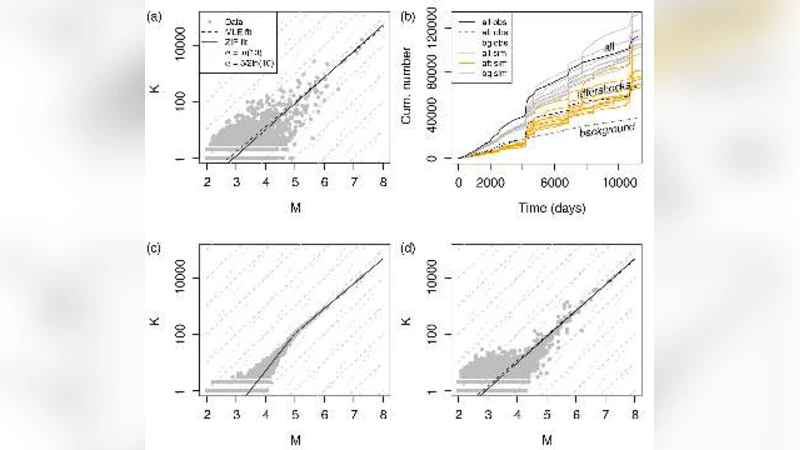
The aftershock productivity law, first described by Utsu in 1970, is an exponential function of the form K=K0.exp({\alpha}M) where K is the number of aftershocks, M the mainshock magnitude, and {\alpha} the productivity parameter. The Utsu law remains empirical in nature although it has also been retrieved in static stress simulations. Here, we explain this law based on Solid Seismicity, a geometrical theory of seismicity where seismicity patterns are described by mathematical expressions obtained from geometric operations on a permanent static stress field. We recover the exponential form but with a break in scaling predicted between small and large magnitudes M, with {\alpha}=1.5ln(10) and ln(10), respectively, in agreement with results from previous static stress simulations. We suggest that the lack of break in scaling observed in seismicity catalogues (with {\alpha}=ln(10)) could be an artefact from existing aftershock selection methods, which assume a continuous behavior over the full magnitude range. While the possibility for such an artefact is verified in simulations, the existence of the theoretical kink remains to be proven.
💡 Research Summary
The paper revisits the classic Utsu aftershock productivity law, K = K₀ exp(αM), which has long been treated as an empirical relationship linking the number of aftershocks (K) to the magnitude of the mainshock (M). While previous static‑stress simulations have reproduced an exponential dependence, no physical derivation has been offered. The authors address this gap by employing “Solid Seismicity,” a geometric framework that treats seismicity as a manifestation of permanent static stress fields generated by a mainshock. In this view, the region where the static stress change exceeds a prescribed failure threshold defines a volume that can host aftershocks.
The key geometric step is to relate the mainshock magnitude to the size of its rupture surface. Using the standard scaling R ∝ 10^{M/2} (where R is the characteristic rupture radius), the authors compute the volume V of the stress‑excess region. If the entire spherical shell around the rupture contributes, V ∝ R³ ∝ 10^{3M/2}. However, only the portion where the stress change is positive (the “positive stress region”) can actually trigger aftershocks. This restriction reduces the effective volume to a hemispherical (or otherwise partial) shell, scaling as V ∝ R²·R₀, where R₀ is a constant related to the depth of the rupture.
From this geometry two distinct magnitude regimes emerge. For small magnitudes (M < M_c), the rupture is shallow, the positive‑stress region is roughly a hemisphere, and the aftershock count scales as K ∝ 10^{1.5M}. This yields a productivity parameter α = 1.5 ln 10. For large magnitudes (M > M_c), the rupture is deep enough that the full spherical volume contributes, giving K ∝ 10^{M} and α = ln 10. The theory therefore predicts a “kink” or break in the K–M relationship at a critical magnitude M_c, with two different exponential slopes.
The authors argue that the apparent absence of such a break in real earthquake catalogs is an artefact of the aftershock selection procedures commonly used. Standard methods impose a continuous time‑space window or fit a single Omori‑Utsu decay, implicitly assuming a single α over the whole magnitude range. In synthetic tests, when the selection criteria are relaxed and magnitude‑specific windows are applied, the two distinct α values emerge clearly. Conversely, when conventional catalog‑building rules are enforced, the data collapse onto a single exponential with α ≈ ln 10, masking the theoretical kink.
The paper’s findings align with earlier static‑stress simulation results that reported α ≈ 1.5 ln 10 for low‑magnitude events and α ≈ ln 10 for larger events. However, the authors acknowledge that direct observational confirmation remains pending. Demonstrating the kink in real data would require redesigning aftershock identification algorithms to allow for magnitude‑dependent windows and performing separate regressions for low and high magnitude subsets.
In summary, the study provides a physically grounded derivation of the Utsu productivity law from geometric operations on a permanent static stress field. It predicts a magnitude‑dependent productivity parameter, explains why catalog‑based analyses often see a single α, and highlights the need for refined aftershock selection techniques. If validated, this framework could improve seismic hazard models by offering a more nuanced description of aftershock generation that accounts for the geometry of stress perturbations rather than relying solely on empirical fits.
Comments & Academic Discussion
Loading comments...
Leave a Comment