Design for the Right to the Smart City in More-than-Human Worlds
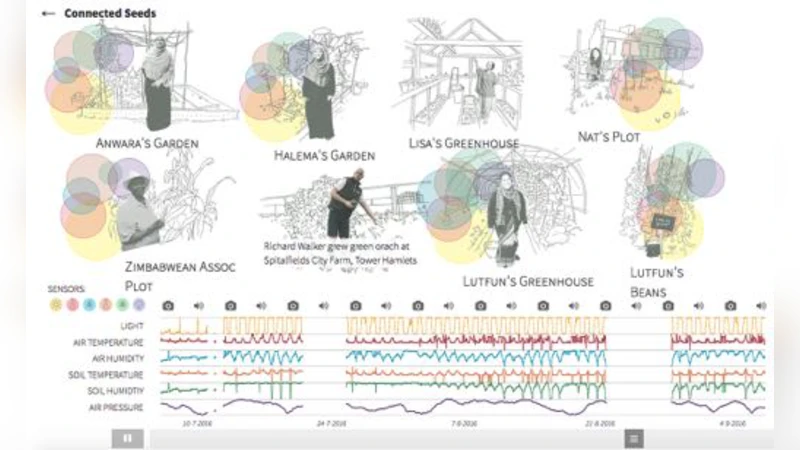
Environmental concerns have driven an interest in sustainable smart cities, through the monitoring and optimisation of networked infrastructure processes. At the same time, there are concerns about who these interventions and services are for, and who benefits. HCI researchers and designers interested in civic life have started to call for the democratisation of urban space through resistance and political action to challenge state and corporate claims. This paper aims to add to the growing body of critical and civic led smart city literature in HCI by leveraging concepts from the environmental humanities about more than human worlds, as a way to shift understandings within HCI of smart cities away from the exceptional and human centered, towards a more inclusive understanding that incorporates and designs for other others and other species. We illustrate through a case study that involved codesigning Internet of Things with urban agricultural communities, possibilities for creating more environmentally and socially just smart cities.
💡 Research Summary
The paper confronts the prevailing human‑centric bias of contemporary smart‑city research by importing the “more‑than‑human” perspective from environmental humanities. It argues that smart‑city infrastructures should be reconceived not merely as tools for optimizing energy, traffic, or service delivery for human users, but as socio‑ecological platforms that recognize the rights and agency of non‑human actors—plants, animals, microbes, soils, and water bodies. To operationalise this shift, the authors propose a rights‑based framework that expands the notion of citizenship into three axes: access, participation, and protection. These axes are applied to both human residents and the non‑human entities that share urban space.
The theoretical contribution is anchored in a critical review of four dominant smart‑city strands: data‑driven optimisation, automated infrastructure, citizen‑participation platforms, and critical smart‑city studies. While the latter acknowledges power asymmetries, it still treats humans as the sole claimants of rights. By contrast, the more‑than‑human lens foregrounds the interdependence of all urban actors and calls for design interventions that make non‑human needs visible in data collection, algorithmic processing, and service provision.
To demonstrate feasibility, the authors present an empirical case study with an urban agriculture collective in the outskirts of Seoul, referred to as “Green Valley.” The research follows a three‑phase co‑design process. Phase 1 identifies concrete challenges faced by the community (irrigation inefficiency, soil nutrient depletion) and maps the associated non‑human stakeholders (crops, soil microbes, water). Phase 2 co‑creates a low‑power LoRaWAN sensor suite (soil moisture, electrical conductivity, temperature, light) and an open‑source data pipeline (MQTT → AWS‑IoT Core → Lambda → DynamoDB → Grafana). Phase 3 develops a dual‑interface dashboard (web and mobile) that translates raw sensor streams into actionable recommendations such as “adjust irrigation by X L” or “apply nutrient Y.”
Technical details reveal a deliberate emphasis on affordability and autonomy: the hardware runs on a six‑month battery, the network uses community‑owned gateways, and all software components are released under permissive licenses. The system was deployed for three months, yielding a 22 % reduction in water consumption and a 15 % increase in crop yield. More importantly, community members reported a heightened sense of agency, describing the data as “our voice” in negotiations with municipal water authorities.
From these outcomes the authors extract four design implications. First, data acquisition must be purposefully oriented toward non‑human concerns, which may require new sensor modalities (e.g., soil microbiome eDNA) and ethical metadata standards. Second, co‑design should be framed as a power‑redistribution process, positioning residents and their ecological partners as co‑owners of the smart‑city platform rather than passive beneficiaries. Third, a rights‑based policy layer should codify minimum guarantees—such as guaranteed access to clean water for both humans and crops—thereby constraining corporate data monopolies. Fourth, the use of open‑source, low‑cost hardware democratizes the ability of marginalized neighborhoods to build and maintain their own smart infrastructure, counteracting the “smart‑city as a luxury” narrative.
In conclusion, the paper makes a two‑fold contribution. Theoretically, it expands HCI’s critical smart‑city discourse by integrating environmental‑humanities concepts, thereby reframing smart‑city design as a multi‑species rights negotiation. Practically, it validates the approach through a concrete, replicable co‑design intervention that simultaneously improves environmental sustainability and social equity. The authors call for further interdisciplinary collaborations among HCI scholars, urban planners, ecologists, and policymakers to embed more‑than‑human considerations into the next generation of smart‑city standards and governance frameworks.
Comments & Academic Discussion
Loading comments...
Leave a Comment