On the convergence of discrete-time linear systems: A linear time-varying Mann iteration converges iff the operator is strictly pseudocontractive
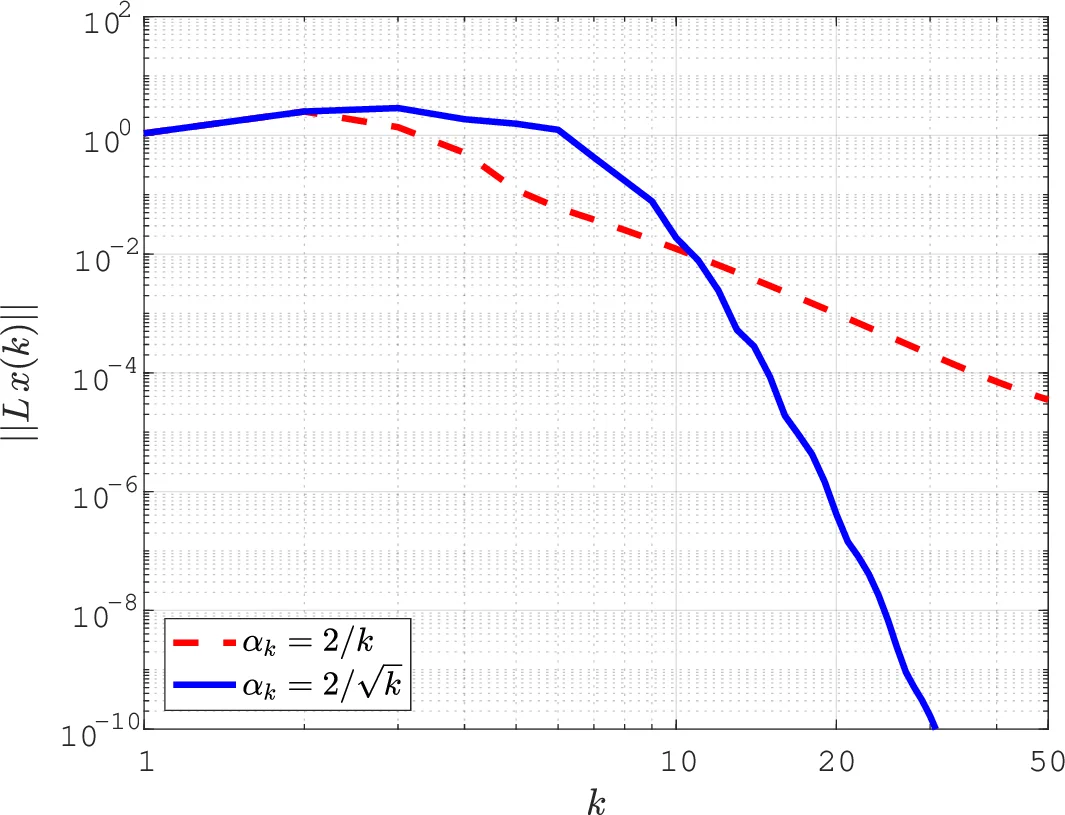
We adopt an operator-theoretic perspective to study convergence of linear fixed-point iterations and discrete- time linear systems. We mainly focus on the so-called Krasnoselskij-Mann iteration x(k+1) = ( 1 - \alpha(k) ) x(k) + \alpha(k) A x(k), which is relevant for distributed computation in optimization and game theory, when A is not available in a centralized way. We show that convergence to a vector in the kernel of (I-A) is equivalent to strict pseudocontractiveness of the linear operator x -> Ax. We also characterize some relevant operator-theoretic properties of linear operators via eigenvalue location and linear matrix inequalities. We apply the convergence conditions to multi-agent linear systems with vanishing step sizes, in particular, to linear consensus dynamics and equilibrium seeking in monotone linear-quadratic games.
💡 Research Summary
The paper investigates the convergence properties of linear fixed‑point iterations, focusing on the Krasnoselskij–Mann scheme
\
Comments & Academic Discussion
Loading comments...
Leave a Comment