Mixed Malaga-$mathcal{M}$ and Generalized-$cal K$ Dual-Hop FSO/RF Systems with Interference
This paper investigates the impact of radio frequency (RF) cochannel interference (CCI) on the performance of dual-hop free-space optics (FSO)/RF relay networks. The considered FSO/RF system operates over mixed M\'alaga-$\mathcal{M}$/composite fading…
Authors: Im`ene Trigui, Nesrine Cherif, Sofi`ene Affes
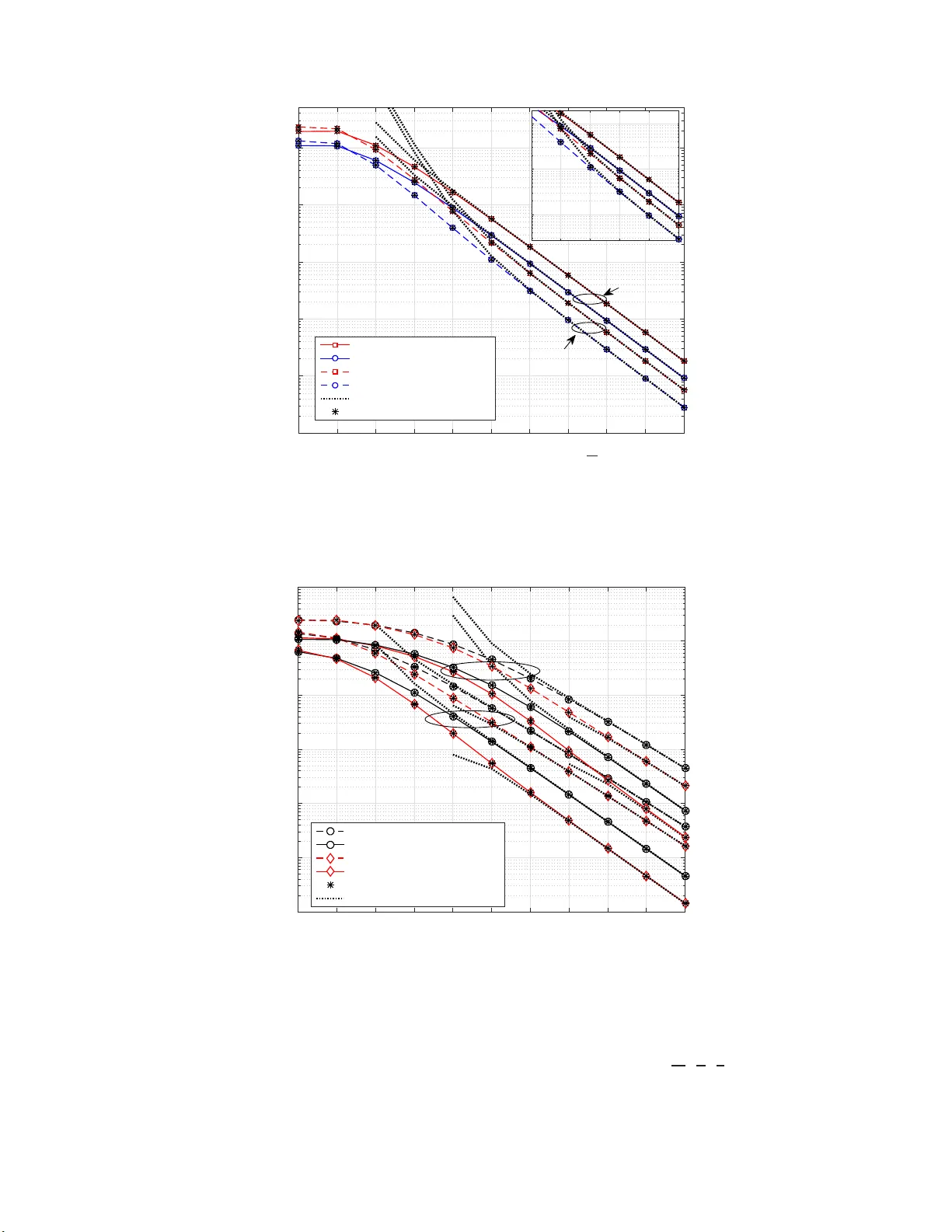
1 Mix ed M ´ alaga - M and G eneralized- K Dual-Hop FSO/RF Systems with Interfe rence Im ` ene T rigui, Member , IEEE , Nesrine Cherif, Sofi ` ene Af fes, Senior Member IEEE , Xianbin W ang, Fello w , IEEE , and V ictor C. M. Leung, Fello w , IEEE . Abstract This paper invest igates the impact of rad io frequency (RF) cochannel interference (CCI) on the perfor mance of dual-ho p free-spac e optics (FSO)/RF relay networks. Th e con sidered FSO/RF system operates over mixed M ´ alaga- M /co m posite fading/shadowing gen e ralized- K ( G K ) channels with pointing errors. The H-transfor m the o ry , wherein in tegral transforms in volve Fox’ s H- f unction s as kernels, is embodied into a u nifying perform ance analysis fra m ew ork that encompasses closed-fo rm expr essions for the outage probability , the a verage bit error rate (BER), and the ergodic capacity . By vir tue of som e H-transfor m asymptotic expan sions, the high signal-to- interferen ce-plus-n oise ratio (SINR) analy sis culminates in easy-to-compute expressions f or the o utage probability and BER. I . I N T RO D U C T I O N Free-space optics (FSO) commun ication has recently drawn a significant attention as one promising solution to cope with radio frequency (RF) wi reless spectrum scarcity [1]. Though securing high data rates, FSO communicati o ns performance signi ficantly degrades d u e to atmo- spheric t urbulence-induced fading and st rong path-los s [2]. Aiming t o address t hese sho rtcom- ings, relay-assisted FSO systems hav e been actually identified as an influenti al sol u tion to provide more ef ficient and wider networks. As such, understandin g the fundamental system performance limits of mi xed FSO/RF architectures has att racted a lot of research endeav o r in the past decade (cf. [3], [4] and references therein). Up until recent past, the performance of relay-assist ed FSO systems was inv estigated assuming sev eral irradiance probability density fun ction (PDF) mo d els wi th different degree s of s uccess W ork supported by the Discovery Grants and the CREA TE PE RSW ADE (www .create-perswade.ca) programs o f NSERC, a Discov ery Accelerator Supplement (DAS) A ward from NSERC, and t he NSERC SPG Project on Ad vanc ed Signal Processing and Networking T echniques for Cost-Effecti ve Ultra-Dense 5G Networks. This work was presen ted at the IEEE PIMRC 2017. 2 out of which the most c omm only utilized models ar e the lognormal [5] and the Gamma-Gamma [6] PDF s. Recently , a ne w g eneralized statistical model, the M ´ alaga- M , unifyin g most s t atistical models exploited so far and able t o better reflect a wider range of turbulence conditions was proposed i n [7], [8]. Sev eral performance stud i es of FSO link operating over M ´ alaga- M turbulent channels wit h and witho ut poi nting errors have been conducted in [4], [9]. On the RF side, pre vious works typically assum e either Nakagami- m [3], [6] or Rayleigh [10], [11] fading, thereby lacking the flexibility to account for disparate signal propagation mechanis ms as those characterized in 5G communi cations which will accomm o date a wide range of usage scenarios with div erse link requirements. In fact, in 5G comm u nications d esi gn, the combi ned ef fect of small-scale and shadowed fading n eeds to be prop erly addressed. Shadowing, which is due to obstacles in the l ocal en vironment or human body (user equipm ents) movements, can i mpact l ink performance b y causing fluctuat i ons i n th e recei ved signal. For instance, the shadowing effec t comes to prominence in millim eter wav e (mmW ave) communi cati ons due to their h igher carrier frequency . In this respect, the generalized- K ( G K ) model was proposed by combining Nakagami- m mul t ipath fading and Gamm a-Gamma distributed shadowing [12 ],[13]. While F SO transmissions are rob ust to RF interference, m ixed FSO/RF systems are inherently vulnerable to the harmful ef fect of co-channel in t erference (CCI) through the RF li nk (cf. [14] and references therein). Previous contributions per taining t o FSO relay-assi s ted communication s [3]- [11] relied on the absence of CCI. Re cently , the re cogniti o n o f th e interference -limi t ed n atu re of emerging commu n ication sys tems has motiv ated [15] to account for CCI in the performance analysis of mixed decode and forward RF/FSO systems . Besides ig n oring the shadowing effect on the RF link , [15] ass umes a restrictive Gamma-Gamma model on the FSO l ink. In th i s paper , motiv ated by the aforementioned challenges, we assess the im pact of RF CCI on th e performance o f dual-hop amplify and forward (AF) mixed FSO/RF s ystems operatin g over M ´ alaga- M and composi te fading shadowing generalized- K ( G K ) channels, respectiv ely . Assuming fixed-gain and CSI-assisted relaying schem es and taking into account the effec t of pointi ng errors while consid ering both h et erody n e and intensit y modulation /direct (IM/DD) detection techni q ues, we present a comp rehensiv e performance analysis b y exploiting s em inal results form the H-transform theory . In additio n , we present asymptotic expressions for the outage probability and th e av erage BER at hig h SINR and we deriv e the dive rsity g ain. The remainder of this paper is or ganized as follows. W e describe the system model in Section II. In Section III, we present th e unifying H-transform analysis of the end-to-end SINR statis tics 3 Fig. 1: A dual-hop interference -limited mixed FSO/RF relay system. for both fixed-gain and CSI-assisted relays. Then, i n section IV , we deriv e exact closed-form expressions for the outage probabilit y , th e av erage BER, and the er godic capacity fol l owed by the asym ptotic expressions at high SINR. Section V presents som e num erical and sim ulation results to illust rate the mathematical formalism presented in the previous sec tions . Finally , so m e concluding remarks are drawn out in Section VI. I I . C H A N N E L A N D S Y S T E M M O D E L S W e consid er a downlink of a relay-assisted network featuring a mixed FSO/RF comm unication. W e assume that t he opt i cal source ( S ) comm unicates w i th t he destination ( D ) i n a dual-hop fashion t hrough an intermediate relay ( R ). The lat t er is able to activ ate either heterodyne or IM/DD detection techniques at the reception of the opti cal beam. Using AF relaying, the relay amplifies t he recei ved opti cal sig n al and retransm i ts it t o the d estination wi th M R T using N antennas. W e assum e that the destin ation is subject to inter-cell i nterference ( I ) brought by L co-channel RF s o urces in the network (cf. Fig.1). The optical ( S - R ) channel foll ows a M ´ alaga- M distribution for whi ch t he CDF of th e instantaneous SNR γ 1 in th e presence of pointing errors is given b y F γ 1 ( x ) = ξ 2 Ar Γ( α ) β X k =1 b k Γ( k ) H 3 , 1 2 , 4 " B r x µ r (1 , r ) , ( ξ 2 + 1 , r ) ( ξ 2 , r ) , ( α, r ) , ( k , r ) , ( 0 , r ) # , (1) where ξ i s the ratio between the equiv alent beam radiu s and t he poi n ting error displ acement standard de viation (i.e., jitt er) at the relay (for negligible po i nting errors ξ → + ∞ ) [2], A = α α 2 [ g β / ( g β + Ω)] β + α 2 g − 1 − α 2 and b k = β − 1 k − 1 ( g β + Ω) 1 − k 2 [( g β + Ω) /α β ] α + k 2 (Ω /g ) k − 1 ( α/β ) k 2 , where α , β , g and Ω are the fading parameters related to the atmos p heric turbulence conditions [9]. It may be useful to m ention that g = 2 b 0 (1 − ρ ) where 2 b 0 is the avera ge power of the LOS term and ρ represents the amoun t of scattering p ower coupled t o the LO S component 4 ( 0 6 ρ i 6 1 ). M oreover in (1), H m,n p,q [ · ] and Γ( · ) stand for th e Fox-H function [16, Eq.(1.2)] and the incomplete gamma functi on [17, Eq.(8.3 1 0.1)], respectiv ely , and B = αβ h ( g + Ω) / [( g β + Ω)] with h = ξ 2 / ( ξ 2 + 1) . Furthermo re, r is the parameter that describes th e detection technique at the relay (i.e., r = 1 is associated with heterodyne detection and r = 2 is associated with IM/DD) and, µ r refers to the electrical SNR of the FSO hop [9]. In particular , for r = 1 , µ 1 = µ heterod yne = E [ γ 1 ] = ¯ γ 1 , (2) and for r = 2 , it becomes [9, Eq.(8)] µ 2 = µ IM/DD = µ 1 αξ 2 ( ξ 2 + 1) − 2 ( ξ 2 + 2 ) ( g + Ω) ( α + 1)[2 g ( g + 2Ω) + Ω 2 (1 + 1 β )] . (3) The RF ( R - D ) and ( I - D ) links are assumed to follow generalized- K fading d istributions. Hence the probability densit y function (PDF) of the instantaneous SNR (respecti vely INR), γ X D , X ∈ ( R, I ) , is given by [12, Eq.(5)] f γ X D ( x ) = 2 m X κ X ¯ γ X D κ X + δ X m X 2 x κ X + δ X m X 2 − 1 Γ( δ X m X )Γ( κ X ) K κ X − δ X m X 2 r κ X m X x ¯ γ X D , (4) where X ∈ { R , I } and K ν ( · ) stands for the modi fied Bessel function of the second kind [17, Eq.(8.407.1)]. Moreover , m X > 0 . 5 and κ X > 0 denot e the multi p ath fading and s h adowing sev erity of the X - D th channel coefficient, respectiv ely . Moreov er , δ X = { N , L } for X ∈ { R, I } follows form the conservation property under the summ ation of N and L i .i.d . (independent identically d i stributed) G K random v ariables. Th e interfering signals are assumed to propagate through i.i.d G K channels with parameters m I and κ I . Using [17, Eq. (9. 3 4.3)], the PDF of the G K di s tribution can b e represented in terms of the Meijer’ s-G function as f γ X D ( x ) = m X κ X ¯ γ X D Γ( δ X m X )Γ( κ X ) G 2 , 0 0 , 2 " κ X m X ¯ γ X D x − δ X m X − 1 , κ X − 1 # . (5) The CDF of th e signal-to-interference ratio (SIR) γ 2 = γ RD /γ I D under G K f ading can be derived from a recent result in [13, Lem ma 1] as F γ 2 ( x ) = 1 − 1 Γ( N m )Γ( κ )Γ( Lm I )Γ( κ I ) G 3 , 2 3 , 3 " κmx κ I m I ¯ γ 2 1 − κ I , 1 − Lm I , 1 0 , κ, N m # , (6) where ¯ γ 2 = ¯ γ RD / ¯ γ I D is the a verage SIR of the R F link where, for con s istency , we hav e dropped the subscript R from th e parameters m R and κ R . 5 In the fixed-gain relaying scheme, the end-to-end SINR at the destination can be expressed as [18, Eq.(2)] γ = γ 1 γ 2 γ 2 + C , (7) where C stand s for the fixed gain at th e relay . Whereas, the end-to-end SINR wh en CSI-assisted relaying schem e is considered is expressed as [10, Eq.(7)] γ = γ 1 γ 2 γ 1 + γ 2 + 1 . (8) I I I . E N D - T O - E N D S TA T I S T I C S A. F ixed-Gain Relaying The CDF of the end-to-end SINR of int erference-limited du al-h o p FSO/RF systems using a fixed-gain relay in M ´ alaga- M / G K fading under both heterodyne detection and IM/DD is given by F γ ( x ) = ξ 2 Aκm C Γ( α )Γ( N m )Γ( κ )Γ( Lm I )Γ( κ I ) κ I m I ¯ γ 2 β X k =1 b k Γ( k ) H 0 , 1:0 , 3:4 , 3 1 , 0:3 , 2:4 , 5 µ r B r x κm C κ I m I ¯ γ 2 (0 , 1 , 1) − ( δ, ∆) ( λ, Λ) ( χ, X ) ( υ , Υ) , (9) where H m 1 ,n 1 : m 2 ,n 2 : m 3 ,n 3 p 1 ,q 1 : p 2 ,q 2 : p 3 ,q 3 [ · ] denotes the Fox-H function (FHF) of two variables [19, Eq.(1.1)] also known as the biva riate FHF whos e Mathematica implementati o n may be found in [20, T able I], whereby ( δ , ∆) = (1 − ξ 2 , r ) , (1 − α, r ) , (1 − k , r ) ; ( λ , Λ) = (0 , 1) , ( − ξ 2 , r ) ; ( χ, X ) = ( − 1 , 1) , ( − κ I , 1) , ( − Lm I , 1) , (0 , 1) ; and ( υ , Υ) = ( − 1 , 1) , ( − 1 , 1) , ( κ − 1 , 1) , ( N m − 1 , 1) , ( 0 , 1) Pr oof: See Appendix A. The PDF of the end-to-end SINR γ in mixed M ´ alaga- M / G K is obtained as f γ ( x ) = − ξ 2 Aκm C x Γ( α )Γ( N m )Γ( κ )Γ( Lm I )Γ( κ I ) κ I m I ¯ γ 2 β X k =1 b k Γ( k ) H 0 , 1:0 , 3:4 , 3 1 , 0:3 , 2:4 , 5 µ r B r x κm C κ I m I ¯ γ 2 (0 , 1 , 1) − ( δ, ∆) ( λ ′ , Λ ′ ) ( χ, X ) ( υ , Υ) , (10) 6 where ( λ ′ , Λ ′ ) = (1 , 1 ) , ( − ξ 2 , r ) . Pr oof: Th e result fol lows from di ff erentiating the Mell in-Barnes in t egral in (9) over x using dx − s dx = − sx − s − 1 with Γ ( s + 1) = s Γ( s ) and appl y i ng [16, Eq.(2.57)]. B. CSI-Assisted R elaying Due to th e intractability of the SINR in (8), we resort to an u pper bo u nd giv en by [10, Eq.(20)] as γ = min( γ 1 , γ 2 ) > γ 1 γ 2 / ( γ 1 + γ 2 + 1) , whose CDF can be e xpressed as F γ ( x ) = 1 − F ( c ) γ 1 ( x ) F ( c ) γ 2 ( x ) , where F ( c ) γ 1 and F ( c ) γ 2 stand for the compl em entary CDF of γ 1 and γ 2 , respectiv ely . Hence, using [4, Eq.(8)] and (6), the CDF of dual-ho p FSO/RF systems employing a CSI-assisted relaying schem e can be obtained as F γ ( x ) = 1 − ξ 2 A Γ( α )Γ( N m )Γ( κ )Γ( Lm I )Γ( κ I ) β X k =1 b k Γ( k ) G 4 , 0 2 , 4 " B x µ r 1 r ξ 2 + 1 , 1 0 , ξ 2 , α, k # G 3 , 2 3 , 3 " κmx κ I m I ¯ γ 2 1 − κ I , 1 − Lm I , 1 0 , κ, N m # . (11) I V . P E R F O R M A N C E A N A L Y S I S O F F I X E D - G A I N R E L AY I N G A. Outage Pr obability The quality of s ervice (QoS) of the consi dered mixed FSO/RF syst em is ensured by keeping the instantaneous end-to-end SNR, γ , abov e a threshold γ th . The outage probability of th e con s idered mixed FSO/RF system fol l ows from (9) as P out = F γ ( γ th ) . (12) At high n o rm alized a verage SNR in the FSO l ink ( µ r γ th → ∞ ), t h e outage probability of the system under consideratio n is obtained as P out ≈ µ r γ th ≫ 1 ξ 2 A κm κ I m I C Γ( α )Γ( N m )Γ( κ )Γ( Lm I )Γ( κ I ) ¯ γ 2 β X k =1 b k Γ( k ) Γ( α − ξ 2 )Γ( k − ξ 2 ) r Γ(1 − ξ 2 r ) Ξ γ th , ξ 2 r + Γ( ξ 2 − α )Γ( k − α ) r Γ(1 − α r )Γ(1 + ξ 2 − α ) Ξ γ th , α r + Γ( ξ 2 − k )Γ( α − k ) r Γ(1 − k r )Γ(1 + ξ 2 − k ) Ξ γ th , k r + B r γ th µ r H 7 , 3 6 , 8 " κm C B r γ th κ I m I ¯ γ 2 µ r ( σ , Σ) ( φ, Φ) # ! , (13) where Ξ( x, y ) = B r x µ r y G 4 , 4 5 , 5 κm C κ I m I ¯ γ 2 − κ I , − Lm I , − 1 , y , 0 κ − 1 , N m − 1 , − 1 , − 1 , 0 , (14) 7 ( σ , Σ) = ( − κ I , 1) , ( − Lm I , 1) , ( − 1 , 1 ) , (0 , 1) , (1 + ξ 2 − r , r ) , (0 , 1) , and ( φ, Φ) = ( ξ 2 − r , r ) , ( α − r , r ) , ( k − r , r ) , ( κ − 1 , 1 ) , ( N m − 1 , 1) , ( − 1 , 1 ) , ( − 1 , 1) , (0 , 1) . Pr oof: Resorting t o t he Mellin-Barnes representation of the biv ariate FHF [16, Eq.(2.57)] in (9) and applying [21, Theorem 1.7] yield (13) after some additional algebraic manipu lations. Furthermore, when ¯ γ 2 → ∞ , then by applying [21, Theorem 1.11] to (13) while only keeping the dom inant term, the diversity gain for FSO/RF sy s tems with pointing errors over M ´ alaga- M / G K fading conditions can be shown to be equal to G d = min N m, κ, ξ 2 r , α r , k r . (15) In particular , under Nakagami- m f ading, i.e., when κ → ∞ , we obtain G d = min N m, ξ 2 r , α r , k r [3, Eq. 29]. B. A verage Bit-Error Rate The av erage error probabilit y for the consi d ered dual-hop mixed RF/FSO AF relay system with interference at the dest i nation and po i nting errors at the FSO link under both het erody ne and IM/DD detectio n techniqu es is analytically deriv ed as P e = ξ 2 Aϕκm C 2Γ( α )Γ( p ) Γ( N m )Γ( κ )Γ( Lm I )Γ( κ I ) κ I m I ¯ γ 2 n X j =1 β X k =1 b k Γ( k ) H 0 , 1:1 , 3:4 , 3 1 , 0:3 , 3:4 , 5 µ r q j B r κm C κ I m I ¯ γ 2 (0 , 1 , 1) − ( δ, ∆) ( p, 1) , ( λ, Λ) ( χ, X ) ( υ , Υ) . (16) Pr oof: The av erage BER can be written in terms of the CDF of t he end-to-end SINR as P e = ϕ 2Γ( p ) n X j =1 q p j Z ∞ 0 e − q j x x p − 1 F γ ( x )d x, (17) where Γ( · , · ) stands for the incomplete Gamm a function [17, Eq.(8.350.2)] and the p arameters ϕ , n , p and q j account for dif ferent modulations schemes [12]. Now , substituting the Mell in-Barnes integral form of (9) using [16, Eq.(2.5 6)] into (17), and resorting to [17, Eq.(7.811.4)] yield (16) after som e manipulations . 8 At hig h FSO SNR (i.e. µ r → ∞ ), t he asymptotic average BER is derived as P e ≈ µ r ≫ 1 ξ 2 Aϕκm C 2Γ( α )Γ( p ) Γ( N m )Γ( κ )Γ( Lm I )Γ( κ I ) κ I m I ¯ γ 2 n X j =1 β X k =1 b k Γ( k ) " Γ( α − ξ 2 )Γ( k − ξ 2 ) r Γ(1 − ξ 2 r ) Ξ 1 q j ξ 2 r + Γ( ξ 2 − α )Γ( k − α ) r Γ(1 − α r )Γ(1 + ξ 2 − α ) Ξ 1 q j , α r + Γ( ξ 2 − k )Γ( α − k ) r Γ(1 − k r )Γ(1 + ξ 2 − k ) Ξ 1 q j , k r + B r µ r q j H 7 , 4 7 , 8 " κm C B r κ I m I ¯ γ 2 µ r q j ( σ ′ , Σ ′ ) ( φ, Φ) # # , (18) where ( σ ′ , Σ ′ ) = ( − κ I , 1) , ( − Lm I , 1) , ( − 1 , 1 ) , ( − p, 1) , (0 , 1) , (1 + ξ 2 − r , r ) , ( 0 , 1) . Pr oof: The asympto tic BER fol lows along t he same lines as (13). C. Er go dic Capacity The ergodic capacity of a m i xed M ´ alaga- M /interference-limited G K transmissio n sy s tem under both detecti o n techniq u es with pointi n g errors at t he FSO link is obtained as C = ξ 2 Aκm C 2 ln(2)Γ( α )Γ( N m )Γ( κ )Γ( Lm I )Γ( κ I ) κ I m I ¯ γ 2 β X k =1 b k Γ( k ) H 0 , 1:1 , 4:4 , 3 1 , 0:4 , 3:4 , 5 µ r B r x κm C κ I m I ¯ γ 2 (0 , 1 , 1) − ( δ, ∆) , (1 , 1 ) (0 , 1)( λ ′ , Λ ′ ) ( χ, X ) ( υ , Υ) . (19) Pr oof: The er godic capacity C = 1 2 E [ln 2 (1 + γ )] follows from av eraging ln(1 + γ ) = G 1 , 2 2 , 2 [ γ | 1 , 1 1 , 0 ] over the end-to-end SINR PDF obtained in (10) while resorti ng to [19, Eq. (1. 1 )] and [17, Eq.(7.811.4)] with some manipul ations. The M ´ alaga- M reduces to Gamma-Gamma fading when ( g = 0 , Ω = 1 ), whence all terms in (1) vanish except for the term when k = β . Hence, when g = 0 , Ω = 1 , κ, κ I → ∞ , (19) reduces, when r = 1 , to the ergodic capacity of mixed Gamma-Gamm a FSO/interference-limited Nakagami- m RF transmi s sion with heterodyne detection as given by C = ξ 2 2 ln(2)Γ( N m )Γ( Lm I )Γ( α )Γ( β ) G 1 , 0:1 , 4:3 , 2 1 , 0:4 , 3:4 , 3 " µ 1 αβ h ; m C m I ¯ γ 2 1 − 1 − ξ 2 , 1 − α, 1 − β , 1 1 , 0 , − ξ 2 1 − Lm I , 1 , 0 N m, 0 , 1 # , (20) 9 where G p,q ,k , r,l a, [ c,e ] , b, [ d,f ] [ · , · ] is the generalized M eijer’ s G- function and is used to represent the product of three Mei j er’ s-G funct i ons i n a closed-form [22]. V . P E R F O R M A N C E A N A L Y S I S O F C S I - A S S I S T E D R E L A Y I N G A. Outage Pr obability Based on (11), the outage probabil ity of CSI-assisted mixed M ´ alaga- M turbulent/ G K systems with int erference under both detection techni q ues with poi n ting errors can be lower bounded by P lb out = 1 − ξ 2 Ar Γ( α )Γ( N m )Γ( κ )Γ( Lm I )Γ( κ I ) β X k =1 b k Γ( k ) H 0 , 0:4 , 0:3 , 2 0 , 0:2 , 4:3 , 3 B r γ th µ r κmγ th κ I m I ¯ γ 2 (0 , 1 , 1 ) − ( δ 1 , ∆ 1 ) ( λ 1 , Λ 1 ) ( χ 1 , X 1 ) ( υ 1 , Υ 1 ) , (21) where ( δ 1 , ∆ 1 ) = ( ξ 2 + 1 , r ) , (1 , r ) , ( λ 1 , Λ 1 ) = ( 0 , r ) , ( ξ 2 , r ) , ( α, r ) , ( k , r ) , ( χ 1 , X 1 ) = ( 1 − κ I , 1) , (1 − Lm I , 1) , (1 , 1) , and ( υ 1 , Υ 1 ) = (0 , 1 ) , ( κ, 1) , ( N m, 1) . B. A verage Bit-Error Rate The avera ge BER of a mixed FSO/interference-limited RF CSI-assisted relaying s ystem in M ´ alaga- M turbulent with point ing errors/ G K fading channels under both detection techniques is obt ained as P e = ϕn 2 − ξ 2 Ar ϕ 2Γ( p )Γ( α ) Γ( N m )Γ( κ )Γ( Lm I )Γ( κ I ) n X j =1 β X k =1 b k Γ( k ) H 0 , 1:4 , 0:3 , 2 1 , 0:2 , 4:3 , 3 B r µ r q j κm κ I m I ¯ γ 2 q j (1 − p, 1 , 1) − ( δ 1 , ∆ 1 ) ( λ 1 , Λ 1 ) ( χ 1 , X 1 ) ( υ 1 , Υ 1 ) . (22) Pr oof: Substituting (11) into (17) and resorting to [16, Eq.(1.59)] and [19, Eq.(2.2)] yield the result after some manipulation s. 10 C. Er go dic Capacity The er godic capacity of a mixed FSO/interference-limited RF CSI-assisted relaying system in M ´ alaga- M / G K fading channels under b o th detecti o n techniq u es is expressed by C = ξ 2 Ar µ r 2 ln(2)Γ( α )Γ( N m )Γ( κ )Γ( Lm I )Γ( κ I ) B r β X k =1 b k Γ( k ) H 0 , 1:1 , 4:3 , 3 1 , 0:4 , 3:3 , 4 µ r B r κ I m I ¯ γ 2 κm (0 , 1 , 1) − ( δ 2 , ∆ 2 ) ( λ 2 , Λ 2 ) ( χ 2 , X 2 ) ( υ 2 , Υ 2 ) , (23) where ( δ 2 , ∆ 2 ) = (1 − r , r ) , (1 − ξ 2 − r ,r ) , (1 − α − r,r ) , (1 − k − r,r ) , ( λ 2 , Λ 2 ) = (1 , 1 ) , ( 1 − κ, 1) , ( 1 − N m, 1 ) , ( χ 2 , X 2 ) = (1 , 1 ) , ( 1 − κ, 1) , ( 1 − N m, 1) , and ( υ 2 , Υ 2 ) = (1 , 1 ) , ( κ I , 1) , ( Lm I , 1) , (0 , 1) . Pr oof: See Appendix B. It sh ould be mention ed th at when r = 1 and κ, κ I → ∞ , (23) reduces to the ergodic capacity of mixed FSO/interference-limited RF systems in M ´ alaga/Nakagami- m fading channels as gi ven by C = ξ 2 Aµ 1 2 ln(2) B Γ( α )Γ( N m )Γ( Lm I ) αβ h β X k =1 b k Γ( k ) G 1 , 0:1 , 4:2 , 2 1 , 0:4 , 3:2 , 3 " µ 1 αβ h ; m I ¯ γ 2 m 1 − 0 , − ξ 2 , − α, − k 0 , − ξ 2 − 1 , − 1 1 , 1 − N m 1 , Lm I , 0 # . (24) V I . N U M E R I C A L R E S U LT S In th is section, nu m erical examples are shown to subs tantiate the accurac y of t he new unified mathematical framework and to confirm i t s potential for analyzing mi xed FSO/RF comm uni- cations. Remarkably , all numerical result s obt ained by the direct e valuation o f the analytical expressions developed in this paper , are i n very good match with their Monte-Carlo stim u lated counterparts showing the accuracy and effe ctiveness of our n e w performance analysi s frame work. Unless stated otherwise, all simulati ons were carried out with the follo wing parameters: C = 1 . 7 , m I = 1 . 5 , κ I = 3 . 5 , and ¯ γ 2 = 2 0 dB. Fig. 2 illustrates the outage probabili t y of m ixed FSO/RF fixed-gain AF s y stems versus the FSO link n o rmalized a verage SNR in s t rong (i.e., α = 2 . 4 , β = 2 ) and weak (i.e., α = 5 . 4 , β = 4 ) turbulence condit ions, respectiv ely . The figure also in vestigates the effect of strong (i.e., ξ = 1 . 1 ) and weak (i.e., ξ = 6 . 8 ) pointing errors on the system performance. As expected, the 11 Norm alized Av era ge SNR of the FSO link µ r γ th in dB 0 5 10 15 20 25 30 35 40 45 50 Outa ge Probaba ilit y P out 10 -7 10 -6 10 -5 10 -4 10 -3 10 -2 10 -1 Strong T urbulence/W eak Poin ting Errors Strong T urbulence/Strong Poin ting Errors Moderate T urbu lence /Strong P ointing Errors Moderate T urbu lence/W eak Poin ting Errors Asymptotic Simulation IM/DD detection: r=2 Heterodyne detection: r=1 Fig. 2: Outage probabil ity of a fixed -gain mixe d RF/FSO system with interference under diffe rent turbulen ce and poi nting errors seve rities with N = L = 2 , m = 2 . 5 , and κ = 1 . 09 . outage probability deteriorates by decreasing the pointing error displacement standard de viation , i.e., for sm aller ξ , o r d ecreasing the t urbulence fading parameter , i.e., smaller α and β . At high SNR, the asymptotic expansion in (13) matches very well its exact counterpart, which confirms the validity of our mathemati cal analysi s for different parameter settings. On the ot her hand, we observe that heterodyne detection outperforms IM/DD in turbulent en vironments as p reviously observed in [9]. Fig. 3 depicts the outage probability o f fixed-gain mixed FSO/interference-limited RF syst em s with L = { 1 , 2 } versus th e FSO link no rmalized av erage SNR. As expected, increasing L deteriorates the system performance, by increasing the outage probabil ity while the di versity g ain remains unchanged. Once again we highl i ght the fact that the exact and asymptotic expansion in (13) agree very well at high SNRs. Actually , t he G K fading/shadowing parameters m and κ are important and affect the sys t em performance as sh own in Figs. 4 and 5 , respectively . W e can see that, hea vy shadowing (i.e., small κ ) and/or sev ere fading (i.e., small m ) are detrimental for the sy stem performance. In Fig. 5, we fix α = 2 . 4 , β = 2 , ξ = 6 . 8 , and r = 2 . Expect for κ = 0 . 6 , we notice that all curves hav e the sam e slopes thereby inferring that they have the same di versity order . This i s due t o the 12 Norm alized Av era ge SNR of the FSO link µ r γ th in dB 0 5 10 15 20 25 30 35 40 45 50 Outa ge Probabi lity 10 -7 10 -6 10 -5 10 -4 10 -3 10 -2 Strong P ointing Errors, L=2 Strong P ointing Errors, L=1 No P ointing Errors, L=2 No P ointing Errors, L=1 Asymptotic Simulation 20 25 30 35 40 10 -5 10 -4 10 -3 ξ = 1 . 1 ξ → + ∞ Fig. 3: Outage probabili ty of an interferenc e-limited fixed-g ain mixed RF/FSO system in strong turbulenc e condit ions for dif ferent va lues of L and ξ with N = L = 2 , m = 2 . 5 , and κ = 1 . 09 . Av erag e SNR of the FSO link µ r in dB 0 5 10 15 20 25 30 35 40 45 50 Av erag e BER 10 -7 10 -6 10 -5 10 -4 10 -3 10 -2 10 -1 Strong P ointing Errors/ m = 0 . 5 Strong P ointing Errors/ m = 2 . 5 No P ointing errors/ m=0.5 No P ointing errors/ m=2.5 Simulation Asymptotic 16-P SK Modulation BPS K Modula tion Fig. 4: A vera ge BER of an interference -limited fixed- gain mix ed RF/FSO syste m in strong turbul ence cond itions for diffe rent v alues of m with N = L = 2 , and κ = 1 . 09 . fact that the system diversity order is dependent on G d = min N m, κ, ξ 2 r , α r , k r . For the two curves when κ = 0 . 6 , they have the same slope re vealing equal diversity order d = κ . Figs . 4 13 Av erag e SNR of the FSO link µ r in dB 0 5 10 15 20 25 30 35 40 45 50 Av erag e BER 10 -8 10 -7 10 -6 10 -5 10 -4 10 -3 10 -2 10 -1 Simulation N=5 Simulation N=1 κ = 0 . 6 κ = 1 . 09 κ = 2 . 5 κ = 6 . 8 Asymptotic m = 1 , m I = 0 . 8 , and κ I = 3 . 5 Fig. 5: A vera ge BER of an interference -limited fixed- gain mix ed FSO/RF syste m in strong turb ulence conditi ons for dif ferent v alues of κ and the number of antenn as a t the relay N . and 5 also show that the asympt otic expansion i n (18) agrees very well wi t h the simulati on results, hence corroborating its accuracy . The impact of the number of relay antennas N on the system BER is in vestigated in Fig. 5 under sev eral shadowing conditions . As shown i n (15), spatial diversity resulting from employing a h i gher number of antennas N at t he relay enhances the overa ll system performance. Fig. 6 sho ws the impact of th e FSO link atmospheric turb ulence conditions on system capacity . W e can see th at that decreasing α and β (i.e., stronger turbulence conditions ) deteriorates the system capacity , notably when IM/DD is empl oyed. It is clear from this figure t hat weaker turbulence conditions l eads t o the situat i on where the RF link dominates the system performance thereby inhibitin g any performance i m provement coming from the FSO link. Fig. 7 illu strates the effe ct of th e atm ospheric t urbulence i nduced fading se verity in terms of the powe r amount cou pled to the LOS component i n the FSO link, ρ , on the performance of CSI-assisted relay mixed FSO/RF syst ems. E x p ectedly , as ρ increases, t h e s ystem performance ameliorates due to the reduction of the atm ospheric turbulence over the FSO link. W e highli ght once agai n the effi ciency of the heterodyne detection against the IM/DD technique. Fig. 8 in vestigates the effe ct of sh adowing se verity on the ergodic capacity of m ixed FSO/RF 14 Av erag e SNR of the FSO link µ r in dB 0 5 10 15 20 25 30 35 40 45 50 Ergodic Capa cit y [bps/ Hz] 0.5 1 1.5 2 2.5 3 Moderate T urb ulence Strong T urbulence Simulation IM/ DD detectio n Hete rodyne detectio n Fig. 6: E rgodic capaci ty of an interferenc e-limited fixed-gain mixed FSO/RF system in s trong and weak turbulenc e cond itions with N = L = 2 , m = 2 . 5 , and κ = 1 . 09 . Nor malize d Av erage SINR ¯ γ 1 γ th = ¯ γ 2 γ th in dB 0 5 10 15 20 25 30 35 40 45 50 Out age Probab ilit y 10 -5 10 -4 10 -3 10 -2 10 -1 10 0 Ana lytica l Sim ulation Asy mptot ic ρ = 0 . 1 , 0 . 3 , 0 . 5 , 0 . 7 , 0 . 9 , 1 IM/DD technique Heterodyn e technique Fig. 7: Outage probabili ty of an interferen ce-limite d CSI-assiste d mixed RF/FSO system for dif ferent v alues of ρ under both det ection techniques. CSI-assisted relaying s u f fering G K interference. A general observation is th at the shadowing degrades the system’ s overall performance. Furthermore, more i nterference (i.e., hi gher L ) at 15 Average SIR of the RF l ink γ 2 0 5 10 15 20 25 30 Erg o dic Capa city [b ps/H z] 1 1.1 1.2 1.3 1.4 1.5 1.6 1.7 1.8 1.9 F requen t hea vy shado wing κ = 1 . 06 Moderat e shado wing κ = 2 . 2 ligh t sha do wing κ = 3 . 9 Infre quen t ligh t sha do wing κ = 75 . 5 Nak aga mi- m fading Sim ulation L=3 L=1 Fig. 8: Erg odic capaci ty of an interferen ce-limite d CSI-assisted mixe d FSO/RF relay system in heavy , moderate, and light shado wing for differen t va lues of L . the RF u ser results a lower capacity . A similar behavior has been noticed in [14 ]. It m ay be also useful to menti on that the er godic capacity curves of mixed FSO/RF under infrequent light shadowing and mixed M ´ alaga- M /Nakagami- m systems coincide thereby , unambi guously , corroborating the much wider scope claimed by our novel analysis framework and the rigor of its m athematical deri vations. V I I . C O N C L U S I O N W e ha ve studied the performance of relay-assisted mixed FSO/RF system with RF interference and two dif ferent detection techniques. The H-t ransform t heory is in volved into a unified perfor- mance analysis framework featuring closed-form expressions for the outage probability , th e BER, and the channel capacity assuming M ´ alaga- M /compos i te fading/sh adowing G K channel m odels for the FSO/RF links while t aking into account pointing errors. The end-to-end performance of mixed Gamm a-Gamma/interference-limited Nakagami- m systems can be obtained as a special case of our results. The latter sho w that the system d iversity o rder is related to the the m inimum value of t he atmos pheric turbulence, small-scale fading, shadowing and pointing error parameters. 16 A P P E N D I X A C D F O F T H E E N D - T O - E N D S I N R The CDF of the end-t o-end SINR γ wit h fixed-gain relaying scheme can be deriv ed, usi ng [18, Eq.(8)] as F γ ( x ) = Z ∞ 0 F γ 1 x C y + 1 f γ 2 ( y )d y , (25) where F γ 1 and f γ 2 are the FSO link’ s CDF and the RF link ’ s PDF , resp ectively . f γ 2 is derived by differentiation of (6) over x as f γ 2 ( x ) = − κm Γ( N m )Γ( κ )Γ( Lm I )Γ( κ I ) κ I m I ¯ γ 2 G 3 , 3 4 , 4 " κmx κ I m I ¯ γ 2 − 1 , − κ I , − Lm I , 0 − 1 , κ − 1 , N m − 1 , 0 # . (26) Substitutin g (1) and (26) int o (25) whil e resorti ng to the in tegral representation of t h e Fox-H [16, Eq.(1.2)] and Meijer-G [17, Eq.(9.301)] functions yields F γ ( x ) = − ξ 2 Ar κm Γ( α )Γ( N m )Γ( κ )Γ( Lm I )Γ( κ I ) κ I m I ¯ γ 2 β X k =1 b k Γ( k ) 1 4 π 2 i 2 Z C 1 Z C 2 Γ( ξ 2 + r s )Γ( k + r s ) Γ( α + r s ) Γ( ξ 2 + 1 + r s )Γ(1 − r s ) Γ( − r s )Γ( − 1 − t ) Γ(1 + t ) Γ( κ − 1 − t )Γ( N m − 1 − t ) Γ( − t ) Γ(2 + t )Γ(1 + κ I + t )Γ(1 + Lm I + t ) κm κ I m I ¯ γ 2 t B r x µ r − s Z ∞ 0 1 + C y − s y t d y d s d t, (27) where i 2 = − 1 , and C 1 and C 2 denote the s and t -planes, respectiv ely . Fin all y , sim plifying R ∞ 0 1 + C y − s y t d y to C 1+ t Γ( − 1 − t )Γ(1+ t + s ) Γ( s ) by m eans of [17, Eqs (8. 3 80.3) and (8.384.1 )] while utilizing the relations Γ(1 − r s ) = − r s Γ( − r s ) , and s Γ( s ) = Γ(1 + s ) then [19, Eq.(1 . 1 )] yield (9). A P P E N D I X B E R G O D I C C A P A C I T Y U N D E R C S I - A S S I S T E D R E L A Y I N G S C H E M E From [14], the ergodic capacity can be compu t ed as C = 1 2 ln(2) Z ∞ 0 se − s M ( c ) γ 1 ( s ) M ( c ) γ 2 ( s ) ds, (28) where M ( c ) X ( s ) = R ∞ 0 e − sx F ( c ) X ( x ) dx stand s for the compl ementary MGF (CMGF). The CMGF of the first hop’ s SNR γ 1 under M ´ alaga- M di stribution wit h point i ng errors is g iven by [4, Eq.(9)] M ( c ) γ 1 ( s ) = ξ 2 Ar µ r Γ( α ) B r β X k =1 b k Γ( k ) H 1 , 4 4 , 3 " µ r B r s ( δ 2 , ∆ 2 ) ( λ 2 , Λ 2 ) # . (29) 17 Moreover , the Laplace transform of th e RF lin k ’ s CCDF yields its CMGF after resorting to [17, Eq.(7.813.1)] and [16, Eq.(1.111)] as M ( c ) γ 2 ( s ) = s − 1 Γ( N m )Γ( κ )Γ( Lm I )Γ( κ I ) H 3 , 3 3 , 4 " κ I m I ¯ γ 2 κm s ( χ 2 , X 2 ) ( υ 2 , Υ 2 ) # . (30) Finally , the ergodic capacity expression in (23) fol lows after p l ugging (29) and (30) into (28) and applying [19, Eq.(2.2)]. R E F E R E N C E S [1] S. Arnon, J. Barry , G. Karagiannidis, R . Schober , and M. Uysal, Advanced optical wireless communication systems . Cambridge uni versity press, 2012. [2] F . Y ang, J. Cheng , and T . A. Tsiftsi s, “Free-space optical communication with nonzero boresigh t pointing errors, ” IEE E T ran sactions on Communications , vol. 62, no. 2, pp. 713– 725, 201 4. [3] E. Zedini, H. Soury , and M.-S. Alouini, “On the performance analysis of dual-hop mixed FSO/RF systems, ” IEEE T ran sactions on W ir eless Communications , vol. 15, no. 5, pp. 3 679–3689, 2016. [4] I. T rigui, N. Cherif, and S. Affes, “Relay-assisted mixed FSO/RF systems over M ´ alaga- M and κ - µ shado wed fading channels, ” IEE E W ireles s Communications Letters , vol. P P , no. 99, pp. 1–1 , 2017. [5] E. Soleimani-Nasab and M. Uysal, “Generalized performance analysis of mixed RF /FSO cooperativ e systems, ” IEEE T ran sactions on W ir eless Communications , vol. 15, no. 1, pp. 7 14–727, 2016. [6] E. Zedini, I. S. Ansari, and M.-S. Alouini, “Performance analysis of mixed Nakagami- m and gamma-gamma dual-hop FSO transmission systems, ” IEEE Photonics Journ al , vol. 7, no. 1, pp. 1–20, 2015. [7] A. Na vas, J. Balsells, J. Paris, M. V azquez, and A. Notario, “Impact of pointing errors on the performance of generalized atmospheric optical channels, ” Opt. Expr ess , vol. 20, no. 11, May 2012. [8] J. M. Garrido-Balsells, A. Jurado-Nav as, J. F . Paris, M. Castillo-V azquez, and A. Puerta-Notario, “ Novel formulation of the m model through the Generalized- K distribution for atmospheric optical channels, ” Optics expr ess , vol. 23, no. 5, pp. 6345–6 358, 201 5. [9] I. S. Ansa ri, F . Y ilmaz, and M.-S. Alouini, “Performance an alysis of free-space optical links ov er m ´ alaga- M turbulence channels with pointing errors, ” IEEE T ransac tions on W ir eless Communications , vol. 15, no. 1, pp. 91–10 2, 20 16. [10] L . Y ang, M. O. Hasna, and X. Gao, “P erf ormance of mixed RF /FSO with va riable gain ov er generalized atmospheric turbulenc e channels, ” IEEE J ournal on Selected Ar eas in Communications , vol. 33, no. 9, pp. 1913–1924, 2015. [11] I . S. Ansari, F . Y ilmaz, and M.-S. Alouini, “Impact of pointing errors on the performance of mi xed RF/FSO dual-hop transmission systems, ” IEE E W ire less Communications Letters , vo l. 2, n o. 3, pp. 351–354, 2013. [12] I . T rigui, A. Laourine, S. Affes, and A. S t ´ ephenne , “Performance analysis of mobile radio systems ov er composite fading/sh adowing ch annels with co-located interference, ” IEEE T ransactions on W ir eless Communication s , vol. 8, no. 7, pp. 3448–34 53, 2009 . [13] N. I. Miridakis, “On the er godic cap acity of underlay cogn itive dual-hop af relayed systems under non-iden tical Generalized- K fading channels, ” IEEE Communications Letters , vol. 19, n o. 11, pp. 1965–1968, 2015. [14] I . T rigui, S. Affes, and A. St ´ ephenn e, “Capac ity scaling laws in interference-limited multiple-antenna AF relay networks with user scheduling, ” IEEE T ransa ctions o n Communications , vol. 64, no. 8, pp. 3284–3295, 201 6. 18 [15] A. H. Abd E l-Malek, A. M. S al hab, S. A . Zummo, and M.-S. Alouini, “Effect of RF interference on the security-reliabilit y tradeof f analysis of multiuser mixed RF/FSO relay networks with power allocation, ” Jour nal of Lightwar e T echn ology , vol. 35, no . 9, 2017. [16] A. M. Mathai, R. K. Saxe na, and H. J. Haubold , The H-function: theory and app lications . Springer S cience & Business Media, 2009. [17] I . Grad shteyn and I. Ryzhik, “T able of integrals, series, and products, ” 19 94. [18] I . T rigui, S. Affes, and A. Stephenne, “On the performance of dual-hop fixed gain rel aying systems ov er composite multipath/shado wing channels, ” in V ehicular T echnolog y Confer ence F all (VTC 2010-F all), 2010 IE EE 72nd . IEEE, 2010, pp. 1–5. [19] P . Mittal an d K. Gupta, “ An integral in vo lving generalized function of t wo v ari ables, ” in Pr oceeding s of the Indian A cademy of Sciences-Section A , vol. 75, n o. 3. Springer , 1972, pp. 117–12 3. [20] H. Lei, I. S. Ansari, G. Pan, B. Alomair, and M.-S. Alouini, “Secrecy capacity analysis o ver α - µ fading channels, ” IEEE Communications Letters , 2017. [21] A. A. Kil bas, H-transforms: Theory and Applications . CRC Press, 2004 . [22] R . V erma, “On some integrals inv olving Meijer’ s G-fucntion of two v ariables, ” in Pr oc. Nat. Inst. Sci. India , vo l. 39, no. 5/6, 1966, pp. 509–51 5.
Original Paper
Loading high-quality paper...
Comments & Academic Discussion
Loading comments...
Leave a Comment