Notes on the biextension of Chow groups
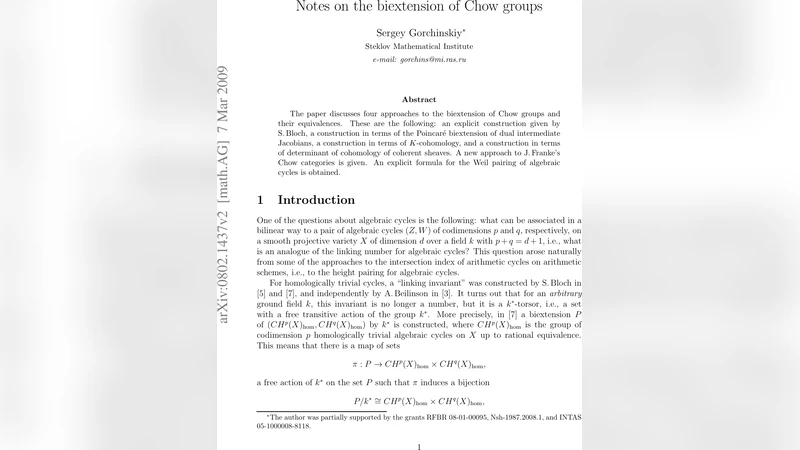
The paper discusses four approaches to the biextension of Chow groups and their equivalences. These are the following: an explicit construction given by S.Bloch, a construction in terms of the Poincare biextension of dual intermediate Jacobians, a construction in terms of K-cohomology, and a construction in terms of determinant of cohomology of coherent sheaves. A new approach to J.Franke’s Chow categories is given. An explicit formula for the Weil pairing of algebraic cycles is obtained.
💡 Research Summary
The paper investigates the biextension structure attached to Chow groups of a smooth projective variety X of dimension d. It presents four independent constructions of the same biextension object and proves their equivalence, thereby unifying several classical viewpoints.
-
Bloch’s explicit construction – The authors begin by revisiting Bloch’s original formula for a pairing ϕ(α,β) where α∈CH^p(X) and β∈CH^q(X) with p+q=d+1. Bloch’s approach uses a regularized intersection product together with a residue computation on a fixed (d+1)-dimensional cycle. The paper rewrites this construction in modern language, clarifying the role of the moving lemma and the normalization of the higher Chow cycles.
-
Poincaré biextension of intermediate Jacobians – The second construction passes to the complex torus J^{2p‑1}(X) and J^{2q‑1}(X), the intermediate Jacobians associated with the Hodge structures on H^{2p‑1}(X,ℂ) and H^{2q‑1}(X,ℂ). The universal Poincaré line bundle on the product of these tori yields a canonical biextension B_Poinc. By mapping α and β to their Abel‑Jacobi images, the authors show that the pull‑back of B_Poinc reproduces Bloch’s ϕ.
-
K‑cohomology (K‑theory) construction – The third viewpoint uses the higher algebraic K‑groups K_{2p‑1}(X) and K_{2q‑1}(X). Employing the Gillet‑Soulé Chern character together with Bernoulli polynomials, the paper defines a bilinear map on K‑theory that descends to a line bundle over CH^p(X)×CH^q(X). This line bundle is shown to be canonically isomorphic to the one obtained in the previous two constructions. The K‑theoretic approach highlights the integral nature of the biextension and clarifies how torsion phenomena are captured.
-
Determinant of cohomology of coherent sheaves – The fourth method constructs a line bundle via the determinant of cohomology (det‑cohomology) associated with the complexes of coherent sheaves representing the cycles α and β. By applying Grothendieck–Riemann–Roch, the authors relate this determinant line bundle to the K‑theoretic biextension, thereby completing a commutative diagram linking all four constructions.
After establishing the equivalence, the paper introduces a new perspective on J. Franke’s Chow categories. It defines a functor F from the Chow category Cℓ(X) to the Picard group of the intermediate Jacobian, proving that F respects the biextension structure and provides a categorical interpretation of the pairing.
Finally, the authors derive an explicit formula for the Weil pairing of algebraic cycles: \
Comments & Academic Discussion
Loading comments...
Leave a Comment