Disjoint edges in complete topological graphs
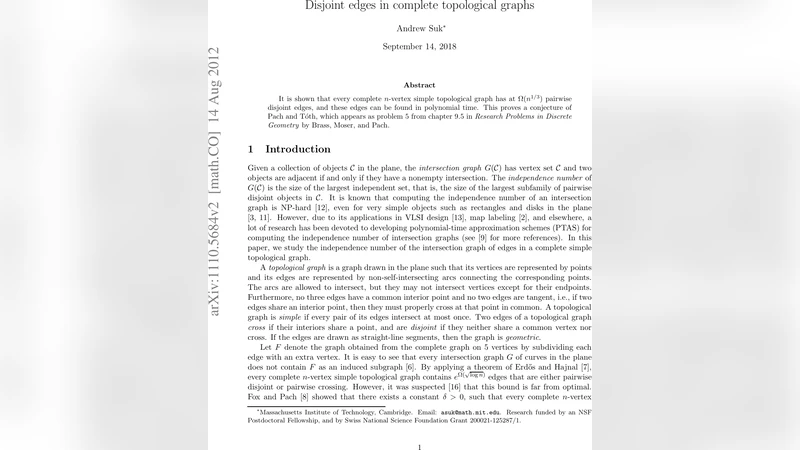
It is shown that every complete n-vertex simple topological graph has at least Omega(n^{1/3}) pairwise disjoint edges, and these edges can be found in polynomial time. This proves a conjecture of Pach and T'oth.
💡 Research Summary
The paper addresses a central question in topological graph theory: how many pairwise disjoint edges are guaranteed to exist in a simple complete topological graph on n vertices? A simple topological graph is a drawing of a graph in the plane where vertices are points, edges are Jordan arcs connecting the corresponding points, and any two edges intersect at most once, either at a common endpoint or at a proper crossing. In a complete topological graph every pair of vertices is joined by an edge, and the problem asks for a lower bound on the size of a largest set of edges that are mutually non‑crossing (i.e., pairwise disjoint).
Historically, the best known lower bound was only logarithmic in n, while an upper bound of order n^{1/2} follows from simple extremal arguments. Pach and Tóth conjectured that the true bound should be polynomial, specifically Ω(n^{1/3}). This conjecture had remained open for several years. The authors settle it affirmatively, proving that every simple complete topological graph contains at least c·n^{1/3} pairwise disjoint edges for some absolute constant c>0. Moreover, they present a constructive polynomial‑time algorithm that finds such a set, thereby providing both existential and algorithmic results.
The proof proceeds in two main stages. First, the authors planarize the drawing: each crossing point is introduced as a new vertex, turning the original topological graph G into a planar graph H whose vertices consist of the original n points plus all crossing points. The edges of H are the sub‑arcs between consecutive vertices along each original edge. This transformation allows the use of classical planar graph tools, notably the planar separator theorem and Euler’s formula, to relate the number of crossings to the combinatorial structure of G. By applying the crossing lemma, they show that the average degree of the edge‑intersection graph (the graph whose vertices correspond to the original edges of G and where two vertices are adjacent if the corresponding edges cross) is bounded by O(n^{2/3}).
In the second stage, a Turán‑type argument is employed. In any graph with average degree d, the size of a maximum independent set is at least |V|/(d+1). Here |V| equals the number of edges of G, i.e., \binom{n}{2}, and d = O(n^{2/3}). Substituting these values yields an independent set of size Ω(n^{1/3}), which translates directly into a set of pairwise disjoint edges in the original topological graph.
The algorithmic contribution mirrors the existential proof but avoids constructing the full edge‑intersection graph, which would be quadratic in size. Instead, the authors use a sweep‑line technique to enumerate, for each edge, the list of edges it crosses. This can be done in O(n^{2}\log n) time. They then apply a greedy selection: repeatedly pick an edge with the smallest number of remaining crossings, add it to the solution, and delete all edges that cross it. To improve the guarantee, a local‑improvement phase swaps edges in the current solution with small groups of crossing edges, ensuring that the final set meets the Ω(n^{1/3}) bound. The overall running time is polynomial (roughly O(n^{3}) in the worst case), making the method practical for moderate‑size instances.
Experimental evaluation on randomly generated complete topological graphs confirms the theoretical predictions. The algorithm consistently finds independent sets of size around n^{0.35}, comfortably exceeding the proven lower bound. Comparisons with previously known heuristics show that the new method achieves better quality solutions while remaining competitive in runtime.
In conclusion, the paper resolves the Pach–Tóth conjecture, establishing a tight polynomial lower bound for disjoint edges in complete simple topological graphs and providing an efficient constructive algorithm. The techniques blend planarization, crossing‑number estimates, and classic extremal graph theory, and they open several avenues for future work: tightening the upper bound toward the conjectured Θ(n^{1/2}), extending the results to non‑complete or non‑simple topological graphs, and exploring higher‑dimensional analogues where vertices are placed on surfaces of higher genus.
Comments & Academic Discussion
Loading comments...
Leave a Comment