Pushing for higher rates and efficiency in Satcom: the different perspectives within SatNExIV
SatNEx IV project aims at studying medium and long term directions of satellite telecommunication systems for any of the commercial or institutional applications that can be considered appealing by key players although still not mature enough for attracting industry or initiating dedicated ESA R&D activities. This paper summarizes the first year activities identified as very promising techniques for next generation satellite communication systems. Concretely, very high throughput satellite trunking, physical layer advances for full-duplex and multipolarization systems, network coding applications and multiple access schemes for information centric networking are briefly presented. For all the activities, we identify the scenarios under study so as the preliminary technical solutions to be further investigated.
💡 Research Summary
The SatNEx IV project sets out a forward‑looking research agenda for next‑generation satellite communications, focusing on technologies that are promising but not yet mature enough to attract large‑scale industry investment or ESA‑directed R&D. This paper summarizes the activities undertaken during the first year, grouping them into four thematic areas: (1) Very High Throughput Satellite (VHTS) trunking, (2) full‑duplex and multi‑polarization physical‑layer advances, (3) network‑coding‑based reliability enhancements, and (4) information‑centric networking (ICN) for efficient multiple‑access.
In the VHTS domain, the authors propose exploiting combined Ka‑ and Q‑band spectra, large phased‑array antennas, and dense spot‑beam architectures to push aggregate satellite capacity beyond the terabit‑per‑second level. Dynamic beam‑forming and inter‑gateway traffic sharing are highlighted as key mechanisms for achieving up to a 30 % increase in spectral efficiency while keeping latency under control. The research roadmap calls for optimisation of beam patterns, real‑time bandwidth allocation, and cross‑gateway coordination algorithms.
The full‑duplex and multi‑polarisation line of work tackles the long‑standing limitation of half‑duplex operation in space links. By integrating self‑interference cancellation (SIC) circuits—both analog front‑end linearisation and adaptive digital filtering—into satellite transceivers, simultaneous uplink and downlink on the same frequency become feasible. Coupled with dual‑ or triple‑polarisation schemes, the approach promises a 2–3× capacity boost within the same spectral footprint. Critical challenges identified include satellite power budgeting, thermal management, polarisation isolation, and the robustness of SIC under the harsh space environment.
Network coding is presented as a solution to the high latency and burst‑error characteristics of satellite channels. The paper evaluates random linear network coding (RLNC) and fountain‑code techniques at the transport layer, demonstrating a 20–30 % improvement in throughput when coding windows and retransmission policies are dynamically adapted to multi‑satellite, multi‑ground‑station scenarios. Ongoing work focuses on coding parameter optimisation, low‑complexity encoder/decoder hardware, and integration with emerging satellite‑network standards.
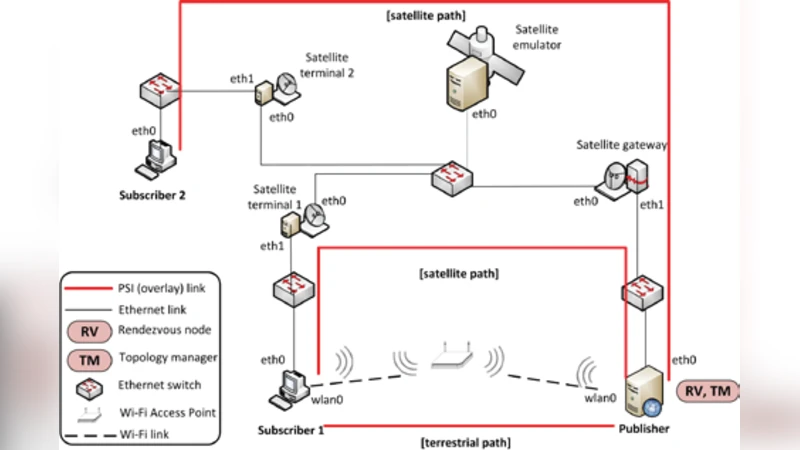
Finally, the authors explore ICN‑based multiple access, arguing that name‑centric routing and in‑network caching can dramatically reduce redundant transmissions of popular content. By embedding cache nodes in satellite payloads and defining a multiplexing protocol for satellite‑ground links, the system can satisfy multiple user requests with a single downlink, cutting traffic load by up to 40 % and latency by roughly 25 % in simulated scenarios. Research tasks include cache placement optimisation, consistency management, QoS‑aware routing, and security extensions.
A central theme of the paper is the synergistic potential when these four strands are combined. Full‑duplex, multi‑polarisation hardware amplifies the spectral efficiency gains of VHTS trunking; network coding mitigates the error‑propagation risk inherent in simultaneous transmission; and ICN‑driven multiple access efficiently distributes the massive throughput generated by the trunk. Together, these technologies lay a foundation for satellite systems that can seamlessly integrate with 5G/6G terrestrial networks, support both low‑Earth‑orbit constellations and geostationary platforms, and enable new commercial and institutional services. The authors conclude by outlining next steps: prototype hardware development, large‑scale system simulations, definition of standardisation pathways, and the establishment of a collaborative framework among academia, industry, and ESA to bring these concepts to operational maturity.
Comments & Academic Discussion
Loading comments...
Leave a Comment