Problems on Matchings and Independent Sets of a Graph
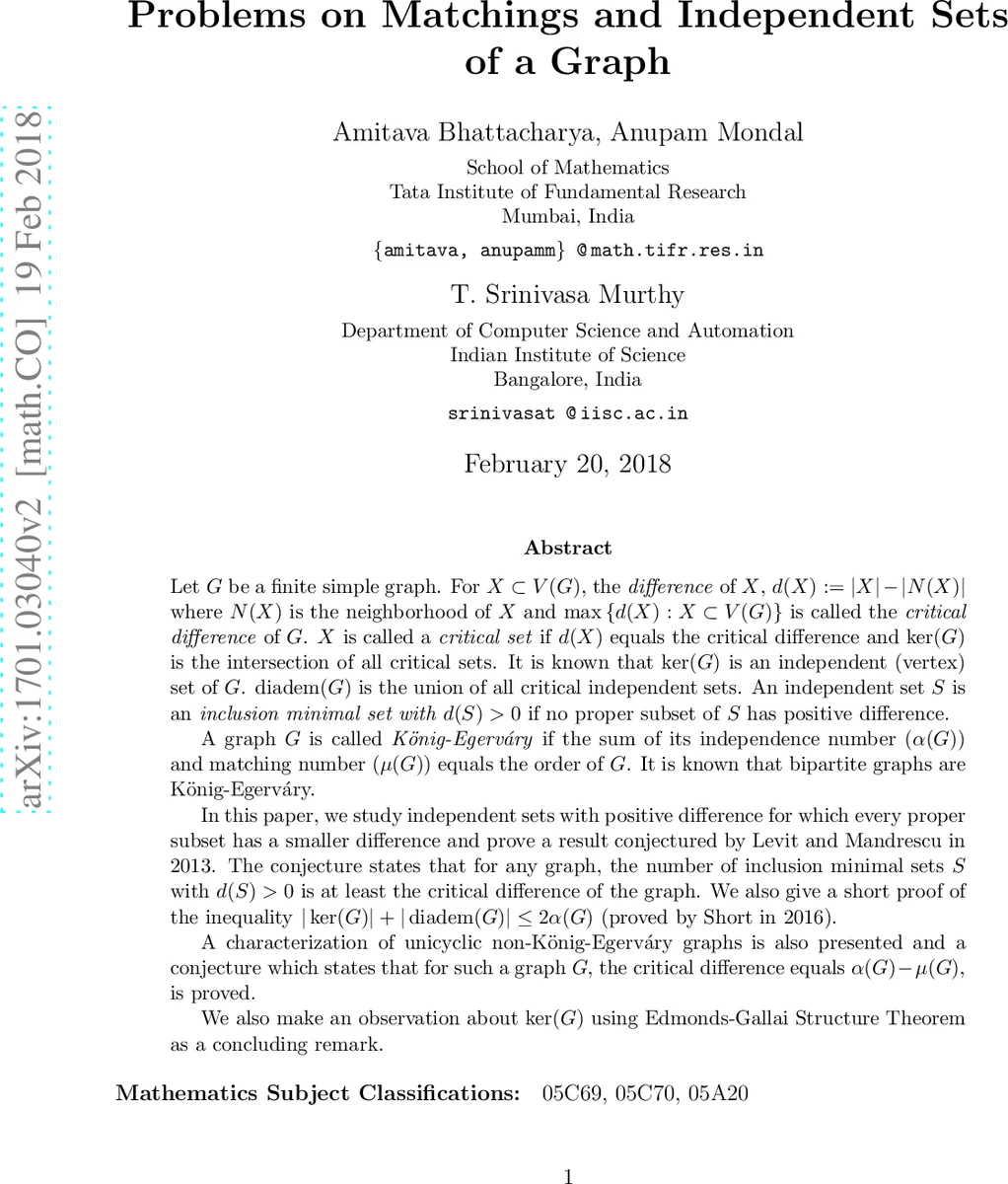
Let $G$ be a finite simple graph. For $X \subset V(G)$, the difference of $X$, $d(X) := |X| - |N (X)|$ where $N(X)$ is the neighborhood of $X$ and $\max , {d(X):X\subset V(G)}$ is called the critical difference of $G$. $X$ is called a critical set if $d(X)$ equals the critical difference and ker$(G)$ is the intersection of all critical sets. It is known that ker$(G)$ is an independent (vertex) set of $G$. diadem$(G)$ is the union of all critical independent sets. An independent set $S$ is an inclusion minimal set with $d(S) > 0$ if no proper subset of $S$ has positive difference. A graph $G$ is called K"onig-Egerv'ary if the sum of its independence number ($\alpha (G)$) and matching number ($\mu (G)$) equals $|V(G)|$. It is known that bipartite graphs are K"onig-Egerv'ary. In this paper, we study independent sets with positive difference for which every proper subset has a smaller difference and prove a result conjectured by Levit and Mandrescu in 2013. The conjecture states that for any graph, the number of inclusion minimal sets $S$ with $d(S) > 0$ is at least the critical difference of the graph. We also give a short proof of the inequality $|$ker$(G)| + |$diadem$(G)| \le 2\alpha (G)$ (proved by Short in 2016). A characterization of unicyclic non-K"onig-Egerv'ary graphs is also presented and a conjecture which states that for such a graph $G$, the critical difference equals $\alpha (G) - \mu (G)$, is proved. We also make an observation about ker$G)$ using Edmonds-Gallai Structure Theorem as a concluding remark.
💡 Research Summary
The paper investigates several fundamental questions concerning matchings and independent sets in finite simple graphs by focusing on the “difference” function d(X)=|X|−|N(X)|, where N(X) denotes the neighborhood of X. The maximum value of d over all vertex subsets is called the critical difference dc(G). A set attaining this maximum is a critical set, and the intersection of all critical sets is denoted ker(G). It is known that ker(G) is an independent set. The union of all critical independent sets is called diadem(G).
The first major contribution is a proof of a conjecture posed by Levit and Mandrescu in 2013: for any graph G, the number of inclusion‑minimal independent sets S with d(S)>0 is at least dc(G). The authors call such sets “minimal positive‑difference independent sets”. They first establish that the difference function is supermodular (d(X∪Y)+d(X∩Y)≥d(X)+d(Y)) and that the family of critical sets is closed under union and intersection. Using these properties they prove a key structural theorem (Theorem 2.12): if X is an independent set with d(X)=k>0 and every proper subset Y⊂X satisfies d(Y)<k, then X can be expressed as the disjoint union of exactly k distinct inclusion‑minimal positive‑difference independent sets, each of which has d=1. This decomposition shows that ker(G), being the unique minimal critical independent set, is a union of at least dc(G) such minimal sets, thereby confirming the conjecture.
The second contribution is a short, direct proof of the “ker‑diadem inequality” |ker(G)|+|diadem(G)| ≤ 2α(G), originally proved by Short (2016) via sophisticated structural arguments. The authors first prove Lemma 3.1, which states that for any two critical independent sets X and Y, the sizes of N(X)∩Y and N(Y)∩X coincide. Then they show (Theorem 3.2) that for a maximal critical independent set X, the diadem is contained in X∪N(X) minus the neighborhood of ker(G). Since X is independent, |X∪N(X)| = |X|+|N(X)| = 2|X|−dc(G). Substituting the inclusion yields |diadem(G)| ≤ 2|X|−|ker(G)|, and because |X| ≤ α(G) the desired inequality follows. This argument avoids the need for Larson’s decomposition and provides a clean combinatorial proof.
The third major result concerns unicyclic graphs that are not König‑Egerváry (KE). Recall that a graph is KE if α(G)+μ(G)=|V(G)|, where μ(G) is the size of a maximum matching. For unicyclic non‑KE graphs the authors prove Conjecture 1.3: dc(G)=α(G)−μ(G). They first characterize unicyclic non‑KE graphs (Section 4) by showing that such graphs satisfy α(G)+μ(G)=|V(G)|−1 and that the unique cycle must be odd. Using this structural description they compute dc(G) directly and verify that it equals the difference between the independence number and the matching number. This settles the conjecture for the whole class of unicyclic non‑KE graphs.
Finally, the paper offers an observation based on the Edmonds‑Gallai structure theorem. By partitioning V(G) into D (vertices missed by some maximum matching), A (neighbors of D), and C (the remaining vertices), they note that ker(G) is always contained in A∪C, and when there exists a perfect matching from N(core(G)) into core(G) the core itself becomes critical. This perspective suggests a pathway to address Problems 1.4 and 1.5 concerning graphs whose core or ker coincides with the core.
In summary, the paper unifies several strands of graph theory—difference functions, critical sets, matchings, and structural decomposition—to resolve longstanding conjectures, provide streamlined proofs of known inequalities, and deepen our understanding of the interplay between independence and matching parameters in both general and specialized graph classes.
Comments & Academic Discussion
Loading comments...
Leave a Comment