Using a Model-driven Approach in Building a Provenance Framework for Tracking Policy-making Processes in Smart Cities
The significance of provenance in various settings has emphasised its potential in the policy-making process for analytics in Smart Cities. At present, there exists no framework that can capture the provenance in a policy-making setting. This research therefore aims at defining a novel framework, namely, the Policy Cycle Provenance (PCP) Framework, to capture the provenance of the policy-making process. However, it is not straightforward to design the provenance framework due to a number of associated policy design challenges. The design challenges revealed the need for an adaptive system for tracking policies therefore a model-driven approach has been considered in designing the PCP framework. Also, suitability of a networking approach is proposed for designing workflows for tracking the policy-making process.
💡 Research Summary
The paper addresses the lack of a provenance framework capable of capturing the entire policy‑making lifecycle in smart cities. While provenance has been applied to policy analytics, simulation, and evidence collection, no existing solution records the dynamic, iterative process of policy creation itself. To fill this gap, the authors propose the Policy Cycle Provenance (PCP) Framework, which combines a model‑driven approach with a networking‑inspired workflow mechanism.
First, the authors analyse four case studies of policy cycles from different countries, extracting key observations: (1) tasks within each phase do not follow a strict chronological order and can loop back to previous phases; (2) each policy may require a distinct set of data and tasks, demanding high adaptability; (3) citizen participation varies across phases, requiring flexible stakeholder integration; and (4) the same task can be performed by multiple departments, raising data‑governance challenges. These observations motivate the need for a flexible, extensible provenance capture mechanism.
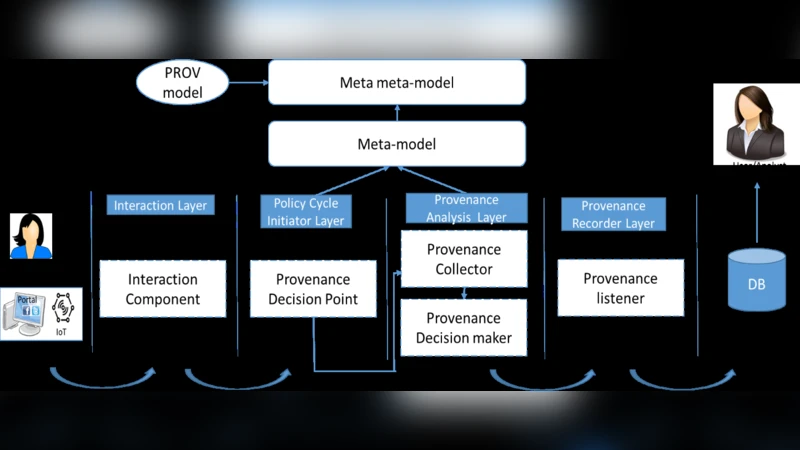
The core of the PCP Framework is a hierarchy of meta‑models. The policy‑cycle meta‑model defines five high‑level phases—agenda setting, prior analysis, policy creation, implementation, and monitoring—along with a detailed task catalogue for each phase (problem identification, validation, plan setting, challenges identification, solution design, formal consultation, decision making, drafting, implementation planning, inter‑agency collaboration, regulation drafting, monitoring data collection, evaluation, and loop‑back). A meta‑meta‑model encodes constraints such as permissible task sequences, dependency rules, and stakeholder routing logic. By altering these meta‑models, the framework can accommodate new policies without code changes, offering reusability and dynamism.
To operationalise the meta‑models, the authors propose a networking‑based workflow architecture inspired by IP packet switching. Each task is treated as a network node, and the flow of policy work is routed dynamically, allowing distributed stakeholders to interact in real time and enabling provenance data to be captured as “packets” traversing the network. This approach overcomes the rigidity of traditional static workflow engines, which struggle with the policy domain’s frequent changes and distributed nature.
The PCP Framework is organized into four layers: (1) Interaction Layer – gathers inputs from users or external systems; (2) Policy Cycle Initiator – maps inputs to the appropriate phase and tasks according to the meta‑model, generating a concrete workflow instance; (3) Provenance Analysis Layer – validates the generated workflow against constraints (e.g., ordering, stakeholder permissions) and enriches it with contextual metadata; (4) Provenance Recorder Layer – persistently stores every event (who, what, when, where, why) in a standardized provenance store. This separation of concerns facilitates maintenance, scalability, and future extensions.
The paper acknowledges that implementation, performance evaluation, and security considerations (e.g., provenance integrity, access control) are out of scope and will be addressed in future work. Nonetheless, the proposed model‑driven, network‑enabled PCP Framework provides a solid conceptual foundation for tracking policy‑making processes, promising enhanced transparency, accountability, and data quality for smart‑city governance.
Comments & Academic Discussion
Loading comments...
Leave a Comment