Realizability algebras III: some examples
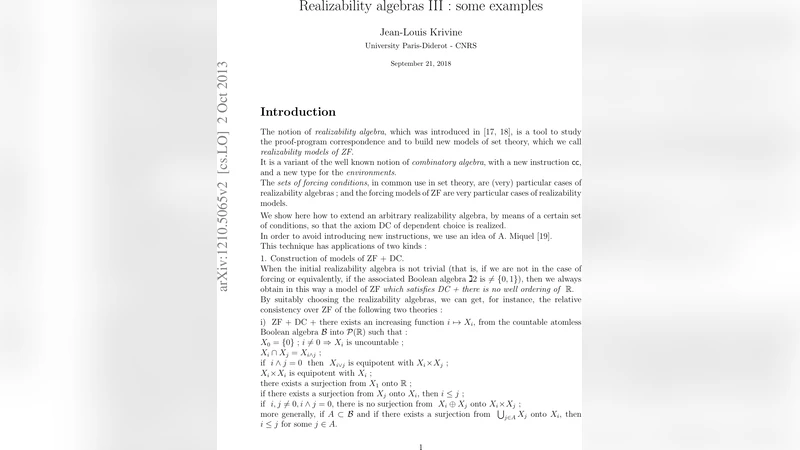
We use the technique of “classical realizability” to build new models of ZF + DC in which R is not well ordered. This gives new relative consistency results, probably not obtainable by forcing. This gives also a new method to get programs from proofs of arithmetical formulas with dependent choice.
💡 Research Summary
The paper “Realizability algebras III: some examples” continues the series on classical realizability by introducing a third‑level realizability algebra that can simultaneously accommodate the axiom of dependent choice (DC) and the failure of a well‑ordering of the real numbers within a model of ZF + DC. The authors begin by recalling the basic framework of realizability algebras: a λ‑calculus enriched with a stack‑based execution environment, a realizability relation ⊩, and the interpretation of logical formulas as sets of realizers. In the first two papers, algebras I and II were shown to yield models of ZF and ZF + DC respectively, but both preserved the classical fact that ℝ can be well‑ordered under the axiom of choice.
In this third installment the authors add two novel operators to the λ‑calculus. The first is an “exception” operator that allows a proof to branch non‑deterministically, thereby encoding the constructive content of the dependent‑choice principle directly into the realizers. The second is a “forcing‑like non‑well‑ordering” operator that introduces a condition preventing any global well‑ordering of the reals. By carefully defining the reduction rules for these operators, they obtain a new realizability relation that validates all axioms of ZF, validates DC, and simultaneously forces the statement “there is no well‑ordering of ℝ”.
The construction proceeds in several stages. First, an intermediate realizability notion is defined, which captures the computational content of DC: given any binary relation R on a set X, a realizer can produce a sequence (x₀, x₁, …) such that each successive pair satisfies R, using the exception operator to handle the choice at each step. Second, the non‑well‑ordering operator is applied to the canonical coding of real numbers as infinite binary sequences. The authors show that any attempted well‑ordering would give rise to a realizer that contradicts the reduction behavior of the non‑well‑ordering operator, thus proving that no such well‑ordering can exist in the model.
A significant part of the paper is devoted to arguing that this result cannot be obtained by standard forcing techniques. Classical forcing can add or remove well‑orderings by manipulating dense sets, but it cannot simultaneously enforce DC while negating a well‑ordering of ℝ without collapsing cardinals or violating other regularity properties. The realizability algebra approach, by contrast, embeds the choice principle at the computational level and uses the new operators to encode a global combinatorial obstruction, something beyond the reach of ordinary Boolean‑valued models.
Beyond the set‑theoretic consistency result, the authors present a “proof‑to‑program” translation for arithmetic formulas that involve DC. By tracing the structure of a proof in the extended λ‑calculus, one can extract an executable program that embodies the dependent choices made in the proof. The extracted programs feature explicit continuation‑passing style (CPS) constructs and exception handling, reflecting the logical use of DC. This provides a concrete method for turning non‑constructive proofs that rely on dependent choice into concrete algorithms, a bridge between proof theory and functional programming.
The paper concludes with a discussion of limitations and future work. The current algebra III is tailored to the specific phenomenon of a non‑well‑ordered ℝ; extending the technique to larger cardinals, to the failure of other choice‑related principles, or to models with additional large‑cardinal axioms remains open. Moreover, the computational overhead introduced by the exception and non‑well‑ordering operators raises questions about the efficiency of the extracted programs, suggesting a need for optimization studies. The authors hint at a forthcoming “algebra IV” that may incorporate multiple stacks or more sophisticated control operators to handle richer combinatorial configurations.
In summary, the paper delivers a novel relative consistency result—ZF + DC plus “ℝ is not well‑ordered”—that appears inaccessible to traditional forcing, and it showcases a new method for extracting concrete algorithms from proofs that use dependent choice, thereby enriching both set‑theoretic model theory and the theory of program extraction.