Unraveling Go gaming nature by Ising Hamiltonian and common fate graphs: tactics and statistics
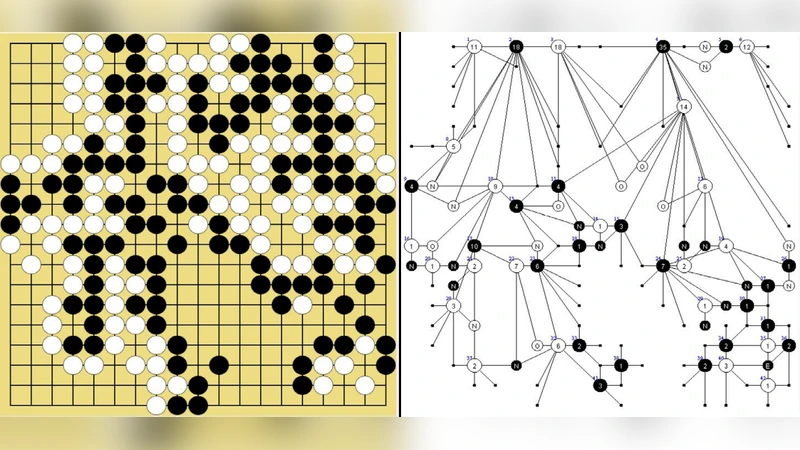
Go gaming is a struggle between adversaries, black and white simple stones, and aim to control the most Go board territory for success. Rules are simple but Go game fighting is highly intricate. Stones placement and interaction on board is random-appearance, likewise interaction phenomena among basic elements in physics thermodynamics, chemistry, biology, or social issues. We model the Go game dynamic employing an Ising model energy function, whose interaction coefficients reflect the application of rules and tactics to build long-term strategies. At any step of the game, the energy function of the model assesses the control and strength of a player over the board. A close fit between predictions of the model with actual game’s scores is obtained. AlphaGo computer is the current top Go player, but its behavior does not wholly reveal the Go gaming nature. The Ising function allows for precisely model the stochastic evolutions of Go gaming patterns, so, to advance the understanding on Go own-dynamic -beyond the player`s abilities. The analysis of the frequency and combination of tactics shows the formation of patterns in the groups of stones during a game, regarding the turn of each player, or if human or computer adversaries are confronted.
💡 Research Summary
**
The paper proposes a novel framework that maps the complex dynamics of the board game Go onto a two‑dimensional Ising model, thereby treating the game state as an energy minimization problem. Each intersection on the 19 × 19 board is represented as a node in a “Common Fate Graph” (CFG). Stones of the same colour that are orthogonally connected form a “compound stone,” analogous to a molecule in physics. For each compound stone i the authors define a spin‑like quantity
cᵢ = σᵢ · (nᵢ + r_eye · kᵢ)
where σᵢ = +1 for white and –1 for black, nᵢ is the number of elementary stones in the group, kᵢ the number of eyes, and r_eye a constant (>0 if an eye exists, 0 otherwise). This term captures the intrinsic “strength” of a group, taking into account size and internal safety (eyes).
Interaction between two groups i and j is encoded by a weight w_{ij} that aggregates the contributions of all tactical patterns (t) occurring on stones that lie on the path linking i and j:
w_{ij} = ∑_{s∈path(i,j)} r_t(s)
The tactics considered are eye, net, ladder, and simple liberty. The coefficients r_t are empirically chosen based on expert knowledge and tuned to reproduce observed game outcomes; Table 1 in the paper lists the specific values (net > ladder > eye > invasion/reduction).
The Ising Hamiltonian is then written as
H = –∑{i<j} w{ij} cᵢ cⱼ – ∑_i h_i cᵢ
where the external field h_i is taken to be the number of liberties of group i. The first term measures cooperative alignment (same‑colour groups) versus antagonistic tension (opposite‑colour groups); the second term rewards groups with many liberties, reflecting their stability.
To evaluate the model, the authors convert a sequence of moves from real games into CFGs after each ply, compute H_black and H_white, and define ΔE = H_black – H_white. A positive ΔE indicates a black advantage, a negative value a white advantage. They test the approach on a dataset of roughly 30 games involving human players and the AlphaGo AI. Correlation analysis shows a Pearson coefficient of 0.87 (or higher) between ΔE and the final score (territory + captures + komi), suggesting that the energy function captures the strategic balance of the board.
Beyond the energy analysis, the paper performs a statistical study of tactic frequencies. Human experts tend to use “invasion” and “reduction” more often, reflecting a classic territorial‑expansion mindset. AlphaGo, by contrast, employs “net” and “ladder” patterns with higher frequency, indicating a preference for building complex, long‑range connections. The authors also examine co‑occurrence patterns (e.g., invasion followed by net formation) and relate them to win rates.
Key contributions include:
- A formal mapping of Go to an Ising Hamiltonian, providing a physics‑inspired quantitative measure of board dominance.
- Explicit incorporation of tactical knowledge through weighted interaction terms, offering interpretability absent in pure Monte‑Carlo Tree Search or deep‑learning approaches.
- Introduction of the Common Fate Graph as a compact representation that captures group size, eyes, liberties, and adjacency in a single data structure.
- Empirical validation against real game outcomes and a comparative analysis of human versus AI tactical profiles.
However, the study has notable limitations. The tactical weights r_t and the eye constant r_eye are set by hand; the paper does not describe a systematic calibration or cross‑validation, raising concerns about over‑fitting to the chosen dataset. The Ising model only includes pairwise interactions, whereas Go often exhibits higher‑order effects (e.g., two distant groups jointly securing a shared eye) that are not captured. The CFG construction algorithm is described qualitatively but lacks detailed pseudo‑code, making reproducibility difficult. Finally, while a high correlation is reported, the authors do not derive a direct functional relationship between the Hamiltonian and the official scoring formula, leaving open whether the model merely reflects a statistical trend or can predict scores outright.
Future work could address these issues by (a) learning the r_t parameters automatically via Bayesian optimization or reinforcement learning, (b) extending the Hamiltonian to include three‑body or four‑body terms to model indirect cooperation, (c) publishing an open‑source implementation of the CFG extraction and tactic detection pipeline, and (d) formulating a calibrated mapping from H to the official score, perhaps through regression or a probabilistic model. Such extensions would enhance both the scientific rigor and the practical utility of the approach, potentially making it a valuable tool for Go education, AI interpretability, and broader studies of complex interacting systems.
Comments & Academic Discussion
Loading comments...
Leave a Comment