Optimization of Scheduling in Wireless Ad-Hoc Networks Using Matrix Games
In this paper, we present a novel application of matrix game theory for optimization of link scheduling in wireless ad-hoc networks. Optimum scheduling is achieved by soft coloring of network graphs. Conventional coloring schemes are based on assignment of one color to each region or equivalently each link is member of just one partial topology. These algorithms based on coloring are not optimal when links are not activated with the same rate. Soft coloring, introduced in this paper, solves this problem and provide optimal solution for any requested link usage rate. To define the game model for optimum scheduling, first all possible components of the graph are identified. Components are defined as sets of the wireless links can be activated simultaneously without suffering from mutual interference. Then by switching between components with appropriate frequencies (usage rate) optimum scheduling is achieved. We call this kind of scheduling as soft coloring because any links can be member of more than one partial topology, in different time segments. To simplify this problem, we model relationship between link rates and components selection frequencies by a matrix game which provides a simple and helpful tool to simplify and solve the problem. This proposed game theoretic model is solved by fictitious playing method. Simulation results prove the efficiency of the proposed technique compared to conventional scheduling based on coloring
💡 Research Summary
The paper tackles the problem of link scheduling in wireless ad‑hoc networks by introducing a novel “soft‑coloring” concept and modeling the resulting optimization as a zero‑sum matrix game. Traditional TDMA‑based scheduling often relies on graph coloring, where each link is assigned a single color (i.e., belongs to exactly one partial topology). This rigid assignment becomes sub‑optimal when links have heterogeneous traffic demands, because a single coloring cannot simultaneously satisfy different usage rates.
To overcome this limitation, the authors propose soft‑coloring, which allows a link to belong to multiple partial topologies (called components) at different time slots. A component is defined as a set of links that can be activated concurrently without mutual interference. Starting from single‑link (first‑generation) components, larger components are formed hierarchically; parent components are supersets of their child components. The scheduling problem then reduces to selecting a subset of components (typically the last generation) and determining how often each should be used.
The relationship between link demand vector r and component usage frequencies is captured by a payoff matrix H, where entry h_{ij} denotes the contribution of component j to link i’s traffic if that component is active. The authors formulate a min‑max zero‑sum game between two players: Player 1 chooses a mixed strategy over links, Player 2 chooses a mixed strategy over components. At equilibrium, the mixed strategy y of Player 2 directly yields the optimal activation probabilities for the components, while the value of the game corresponds to the minimum guaranteed link rate. The equilibrium condition (\max_y \min_i (Hy)_i = \min_i \max_y (Hy)_i) is precisely the optimal scheduling condition.
Because solving the game analytically is impractical for realistic network sizes, the paper adopts the fictitious play (FP) algorithm. In each iteration, a player best‑responds to the empirical frequency distribution of the opponent’s past actions; the empirical distributions are then updated. The algorithm is guaranteed to converge for the class of games considered, and the authors further exploit dominance relations to prune parent components that are always outperformed by their children, thereby reducing computational load.
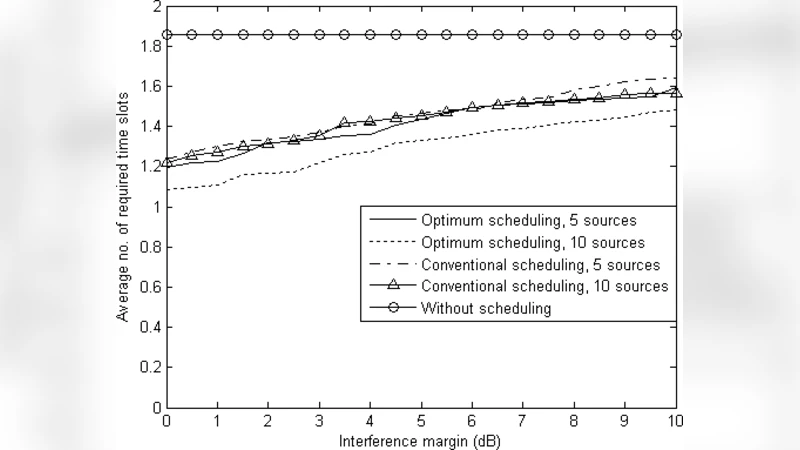
Simulation experiments are conducted on randomly generated networks with 10 and 20 nodes uniformly placed in a unit square. Multiple source‑sink pairs are randomly selected, and for each pair the shortest‑path route is computed via Dijkstra’s algorithm. Traffic loads follow a Poisson distribution, the path‑loss exponent is set to 4, and an interference margin β is varied. Performance is measured by the average number of time slots required to deliver a packet from source to sink, averaged over 1,000 independent runs. Results show that the soft‑coloring / matrix‑game approach consistently outperforms conventional graph‑coloring scheduling. For 10 parallel sessions, the optimal scheme reduces required slots by roughly 11 %–25 % compared with traditional coloring; the gain grows with the number of concurrent sessions because more links can share components, increasing the size of the final component generation. Similar trends are observed for 20‑node networks.
In conclusion, the paper demonstrates that by recasting link scheduling as a matrix game and applying fictitious play, one can achieve a flexible, near‑optimal allocation of time resources in wireless ad‑hoc networks. The soft‑coloring framework eliminates the rigidity of classic coloring, while the game‑theoretic formulation provides a systematic way to compute component usage rates with provable convergence. The methodology is computationally tractable, scales with network size, and offers a promising foundation for extensions to QoS‑aware, dynamic, or heterogeneous network environments.
Comments & Academic Discussion
Loading comments...
Leave a Comment