An Agent-Based Simulation of Residential Location Choice of Tenants in Tehran, Iran
Residential location choice modeling is one of the substantial components of land use and transportation models. While numerous aggregated mathematical and statistical approaches have been developed to model the residence choice behavior of households, disaggregated approaches such as the agent-based modeling have shown interesting capabilities. In this article, a novel agent-based approach is developed to simulate the residential location choice of tenants in Tehran, the capital of Iran. Tenants are considered as agents who select their desired residential alternatives according to their characteristics and preferences for various criteria such as the rent, accessibility to different services and facilities, environmental pollution, and distance from their workplace and former residence. The choice set of agents is limited to their desired residential alternatives by applying a constrained NSGA-II algorithm. Then, agents compete with each other to select their final residence among their alternatives. Results of the proposed approach are validated by comparing simulated and actual residences of a sample of tenants. Results show that the proposed approach is able to accurately simulate the residence of 59.3% of tenants at the traffic analysis zone level.
💡 Research Summary
This paper presents a novel agent‑based simulation framework for modeling the residential location choices of tenants in Tehran, Iran. Recognizing the limitations of traditional aggregate statistical approaches—such as discrete‑choice models—that capture only average tendencies, the authors adopt a disaggregated perspective in which each tenant is represented as an autonomous agent with its own socio‑economic profile and set of preferences. The study begins with a detailed household survey of 1,200 tenants, collecting data on income, education, household size, and a range of attributes influencing residential decisions: monthly rent, accessibility to public transport, schools, hospitals, environmental quality (air and noise pollution), and distances to workplace and previous residence.
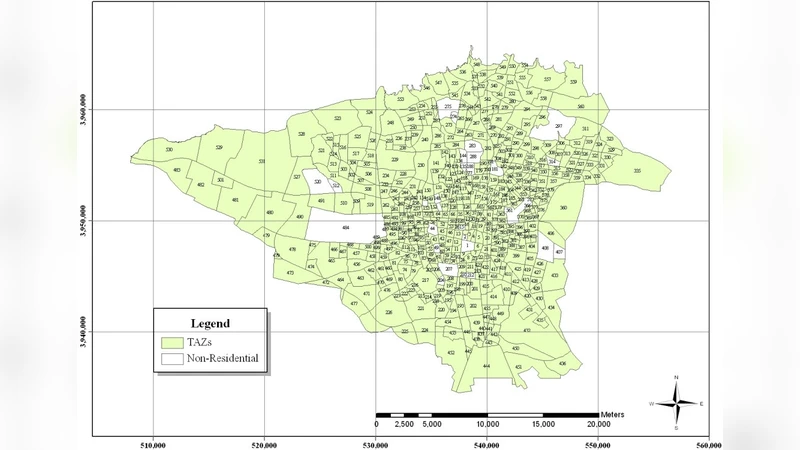
Using these data, the authors construct a multi‑objective utility function for each agent. The four competing objectives are (1) minimizing rent, (2) maximizing accessibility to key services, (3) minimizing environmental pollution, and (4) minimizing travel distance to work and former home. To generate a realistic yet tractable choice set, the authors apply the Non‑Dominated Sorting Genetic Algorithm II (NSGA‑II). This evolutionary algorithm efficiently identifies a Pareto front of feasible residential alternatives for each tenant, typically yielding five to ten candidate Traffic Analysis Zones (TAZs) out of the 350 zones covering Tehran.
After the candidate set is defined, agents enter a competitive allocation stage that mimics market dynamics. Each TAZ has a limited housing capacity; agents are ranked according to their individual utility scores for that zone. When demand exceeds supply, lower‑scoring agents are placed in a waiting list and may be reassigned to secondary alternatives in subsequent iterations. This iterative competition continues until every agent is assigned a final residence.
The model’s performance is evaluated by comparing simulated allocations with the actual residences reported in the survey. At the TAZ level, the simulation correctly predicts the residence of 59.3 % of tenants. Accuracy varies across socio‑economic groups: high‑income, highly educated tenants achieve a 68 % match rate, whereas low‑income tenants reach only 45 %. These results indicate that the framework captures key behavioral patterns while reflecting the constraints faced by different income groups. Spatial analysis of the outcomes also reveals expected clustering in well‑connected, low‑pollution zones, confirming that the agents’ preferences for accessibility and environmental quality are being honored.
The paper contributes to the literature in three main ways. First, it integrates multi‑objective optimization with agent competition, offering a more behaviorally realistic alternative to conventional aggregate models. Second, it demonstrates that NSGA‑II can efficiently generate individualized choice sets without exploding computational cost, even in a city the size of Tehran. Third, the validation against real‑world data provides empirical credibility, showing that the approach can be used for policy‑oriented scenario testing.
Limitations are acknowledged. The survey provides only a cross‑sectional snapshot, preventing analysis of temporal dynamics such as relocation over time. The NSGA‑II parameters (population size, crossover and mutation rates) influence the Pareto front and may affect robustness. Moreover, the use of TAZs as the spatial unit imposes a relatively coarse resolution, potentially obscuring finer‑grained neighborhood effects.
Future research directions include incorporating panel data to model longitudinal migration, exploring reinforcement‑learning agents that adapt preferences based on past experiences, and refining the spatial granularity to the block or parcel level. The authors also suggest coupling the residential choice model with transportation network simulations to evaluate the feedback loops between land use and travel behavior.
In summary, the study demonstrates that an agent‑based, multi‑objective simulation can accurately reproduce tenants’ residential location decisions in a complex metropolitan context, offering a powerful tool for urban planners and transportation modelers seeking to assess the impacts of policy interventions on housing markets and travel patterns.
Comments & Academic Discussion
Loading comments...
Leave a Comment