Resource Allocation in Wireless Networks with Energy Constraints
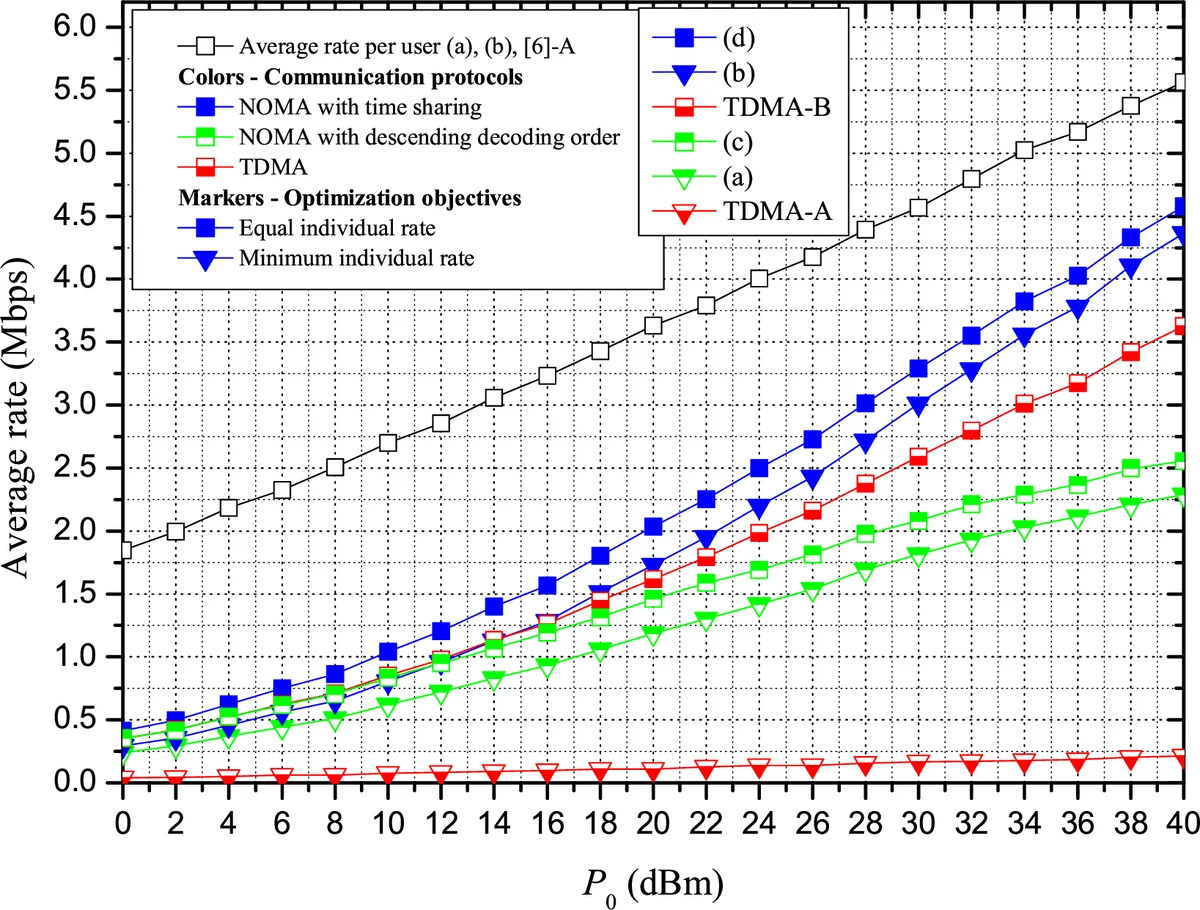
This dissertation focuses on the development of novel scheduling and resource allocation schemes, which take into account and regulate the energy constraints imposed by the levels of harvested energy. To this direction, first, the optimal energy, time, and bandwidth allocation problem for the downlink of energy harvesting base stations (EHBSs) is investigated, with the main focus being on autonomous EHBSs. The presented analysis considers the impact of the energy constraint on users’ preferences and the BS’s revenue. In order to model the competitive nature of the problem, game theory is used. The next two chapters focus on wireless powered networks (WPNs) and simultaneous wireless information and power transfer (SWIPT) using radio frequency (RF) technology. One of the main contributions of these chapters is the introduction of both uplink and downlink non-orthogonal multiple access (NOMA) for WPNs. Moreover, the individual data rates and fairness are improved, while the formulated problems are optimally and efficiently solved. It is shown that, compared to orthogonal multiple access, NOMA offers a considerable improvement in throughput, fairness, and energy efficiency. Rather than this, proportional fairness is maximized and uplink/downlink of WPNs are jointly optimized, in which cases, except for NOMA, time division multiple access (TDMA) is also investigated. Furthermore, the role of interference is considered, which has been recognized as one of the main reasons of the asymmetric overall degradation of the users’ performance, due to different path-loss values, called from now on as cascaded near-far problem. Moreover, SWIPT is investigated and efficiently optimized in the context of multicarrier cooperative communication networks. Finally, simultaneous lightwave information and power transfer (SLIPT) is introduced, while novel and fundamental techniques are proposed.
💡 Research Summary
This doctoral dissertation, titled “Resource Allocation in Wireless Networks with Energy Constraints,” presents a comprehensive investigation into optimizing wireless network performance under stringent energy limitations. The research is driven by the need to reduce operational expenses (OPEX) and extend network lifetime for emerging data-intensive applications like the Internet of Things (IoT), smart cities, and autonomous systems.
The work is structured around four core technological pillars: Energy Harvesting Base Stations (EHBS), Wireless Powered Networks (WPN), Simultaneous Wireless Information and Power Transfer (SWIPT), and Simultaneous Lightwave Information and Power Transfer (SLIPT).
The first major contribution involves the optimal allocation of energy, time, and bandwidth for the downlink of autonomous EHBS. Recognizing the competitive interplay between user preferences and base station revenue, the author employs game theory, specifically a generalized Stackelberg game framework. An efficient iterative algorithm is proposed to achieve the variational equilibrium, effectively balancing these competing interests.
The second and central contribution is the pioneering integration of both uplink and downlink Non-Orthogonal Multiple Access (NOMA) into Wireless Powered Networks. The dissertation formulates and optimally solves problems aimed at maximizing system throughput, ensuring minimum user rates, and maximizing proportional fairness. Through rigorous analysis and simulations, it is conclusively demonstrated that NOMA offers substantial gains over traditional Orthogonal Multiple Access (OMA) and Time Division Multiple Access (TDMA) in terms of overall throughput, energy efficiency, and user fairness. A key insight is the identification and mitigation of the “cascaded near-far problem,” where differing user path losses lead to asymmetric performance degradation due to interference.
The third part delves deeper into SWIPT systems. It addresses the joint design of downlink (with integrated wireless power transfer) and uplink in multi-user WPNs where interference is a critical factor. Furthermore, it explores throughput maximization in multicarrier cooperative relay networks employing SWIPT, optimizing both power allocation and power-splitting ratios at the energy-harvesting relays.
Finally, the dissertation introduces SLIPT as a viable alternative to RF-based SWIPT for indoor IoT applications. Acknowledging the fundamental differences in channel characteristics and hardware (e.g., using solar panels as receivers), the author proposes novel and fundamental SLIPT strategies suitable for Visible Light or Infrared communication systems. Optimization problems are formulated to balance the inherent trade-off between harvested energy and communication data rate, with optimal solutions provided.
In summary, this thesis provides a holistic and mathematically rigorous framework for resource allocation in next-generation energy-aware wireless networks. It successfully bridges theoretical optimization with practical implementation challenges, offering significant advancements in throughput, fairness, and energy sustainability across a range of network architectures and enabling technologies like EH, WPT, NOMA, SWIPT, and SLIPT.
Comments & Academic Discussion
Loading comments...
Leave a Comment