Standardization of work: co-constructed practice
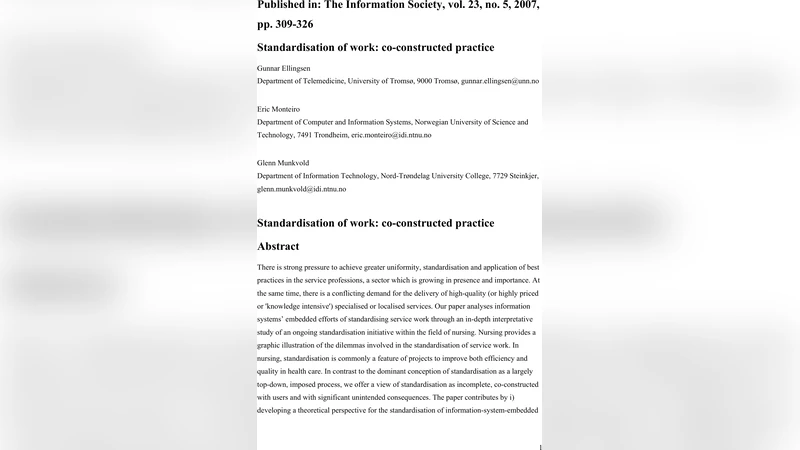
There is strong pressure to achieve greater uniformity, standardisation and application of best practices in the service professions, a sector which is growing in presence and importance. At the same time, there is a conflicting demand for the delivery of high quality or highly priced or knowledge intensive specialised or localised services. Our paper analyses information systems embedded efforts of standardising service work through an indepth interpretative study of an ongoing standardisation initiative within the field of nursing. Nursing provides a graphic illustration of the dilemmas involved in the standardisation of service work. In nursing, standardisation is commonly a feature of projects to improve both efficiency and quality in health care. In contrast to the dominant conception of standardisation as a largely topdown, imposed process, we offer a view of standardisation as incomplete, co-constructed with users and with significant unintended consequences. The paper contributes by developing a theoretical perspective for the standardisation of information-system-embedded service work and operational and practical implications for system design and health care management.
💡 Research Summary
The paper investigates how the standardisation of service work unfolds in a nursing context where information systems are deeply embedded in daily practice. It begins by outlining the dual pressures facing modern health‑care organisations: the demand for greater uniformity, efficiency, and cost control, and the simultaneous need to deliver high‑quality, patient‑centred, knowledge‑intensive care. While standardisation is often portrayed as a top‑down, technocratic imposition, the authors argue that in practice it is an incomplete, co‑constructed process that emerges through continuous negotiation between system designers, managers, and frontline nurses.
Methodologically, the study adopts an interpretative case‑study approach. Data were collected from a large teaching hospital undergoing an electronic medical record (EMR) driven standardisation initiative. The researchers conducted semi‑structured interviews with thirty participants—including staff nurses, nurse managers, and IT specialists—observed routine nursing workflows, and analysed project documentation and system usage logs. The qualitative material was coded iteratively to uncover the meanings that participants attached to the standardisation effort and the ways in which those meanings shaped their actions.
Key findings reveal three interrelated dynamics. First, standardisation goals become meaningful to nurses only when they are translated from abstract efficiency or safety metrics into concrete, patient‑focused scenarios. When checklists and templates are explicitly linked to real clinical situations, nurses are more willing to adopt them. Second, the design of the supporting information system initially lacked sufficient user input, leading to redundant data entry, excessive clicking, and limited flexibility for nuanced patient assessments. Introducing iterative feedback loops—prototype testing, real‑time log analysis, and regular co‑design workshops—mitigated these problems but also exposed early resistance and workflow disruptions. Third, once embedded, the standardised artefacts evolved from mere compliance tools into communication scaffolds that facilitated hand‑overs, interdisciplinary coordination, and shared situational awareness. In this sense, standardisation contributed positively to patient safety by improving information flow.
However, the study also documents unintended consequences. Over‑reliance on standardised forms can encourage “checkbox mentalities,” where nurses prioritize completing the form over exercising clinical judgment. Certain patient groups, such as older adults with multimorbidity, experience a mismatch between rigid protocols and the need for individualized care, prompting ad‑hoc workarounds. These observations underscore that standardisation is never final; it remains a dynamic, negotiated practice that must be continuously revisited.
Theoretically, the authors integrate socio‑technical systems theory with practice theory to propose a framework in which technical standards and social practices co‑evolve. Standardisation is portrayed not as a static set of rules but as a lived practice that gains legitimacy through joint meaning‑making. This perspective challenges the conventional view of standards as purely managerial control mechanisms and highlights the agency of frontline professionals in shaping, adapting, and sometimes subverting imposed structures.
From a managerial and design standpoint, the paper offers concrete recommendations. System designers should embed co‑design workshops at the outset to capture nurses’ workflow nuances and cognitive models. Standardised processes must incorporate built‑in flexibility, such as explicit exception handling pathways, to accommodate patient variability. Health‑care leaders are urged to treat standardisation projects as learning opportunities rather than mere cost‑saving exercises, establishing ongoing training, feedback, and performance‑monitoring cycles that reinforce a culture of continuous improvement.
In conclusion, the research demonstrates that the standardisation of service work in nursing is a co‑constructed, socially embedded endeavour rather than a top‑down imposition. Successful standardisation hinges on aligning technical artefacts with the lived realities of care providers, fostering iterative collaboration, and remaining vigilant to unintended side effects. By reconceptualising standards as dynamic, negotiated practices, the study provides a robust theoretical lens and actionable guidance for information‑system design and health‑care management aimed at achieving both efficiency and high‑quality patient care.
Comments & Academic Discussion
Loading comments...
Leave a Comment