Social shaping of information infrastructure: on being specific about the technology
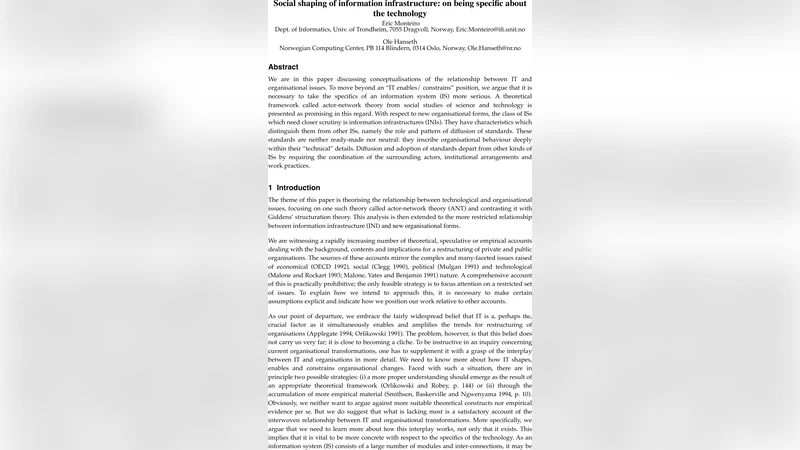
We are in this paper discussing conceptualisations of the relationship between IT and organisational issues. To move beyond an IT enables/ constrains position, we argue that it is necessary to take the specifics of an information system (IS) more serious. A theoretical framework called actor network theory from social studies of science and technology is presented as promising in this regard. With respect to new organisational forms, the class of ISs which need closer scrutiny is information infrastructures (INIs). They have characteristics which distinguish them from other ISs, namely the role and pattern of diffusion of standards. These standards are neither ready-made nor neutral: they inscribe organisational behaviour deeply within their technical details. Diffusion and adoption of standards depart from other kinds of ISs by requiring the coordination of the surrounding actors, institutional arrangements and work practices.
💡 Research Summary
The paper critiques the dominant “IT enables or constrains” dichotomy that has guided much of the information systems (IS) literature, arguing that such a view glosses over the concrete technical specifics that shape organizational outcomes. To move beyond this simplistic framing, the authors draw on Actor‑Network Theory (ANT) from the social studies of science and technology. ANT treats both human and non‑human elements—such as software, hardware, standards, and protocols—as actors that form networks, and it emphasizes that these networks produce social and organizational effects rather than merely reflecting pre‑existing structures.
Within this theoretical lens, the authors focus on a particular class of IS: information infrastructures (INIs). An INI is not just a collection of applications or databases; it is a networked system built upon shared technical standards that enable disparate organizations to interoperate. The paper identifies two distinctive features of INIs that set them apart from other IS. First, the role and diffusion pattern of standards: standards are not neutral, pre‑packaged artifacts but are socially constructed through negotiations among vendors, regulators, users, and other stakeholders. In the process of being codified, standards embed organizational routines, power relations, and institutional logics into their technical specifications—a process the authors refer to as “inscription.” Second, the diffusion and adoption of INIs require coordination across multiple layers of actors and institutions, because a single organization’s adoption of a standard creates pressures on its partners, suppliers, and customers to conform.
The authors propose a three‑stage model of INI evolution. In the design stage, technical choices (e.g., protocol parameters, data formats) are made in negotiation with organizational interests, thereby pre‑configuring certain work practices and limiting others. In the adoption stage, organizations must align internal processes, training programs, and governance mechanisms with the chosen standard, often requiring institutional adjustments such as new policies or contractual arrangements. In the diffusion stage, the standard spreads through the network, and the cumulative effect of many coordinated adoptions reshapes the broader socio‑technical landscape, sometimes reconfiguring existing power structures. Throughout these stages, coordination is not limited to technical compatibility; it also encompasses legal frameworks, normative expectations, and the cultivation of trust among heterogeneous actors.
Empirical illustrations—ranging from email systems and electronic payment networks to health‑care data exchange standards—demonstrate how standards become vehicles for organizational change. The case studies reveal that standards can lock in particular business models, marginalize alternative practices, and generate new forms of collaboration or competition. Moreover, the authors show that the perceived “neutrality” of technical standards often masks underlying economic and political interests, making the standardization process a contested arena.
The paper’s central contribution is to foreground the materiality of technology in shaping organizational behavior. By treating standards as active actors that inscribe organizational logics into code, the authors argue that policymakers, managers, and IT governance bodies must explicitly address the coordination challenges inherent in INI diffusion. This entails designing standards with an awareness of their socio‑organizational implications, fostering inclusive negotiation processes among stakeholders, and building institutional mechanisms that can adapt as the network evolves. In sum, the study advances a more nuanced, micro‑level understanding of how information infrastructures are socially shaped, urging scholars and practitioners to move beyond the binary “enabler vs. constraint” narrative toward a perspective that sees technology and organization as co‑constitutive.
Comments & Academic Discussion
Loading comments...
Leave a Comment