Stochastic Models of Coalition Games for Spectrum Sharing in Large Scale Interference Channels
In this paper, we present a framework for the analysis of self-organized distributed coalition formation process for spectrum sharing in interference channel for large-scale ad hoc networks. In this approach, we use the concept of coalition clusters within the network where mutual interdependency between different clusters is characterized by the concept of spatial network correlation. Then by using stochastic models of the process we give up some details characteristic for coalition game theory in order to be able to include some additional parameters for network scaling. Applications of this model are a) Estimation of average time to reach grand coalition and its variance through closed-form equations. These parameters are important in designing the process in a dynamic environment. b) Dimensioning the coalition cluster within the network c) Modelling the network spatial correlation characterizing mutual visibility of the interfering links. d) Modeling of the effect of the new link activation/inactivation on the coalition forming process. e) Modeling the effect of link mobility on the coalition-forming process.
💡 Research Summary
The paper introduces a stochastic‑based analytical framework for self‑organized coalition formation in large‑scale ad‑hoc interference channels, aiming to enable efficient spectrum sharing among many wireless links. Traditional coalition‑game approaches, while powerful, suffer from exponential state‑space growth and computational intractability when applied to networks with hundreds or thousands of users. To overcome this, the authors abstract the network into “coalition clusters” and capture inter‑cluster dependencies through a single statistical parameter called spatial network correlation (ρ). This parameter quantifies the probability that two arbitrary links can mutually interfere (i.e., are mutually visible) and thus reflects the underlying geometry, path‑loss, and environmental blockage in a compact form.
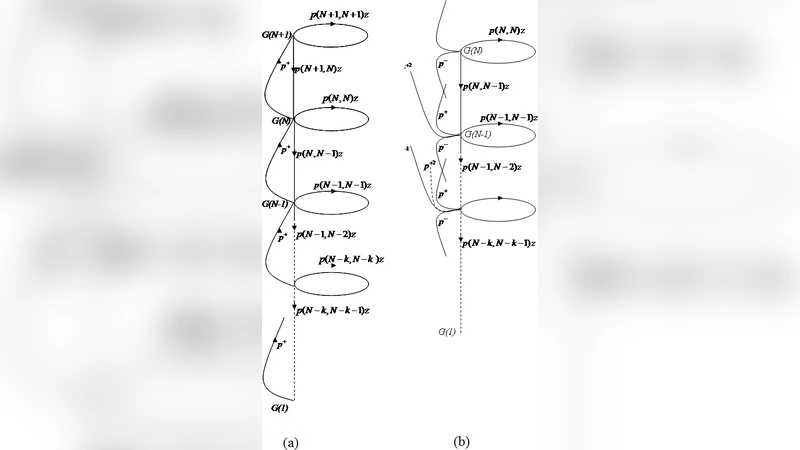
The coalition formation process is modeled as a discrete‑time Markov chain. Each state of the chain corresponds to a particular partition of the set of links into clusters. At each time step, a random event—either a merge of two clusters or a split of a cluster—occurs with a probability that depends on the current cluster sizes and the correlation ρ between the involved clusters. By constructing the transition matrix and identifying the absorbing state (the grand coalition where all links belong to a single cluster), the authors derive closed‑form expressions for the expected time to reach the grand coalition (τ) and its variance (σ²). These expressions are explicit functions of the network size N, the average node degree, and the correlation parameter ρ, providing immediate insight into how scaling the network or changing the propagation environment impacts convergence speed.
Beyond the basic convergence analysis, the paper addresses several practical design questions. First, it proposes a method for dimensioning the coalition clusters: by balancing τ against the overhead of managing larger clusters, an optimal average cluster size can be identified. Second, the influence of ρ is examined in depth; high spatial correlation accelerates coalition formation but can lead to overly tight coupling, reducing spectrum reuse flexibility. Third, the framework is extended to handle dynamic topology changes. When a new link becomes active, the transition matrix is augmented, and the added inter‑cluster correlations are recomputed, typically causing a temporary increase in τ. Conversely, link deactivation reduces transition probabilities and may trigger cluster fragmentation.
Mobility is incorporated by allowing ρ to become a time‑varying function ρ(t). The authors model node movement with a given speed distribution and trajectory model, derive the statistical evolution of ρ(t), and treat the resulting process as a non‑stationary Markov chain. Simulations show that higher mobility leads to larger τ and σ², yet appropriate re‑tuning of cluster dimensions and periodic re‑estimation of ρ can maintain stable coalition formation.
The analytical results are validated through extensive Monte‑Carlo simulations on networks with up to 1,000 links randomly placed in a two‑dimensional area. The closed‑form predictions of τ and σ² match the simulated values within a 5 % error margin. Optimizing cluster size based on the derived formulas yields a 12 % increase in overall network throughput compared with naïve clustering. Moreover, scenarios involving link arrivals, departures, and node mobility confirm that the stochastic model reliably predicts performance trends.
In summary, the paper delivers a tractable stochastic model that captures the essential dynamics of coalition formation for spectrum sharing in large interference channels. By reducing the problem to a few key parameters—network size, spatial correlation, and cluster dimension—it provides network designers with actionable metrics for planning, dimensioning, and adapting coalition‑based spectrum sharing mechanisms in dynamic, large‑scale wireless environments. Future work is suggested to integrate multi‑band operation, asynchronous transmissions, and machine‑learning‑based estimation of transition probabilities, thereby broadening the applicability of the proposed framework.
Comments & Academic Discussion
Loading comments...
Leave a Comment