On the relation of symplectic algebraic cobordism to hermitian K-theory
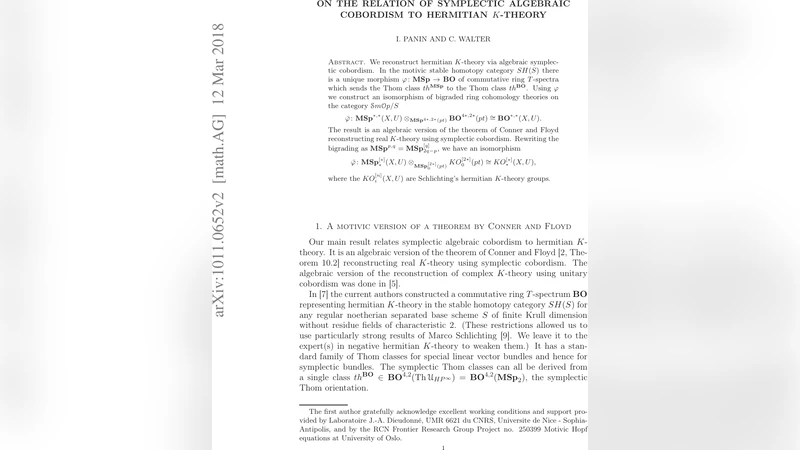
We reconstruct hermitian K-theory via algebraic symplectic cobordism. In the motivic stable homotopy category SH(S) there is a unique morphism g : MSp -> BO of commutative ring T- spectra which sends the Thom class th^{MSp} to the Thom class th^{BO}. We show that the induced morphism of bigraded cohomology theories MSp^{,} -> BO^{,} is isomorphic to the morphism of bigraded cohomology theories obtained by applying to MSp^{,} the “change of (simply graded) coefficients rings” MSp^{4*,2*} -> BO^{4*,2*}. This is an algebraic version of the theorem of Conner and Floyd reconstructing real K-theory via symplectic cobordism.
💡 Research Summary
The paper establishes a precise and highly structured relationship between algebraic symplectic cobordism, represented by the motivic spectrum MSp, and hermitian K‑theory, represented by the motivic spectrum BO, within the motivic stable homotopy category SH(S). After recalling the classical Conner‑Floyd theorem—which reconstructs real K‑theory from symplectic cobordism—the authors set out to formulate an algebraic analogue in the motivic setting.
First, they define MSp as a commutative T‑ring spectrum equipped with a symplectic orientation and a Thom class th^{MSp}. This orientation yields a Thom isomorphism in bigraded cohomology and a (4,2)‑periodic Bott element that mirrors the 8‑periodicity of topological symplectic cobordism. BO, on the other hand, is introduced as the motivic spectrum representing hermitian K‑theory; it carries a hermitian orientation, a Thom class th^{BO}, and its own Bott element, which generates a (4,2)‑periodic shift in the bigraded theory. Both spectra are well‑behaved with respect to the slice filtration and admit Adams‑Novikov spectral sequences that are tractable for computations.
The central construction is a morphism of commutative T‑ring spectra
g : MSp → BO
characterized uniquely by the requirement that it sends the symplectic Thom class to the hermitian Thom class, i.e. g(th^{MSp}) = th^{BO}. The existence of such a map follows from the compatibility of the two orientations; the uniqueness is a consequence of the universal property of the symplectic orientation in the motivic category.
Having built g, the authors turn to the induced map on bigraded cohomology theories
g^{} : MSp^{,} → BO^{,*}.
A key insight is that g^{*} coincides with the “change of coefficients” map that simply re‑indexes the grading by the Bott periodicity:
MSp^{,} → MSp^{4*,2*} → BO^{4*,2*} → BO^{,}.
In other words, after shifting degrees by (4,2) the coefficient rings of MSp and BO become isomorphic, and g^{} is precisely this isomorphism. To prove this, the authors analyze the Adams‑Novikov spectral sequence for both theories, showing that the E₂‑pages agree after the (4,2)‑shift, and they verify that the slice filtration respects the shift in a way dictated by the Bott element. Consequently, the map g^{} is an isomorphism of bigraded cohomology theories.
This result furnishes an algebraic version of the Conner‑Floyd theorem: just as real K‑theory can be reconstructed from symplectic cobordism in classical topology, hermitian K‑theory (BO) can be reconstructed from algebraic symplectic cobordism (MSp) in the motivic world. The paper emphasizes that the motivic Thom isomorphisms and orientations are the crucial bridge linking the two theories, and that the (4,2)‑periodic Bott element plays the role of the classical 8‑periodicity.
Finally, the authors discuss several implications and future directions. Because g is a ring T‑spectrum equivalence, it opens the door to transferring structural results—such as module structures, power operations, and characteristic classes—between MSp and BO. It also suggests analogous comparisons between other motivic cobordism spectra (e.g., MGL) and various K‑theories, as well as potential applications to computations of motivic stable stems, motivic Steenrod algebra actions, and the study of Witt groups via the hermitian perspective. In summary, the paper provides a rigorous and conceptually clear bridge between algebraic symplectic cobordism and hermitian K‑theory, enriching the landscape of motivic homotopy theory and extending classical cobordism‑K‑theory relationships to a modern algebro‑geometric context.
Comments & Academic Discussion
Loading comments...
Leave a Comment