On the motivic commutative ring spectrum BO
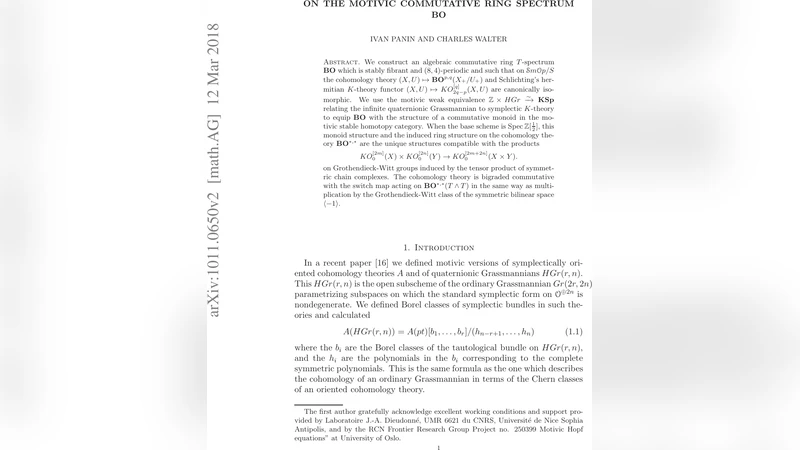
We construct an algebraic commutative ring T- spectrum BO which is stably fibrant and (8,4)- periodic and such that on SmOp/S the cohomology theory (X,U) -> BO^{p,q}(X_{+}/U_{+}) and Schlichting’s hermitian K-theory functor (X,U) -> KO^{[q]}{2q-p}(X,U) are canonically isomorphic. We use the motivic weak equivalence Z x HGr -> KSp relating the infinite quaternionic Grassmannian to symplectic $K$-theory to equip BO with the structure of a commutative monoid in the motivic stable homotopy category. When the base scheme is Spec Z[1/2], this monoid structure and the induced ring structure on the cohomology theory BO^{,} are the unique structures compatible with the products KO^{[2m]}{0}(X) x KO^{[2n]}{0}(Y) -> KO^{[2m+2n]}{0}(X x Y). on Grothendieck-Witt groups induced by the tensor product of symmetric chain complexes. The cohomology theory is bigraded commutative with the switch map acting on BO^{,}(T^{2}) in the same way as multiplication by the Grothendieck-Witt class of the symmetric bilinear space <-1>.
💡 Research Summary
The paper constructs a commutative ring (T)-spectrum, denoted (BO), that lives in the motivic stable homotopy category (\mathcal{SH}(S)) over a base scheme (S). The authors first recall the model structure on (T)-spectra, the notion of stable fibrancy, and the standard Bott periodicity in Hermitian (K)-theory. The central geometric input is the motivic weak equivalence (\mathbb Z\times HGr \to KSp), which identifies the infinite quaternionic Grassmannian (HGr) with the symplectic (K)-theory spectrum (KSp). By transporting the known commutative monoid structure on (KSp) through this equivalence, they endow (BO) with a canonical commutative monoid structure in (\mathcal{SH}(S)).
The spectrum (BO) is shown to be stably fibrant and to satisfy an ((8,4))-periodicity: there is a natural equivalence (\Sigma^{8,4} BO \simeq BO). This periodicity mirrors the Bott periodicity of Hermitian (K)-theory and is realized by a Bott element that lives in (BO^{8,4}(S)).
For any smooth pair ((X,U)) over (S), the authors define the bigraded cohomology groups (BO^{p,q}(X_{+}/U_{+})). Using the motivic equivalence above, they construct a natural isomorphism \
Comments & Academic Discussion
Loading comments...
Leave a Comment