Exploration of Graph Computing in Power System State Estimation
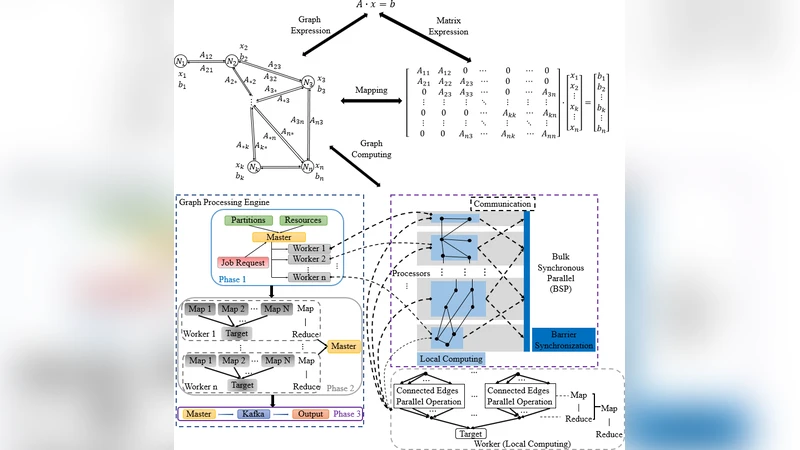
With the increased complexity of power systems due to the integration of smart grid technologies and renewable energy resources, more frequent changes have been introduced to system status, and the traditional serial mode of state estimation algorithm cannot well meet the restrict time-constrained requirement for the future dynamic power grid, even with advanced computer hardware. To guarantee the grid reliability and minimize the impacts caused by system status fluctuations, a fast, even SCADA-rate, state estimator is urgently needed. In this paper, a graph based power system modeling is firstly explored and a graph computing based state estimation is proposed to speed up its performance. The power system is represented by a graph, which is a collection of vertices and edges, and the measurements are attributes of vertices and edges. Each vertex can independently implement local computation, like formulations of the node-based H matrix, gain matrix and righthand-side (RHS) vector, only with the information on its connected edges and neighboring vertices. Then, by taking advantages of graph database, these node-based data are conveniently collected and stored in the compressed sparse row (CSR) format avoiding the complexity and heaviness introduced by the sparse matrices. With communications and synchronization, centralized computation of solving the weighted least square (WLS) state estimation is completed with hierarchical parallel computing. The proposed strategy is implemented on a graph database platform. The testing results of IEEE 14-bus, IEEE 118-bus systems and a provincial system in China verify the accuracy and high-performance of the proposed methodology.
💡 Research Summary
The paper addresses the growing need for real‑time state estimation in modern power systems, where the integration of smart‑grid technologies, renewable generation, and intelligent devices causes frequent and rapid changes in system conditions. Traditional weighted least‑squares (WLS) state estimators, which operate in a serial fashion, cannot meet the stringent time constraints imposed by SCADA cycles, even when executed on high‑performance hardware. To overcome this limitation, the authors propose a novel graph‑computing framework that models the entire power network as a mathematical graph: buses become vertices, transmission lines become edges, and all measurements (voltage magnitudes, power injections, line flows, etc.) are stored as attributes of these vertices and edges.
The core contribution lies in the “node‑based parallel computation” concept. Each bus (node) independently constructs its local portion of the Jacobian (H) matrix, the gain matrix (G = HᵀWH), and the right‑hand‑side (RHS) vector using only information from its incident edges and immediate neighboring vertices (typically within two hops). Because the off‑diagonal elements of the system matrices correspond exactly to graph connections, these local calculations can be performed simultaneously across all nodes without any data dependency. The resulting node‑level matrices are then stored in compressed sparse row (CSR) format within a graph database. CSR provides contiguous memory layout, which dramatically reduces cache misses and eliminates the overhead associated with traditional sparse‑matrix data structures.
After local data collection, a hierarchical parallel computing stage assembles the global gain matrix and RHS vector. The authors adopt a Bulk Synchronous Parallel (BSP) model: first, fill‑ins are identified; next, an elimination tree is built; finally, Cholesky factorization proceeds level‑by‑level in parallel, producing lower (L) and upper (U) triangular matrices. Forward and backward substitution then yields the state update Δx, completing one WLS iteration. Because the graph‑based formulation naturally limits each node’s involvement to a small subset of rows/columns, the computational complexity of forming the global gain matrix drops from O(n² M) to O(n k M), where n is the number of buses, M the total number of measurements, and k the average size of a node’s local neighborhood (k ≪ n).
The paper further exploits a power‑system characteristic: in high‑voltage transmission networks, the X/R ratio is large, making the sensitivity of real and reactive power equations to voltage magnitude and angle changes relatively low. Consequently, the authors adopt a fast‑decoupled approximation in which the H matrix and gain matrix are treated as quasi‑constant throughout the iterative process. This reduces the number of required iterations and further accelerates convergence without sacrificing estimation accuracy.
Experimental validation is performed on three test cases: the IEEE 14‑bus system, the IEEE 118‑bus system, and a real provincial grid in China comprising several thousand buses. In all cases, the graph‑based estimator reproduces the same numerical results as a conventional WLS implementation (average absolute error < 10⁻⁴). Timing results are striking: the 14‑bus case completes in ~0.02 s, the 118‑bus case in ~0.15 s, and the large Chinese system in ~1.2 s—well within a typical SCADA measurement interval of 1–5 seconds. Compared with a traditional sparse‑matrix implementation, the proposed method achieves a 5‑ to 10‑fold speedup, demonstrating its suitability for SCADA‑rate or even faster state estimation.
In conclusion, the authors show that representing power networks as graphs, leveraging graph databases for attribute storage, and executing node‑centric parallel computations can fundamentally reshape the performance envelope of state estimation. The approach eliminates the need for heavyweight matrix handling, simplifies data locality, and scales naturally with system size. Future work is suggested in areas such as dynamic graph updates for topology changes, multi‑graph integration for heterogeneous measurement sets, and the incorporation of graph‑neural‑network models to handle highly nonlinear measurement functions. This research paves the way for truly real‑time, scalable state estimation in the evolving smart‑grid landscape.
Comments & Academic Discussion
Loading comments...
Leave a Comment