RF Wireless Power Transfer: Regreening Future Networks
Green radio communication is an emerging topic since the overall footprint of information and communication technology (ICT) services is predicted to triple between 2007 and 2020. Given this research line, energy harvesting (EH) and wireless power tr…
Authors: Ha-Vu Tran, Georges Kaddoum
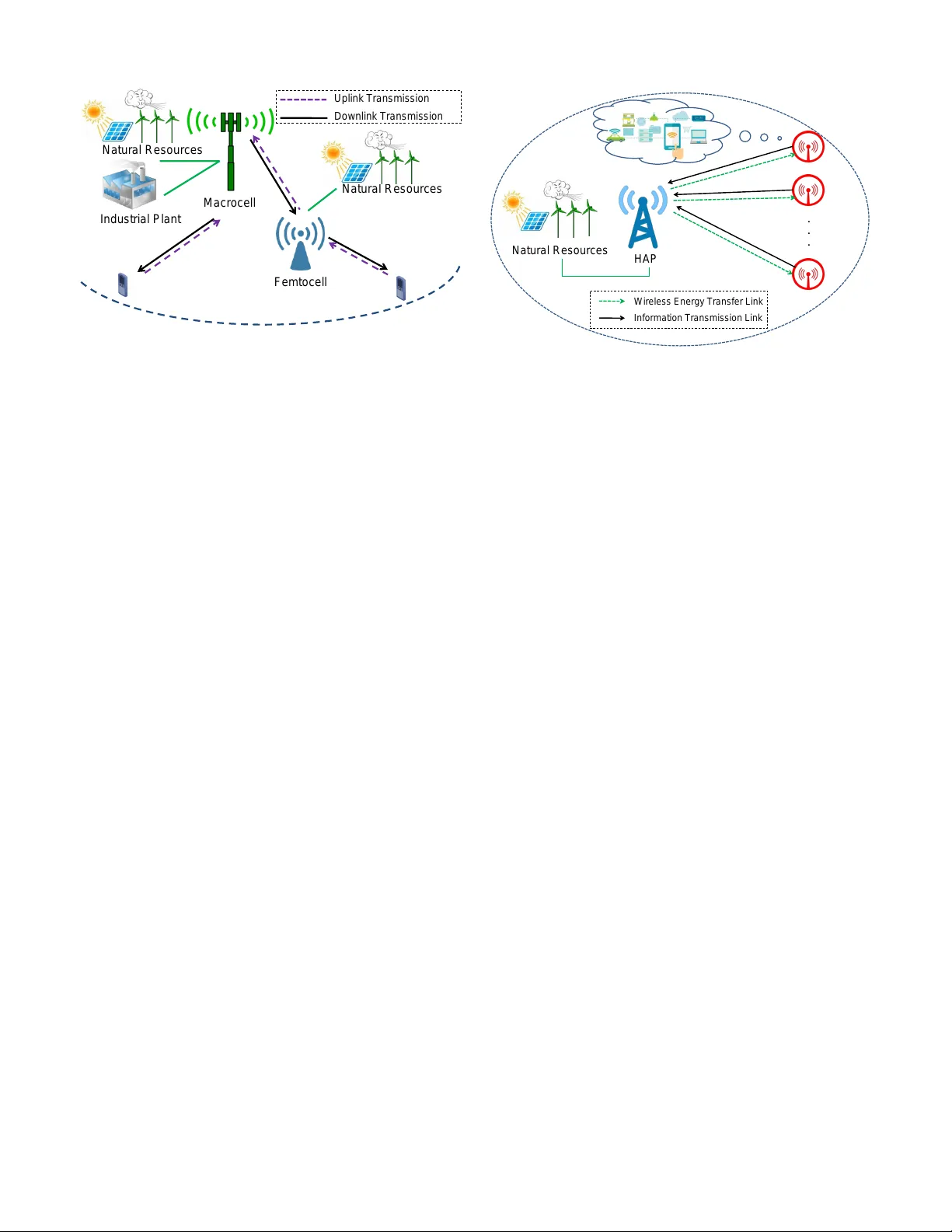
1 This is the authors’ version of the paper that has been accepted for publication in IEEE Potentials Magazine RF W ireless Po wer T ransfer: Re greening Future Networks Ha-V u T ran 1 and Geor ges Kaddoum 1 Abstract —Green radio communication is an emerging topic since the overall footprint of information and communication technology (ICT) services is predicted to triple between 2007 and 2020. Given this research line, energy harvesting (EH) and wireless power transfer (WPT) networks can be evaluated as promising approaches. In this paper , an overview of recent trends for futur e green networks on the platforms of EH and WPT is provided. By rethinking the application of radio frequency (RF)-WPT , a new concept, namely green RF-WTP , is introduced. Accordingly , opening challenges and promising combinations among current technologies, such as small-cell, millimeter (mm)- wav e, and Internet of Things (IoT) networks, are discussed in details to seek solutions f or the question with how to re-gr een the future networks? I . I N T RO D U C T I O N Over past few years, green radio communication has drawn much attention from the research community , and it has strong impacts on various aspects, such as telecom business, wireless technologies, and natural en vironments. Specifically , the elec- tricity cost and CO 2 emissions ha ve been increasing due to wireless network operation. For instance, the number of base stations (BSs) is more than 4 million, and each BS consumes an av erage of 25MWh per year (estimated approximate 80 percent of the total netw ork’ s po wer consumption). Bearing in mind the environmental perspecti ve, generating sufficient power to supply the networks causes a significant amount of CO 2 footprint. Particularly , the overall footprint of information and communication technology (ICT) services, e.g., computer , cell phone, and satellite networks, is predicted to triple by 2020 [1]. Recently , to wards a future green w orld, ener gy harvesting (EH) technique has the potential to deal with the problem of energy inefficienc y [2]-[5]. The main advantages of this ap- proach can be presented in two-fold. First, the EH techniques harnesses green energy from natural sources, e.g., solar and wind. Thus, it contributes to reducing the overall footprint in order to protect surrounding en vironments. No wadays, the popularity of using con v entional energy sources, e.g., diesel, still dominates the use of the green sources. Ho wev er , although the ov erall implementation cost of EH solutions is higher than that of con ventional ones, this cost might be compensated after sev eral years of operation. Second, another main challenge 1 Ha-V u Tran and Georges Kaddoum are with University of Québec, ÉTS engineering school, LA CIME Laboratory , 1100 Notre-Dame west, H3C 1K3, Montreal, Canada. Email: {ha-vu.tran.1@ens.etsmtl.ca, georges.kaddoum@etsmtl.ca.} This work has been supported by NSERC discovery grant 435243 - 2013. in future networks is prolonging the lifetime of smart user devices. Gi ven this concern, EH networks tak e a tremendous advantage in various specific applications. For instance, EH is an ef ficient solution for reducing battery replacement costs in wireless sensor networks. Also, it can rechar ge the devices working in areas where the traditional power supply is in- feasible, e.g., robotic devices working in toxic en vironments. Nev ertheless, the amount of harvested energy from natural resources, such as solar and wind, may v ary randomly ov er time and depend on locations and weather conditions. In other words, harv esting energy from these sources is not controllable and sustainable. For instance, there exists insufficient sunlight at night to generate energy , or it is difficult for indoor devices to harvest solar ener gy . In this context, radio frequenc y (RF) wireless power transfer (WPT) might be a promising approach to ov ercome such a drawback. In this paper , we provide a comprehensiv e revie w to address the mentioned question of regreening the future world. In more specific details, the main contributions of this paper can be summarized as follows. First, by rethinking the use of RF-WPT , a concept so-called gr een RF-WTP is introduced. Second, a vision of future green networks based on the platforms of EH and green RF-WPT is presented. Thus, we discuss potential scenarios with the purpose of bridging green resources to indoor energy-hungry devices in the networks. Third, applications of various interesting concepts, such as small-cell, mm-wa ve, internet of things (IoT), etc., networks are highlighted. Giv en this concern, the challenges on each concept are identified. Further, we discuss some attractiv e combinations of the existing concepts, such as a mixture of full-duplex, RF-WPT , and mm-wa ve, and inv estigate ho w the latter works together properly . T o this end, promising trends in future are drawn to provide solutions for future re-greened networks. I I . E N E R G Y H A RV E S T I N G A N D G R E E N R F W I R E L E S S P OW E R T R A N S F E R In this section, an ov erview of EH models and a discuss on green RF wireless po wer transfer are shown. A. EH Models EH methodology might be described by harnessing energy from surrounding en vironments or thermal and mechanical sources, and then con verting the latter into electrical energy . The generated electrical current can be used to supply devices 2 by RF wireless power transfer . Generally speaking, EH models can be classified into two architectures with harvest-use, and harvest-store-use. In the first one, energy is harvested, and then is used instantly . Besides, given the second one, energy is harvested as much as possible and then stored for future uses. In the follo wing, we discuss the characteristics of such models. In the harvest-use architecture, the EH systems directly supply devices. T o guarantee the operation of the de vices, the power output of the EH systems should be higher than the threshold of minimum working requirements. Otherwise, the devices would be disabled because there is not enough power supplied. As a consequence, unanticipated fluctuation in harv esting capacity close to threshold yields the working devices to vacillate in ON and OFF states. Further , the harvest-store-use model includes a component storing harvested energy and also powering the connected devices. Thanks to the storage, the ener gy can be harv ested until suf ficient for supplying the devices. Moreo ver , such energy might be stored for later uses when there is lack of produced energy or the devices need to increase the working performance. The storage component might include two parts of primary and secondary storages. In this conte xt, the sec- ondary storage can be seen as a backup one. In particular , the harvest-store-use system can make non-stable but foreseeable energy sources, such as solar and wind, more fa vorable in uses. B. Green RF W ir eless P ower T ransfer Over the last decade, solar , wind, mechanical, and thermal energy can be considered as the most efficient resources gen- erating green energy usable for wireless networks. Howe ver , the main dra wback of such sources is the lack of stability . In the quest for an alternati ve solution, the research community has explored that radio signals belonging to a frequency range from 300 GHz to 3 kHz can be used to carry energy over the air [3], [6], [7]. On this basis, a transmitter can proactively recharge wireless de vices by sending energy-bearing RF sig- nals whene ver it is necessary . This is the principle of a so- called RF-WPT technique. In fact, it is well-known that EH is a green technique since it helps to reduce the footprint. Howe ver , in a shared vision, the RF-WPT technique seems to be harmful to surrounding en vironments because it costs electricity to generate RF sig- nals, and causes electromagnetic pollution to the human body as well as interferences to data transmission. By rethinking the role of RF-WTP technique, we suggest that the RF-WTP can be seen as green if f (i) the RF signal carrying ener gy is generated using power harvested from green resources (for example, BSs are connected with outdoor energy harv esters to harvest-and-store green energy and then use such energy to wirelessly recharge to indoor devices using RF signals), and (ii) a tight restriction is applied for increasing the transmit power (i.e., following the equi v alent isotropically radiated power (EIRP) requirement approved by Federal Communi- cations Commission). In this work, the RF-WTP satisfying such two conditions is so-called the gr een RF-WTP . The characteristics of the green RF-WPT technique can be listed as follo ws Bas e Station G reen RF energy Natural Res ources Fig. 1. Green RF-WPT . • The green RF-WPT technique plays a role as a bridge between green ener gy sources and ener gy-hunger devices. • The energy harvested at a receiver is foreseeable. • The amount of harvested energy belongs to transmit power , propagation loss, and wa velength. Indeed, it is expected that the green RF resource is one of the most interesting candidates for future applications. I I I . A V I S I O N O F F U T U R E G R E E N A N D E H N E T W O R K S A. A predicted model of future gr een networks with EH Future networks, e.g., 5G, are expected to support multi- media applications to achiev e 1000-fold higher throughput, 1000-fold higher mobile data per unit area, and 10-fold longer lifetime of devices over the fourth generation (4G) networks [4], [5]. T o adapt this progress, the design of ne w cellular networks tends to a new form embracing a large-scale deployment of small-cells. Generally , the small-cells can be classified into distinct types including femtocell, microcell and picocell. Indeed, the multi-tier HetNet attains a promising gain in terms of spectral and energy efficiencies due to low power consumption and good ubiquitous connecti vities [8]. On the other hand, nowadays, the dev elopment of wire- less networks has broken the limits of power consumption, especially in cellular networks. Moreov er, the energy cost and CO 2 emissions ha ve been promptly growing due to the network operation. Specifically , this has inspired researchers with a challenging topic so-called future green wireless net- works. As a promising solution, EH techniques exploit natural sources, and then contribute to reducing the ov erall footprint and extending the network lifetime. Nevertheless, the natural resources may not be always av ailable to all devices. For instance, it is dif ficult for indoor devices to harvest solar energy . This yields another trend that BSs connected with outdoor harvesters which can harvest-and-store green ener gy when natural resources are av ailable. Afterwards, BSs use such energy to wirelessly charge user de vices using RF signals. Another approach to future green networks is the concept of green IoT [10]. In fact, IoT is an emerging trend that billions of identified low-po wer devices, e.g., sensor nodes, are connected to each other without the need for human inter- action. It can provide solutions to cut CO 2 emissions, reduce 3 D2D Natural Res ources Indus trial Pl ant Macro cel l Mm - w ave Pi c ocel l Rel ay Node IoT Femtoc el l Core Net w o rk Natural Res ources Natural Res ources Informati on T ransm i s s i on Energy T ransfer IoT Fig. 2. A Future Green Network. electromagnetic pollutions and improve energy efficienc y . For instance, with tracking of motion sensors, the lights in rooms where there is no one inside would be turned off. Also, the green IoT technology can monitor energy usage in hi- tech buildings to reduce wasted energy . In fact, the green IoT is expected to enhance all technical, economical and en vironmental benefits. In particular , IoT network architectures mainly rely on the platforms of wireless sensor networks (WSNs), and cooperative networks to connect devices together [9]. In this concern, battery recharging for a large number of IoT devices is challenging indeed. Therefore, enabling the green IoT concept to wards future networks requires advanced solutions of prolonging device’ s life-time, resource manage- ments, and energy-ef ficient communication protocols. T aking all the problems of interest into account, in the following, we further discuss several potential concepts to- wards green future networks as shown in Fig. 2. Specifically , challenges in implementing each concept are identified. B. Green r adio communications: Main concepts and discus- sions 1) Full-duplex networks: as mentioned, indoor devices which might not harv est green ener gy directly can be wire- lessly powered by RF signals sent from BSs. Accordingly , this has inspired a combination of the full-duplex and simultaneous wireless information and po wer transfer (SWIPT) techniques. At the same time, the de vices can receive energy in the downlink transmission while conv eying information in the uplink connections to boost spectral efficiency . Furthermore, we discuss two potential research issues of full-duplex SWIPT systems. First, the antennas at the full- duplex node are con ventionally divided into transmit and receiv e sets. T o improve the performance of SWIPT sys- tems, an advanced form of the full-duplex technique that each antenna can simultaneously send information/energy and receiv e energy/information in the same frequenc y band is highly desirable. Indeed, this approach mainly depends on new hardware designs and new innov ation of self-interference cancellation techniques. Second, full-duplex SWIPT small- cell base station can provide a promising approach regarding wireless backhauls in HetNets. In downlinks, the small-cell BS can recei ve information from macro-cell and transmit infor- mation/energy to users simultaneously . In uplinks, the small- cell BS can receiv e information/ener gy and send information to macro-cell at the same time. On this basis, the small-cell BSs do not require a separate frequency band of backhaul connections. Hence, resources and implementing costs are reduced. 2) Millimeter-wave networks: benefitting from mm-wav e transmission, the o verall electromagnetic field (EMF) e xposure and po wer consumption per bit transmitted of networks are reduced due to a higher free-space attenuation at the mm-wa ve frequency , high directiv e antennas, and short distance links. Therefore, mm-wav e communication has been considered as a primary candidate for green cellular networks in future. This approach is e xpected to achie ve multi-gigabit data rates due to large spectrum resources at a ultra-high frequency band. Specifically , EH de vices can e xtract energy from incident RF signals. Moreover , in mm-wa ve systems, many BSs are densely deployed to ensure proper coverage to ultra-high frequency networks. Thus, this can be attractive for the EH devices to potentially harvest sufficient energy . In ultra-high frequency bands, the mm-wav e signals mainly suffer from the propagation loss, such as poor penetration and dif fraction. T o make mm-wa ve netw orks more fa vorable for SWIPT , beamforming techniques can be a promising solution to increase the network cov erage and system per- formance. Moreov er, in mm-w ave netw orks, although the small wav elength signals allo w large antenna arrays to of fer high beamforming gains, they require the alignment between transmit and receiv e beams to reach the highest possible 4 performance. In these concerns, there is a non-tri vial problem of the beamwidth design. In practice, the length of beam- searching ov erhead is directly proportional to the number of beamformer candidates. The narrower beamwidth is, the more number of the beamformer candidates is, and then the longer ov erhead is. This leads the time of data transmission to be decreased. In constrast, the wider beamwidth means that it is easier for transmit and receiv e beams to be aligned, and the beam-searching process is sped up, howe ver , the beamforming gain is reduced. Therefore, future works should consider the impact of beamwidth in various contexts to maximize the SWIPT system performance. 3) W ireless sensor networks: ov er the last fe w years, the trend for WSNs is one of the most attractive topics due to flexible installation and con venient maintenance. Accord- ingly , man y standards such as WirelessHAR T , WIA-P A, and ISA100.11a have been proposed. Particularly , the IoT tech- nology is mainly implemented on the WSN platform. With an integration of IoT with sensors, sensor devices can be interconnected with the global Internet in order to provide solutions for future networks, such as reducing wasted energy in hi-tech b uidings. Specifically , replacing or charging the batteries in IoT WSNs may take time and costs due to a large number of sensors, and this process becomes dangerous for humans in hazardous environments. As a result, the EH from natural resources and RF signals for WNSs ha ve been considered as a promising solution to prolong the sensor’ s lifetime. As the main distinction from con v entional WSNs, EH- WSNs require ne w criteria in the fairness between information transfer and EH requirements. In fact, the network can fail to adapt the EH requirement while ensuring other system perfor- mances, such as throughput, delay or packet loss. As a result, lev eraging between data transmission and EH is one of the critical concerns in designing EH-WSNs. Therefore, efficient resource allocation schemes should take such a problem into account to achie ve high energy efficienc y for EH-WSNs. 4) Cooperative r elay networks: in recent, the cooperative relay network have been ev aluated as one of the main core networks for the IoT technology where IoT nodes can commu- nicate with each other and forward information and energy to the remote nodes. Up to now , many mature research works of cooperativ e communication hav e clearly shown that the relay can be implemented not only to extend the coverage range b ut also to improve the performance of wireless communications. Further , the concept of EH/WPT relay networks has been proposed and studied to enhance the lifetime of devices and ov erall performance of wireless networks. In cooperative EH/WPT relay networks, impro ving performance gain on the physical layer is one of the main research directions. Hence, most previous efforts attempt to design novel schemes regarding relay operation policies, po wer allocation, precoder optimization and relay selection. Considering existing challenges, the enhancement for both spectral and energy efficiencies in cooperati ve relay networks with the green RF-WTP is remarkable. In this concern, full- duplex or two-way relaying methods might be a promising solution. Further, it is suggested that developed resource U plink T rans m is s ion D ow nlink T rans m is s ion Fig. 3. Mm-wave SWIPT networks with full-duplex communications. allocation schemes should consider the influence of incomplete channel state information (CSI) (e.g., the relay nodes hav e a partial user’ s CSI), and the energy status at the relay nodes and users (e.g., the av ailable energy , current po wer consumption, predicted energy harvested from natural resources or RF signals, etc.) on system performance. I V . F U T U R E R E S E A R C H I S S U E S In the prior section, sev eral challenges of each concept hav e been presented. In future netw orks, since wireless com- munication systems are expected to be a mixture of v arious nov el system concepts to enhance both the spectral and energy efficiencies, some interesting combinations of the existing concepts are discussed as follo ws. A. When full-duplex communications meet mm-wave SWIPT networks? A combination of mm-wa ve and full-duplex SWIPT sys- tems, as shown in Fig. 3, seems to be interesting. Most of the recent research on full-duplex SWIPT systems mainly address the communications in conv entional frequency bands. Howe ver , in mm-w ave frequency bands, there are two main challenges need to be discussed. First, the practical implemen- tation of mm-wa ve full-duplex SWIPT should be in vestig ated with a bandwidth of sev eral GHz. Second, in mm-w ave net- works, the communication is inherently directional. Therefore, at both the transmission and reception sides, the directional antenna should be used. As a result, the node structure should be re-considered according to the characteristics of mm-wav e signals. T o reduce the cost of antennas (i.e. about parabolic antennas), one of the efficient solutions is to employ transmit and receive beams to limit self-interference. Therefore, the future objecti ves should address: • studying how the beamwidth affects the beam alignment, beamforming gain and beam-searching process, • in vestig ating the performance trade-off between self- interference and data transmission time, • and then properly allocating av ailable resources to opti- mize system performance. 5 Natur al Resources Industrial Pl ant Mac rocel l Femtoc el l Natural Res ources U plink T rans m is s ion D ow nlin k T ran s m is s ion Fig. 4. SWIPT and EH HetNets with the full-duplex technique. B. What ar e potential scenarios for SWIPT and EH HetNets with the full-duple x technique? Full-duplex EH-SWIPT HetNets may bring a bright, ho w- ev er , challenging approach. Giv en this concern, in Fig. 4, a macro-cell BS harvests energy from natural sources and then communicates with a small-cell BS. On the other hand, whereas the small-cell BS receiv es information from the macro-cell, it transmits information/energy to the users at the same time. In another case, the small-cell BS transmits information to the macro-cell while it receiv es information from the user simultaneously . Gi ven these scenarios, the sytem benefits from an enhanced spectral ef ficiency , ho wever , there appear a lot of interference sources, e.g., self-, inter -cell and intra-cell interferences due to full-duple x communications. Specifically , dealing with do wnlink-to-uplink interference is a big challenge since the downlink power dominates the uplink one in general. Therefore, using optimization frame works, future works need to focus on: • designing new self-interference cancellation techniques, • managing the downlink-to-uplink interference, • allocating resources to optimize the system performance in terms of the information and power transfer . C. What ar e the main concerns of wir elessly powering Internet of Things networks? Due to large-scale deployments of IoT networks, replac- ing or recharging the device’ s battery is one of the main challenges. Specifically , a large number of IoT sensors are implemented in indoor locations where natural resources might be not av ailable to harvest directly . In this conte xt, the green RF-WPT is a promising candidate for prolonging the lifetime of the IoT low-po wer de vices. Thus, this implies a scenario as illustrated in Fig. 5 where a sink node is responsible for harvesting energy from natural resources and then wirelessly transferring power to devices in a IoT wireless sensor net- work. In addition, the devices can communicate with each other . Given the model, some important concerns need to be addressed as follo ws. • scheduling the po wer transfer to energy-hungry users according to the harvested energy at the sink node, . . . Wireles s E nergy T rans fer Link Inf or mation T ra ns miss ion Link HAP Na tural Re sou rces Fig. 5. RF-WPT Internet of Things networks. • e xploiting interference from ambient en vironments to improv e the EH performance, • maximizing the information performance while satisfying EH requirements. V . C O N C L U D I N G R E M A R K S In this work, we ha ve presented a revie w of promising trends tow ards future green networks. Based on the platform of EH techniques, sev eral potential concepts such as HetNet, mm- wa ve and IoT networks, have been presented. In particular , we discuss a promising architecture, so-called green RF-WPT . In fact, the latter plays a crucial role as a bridge between natural energy resources and smart energy-hungry devices. Accordingly , we have shown a vision of future green networks in which smart de vices can be rechar ged by green resources ev en when they cannot harvest ener gy directly . Furthermore, to facilitate the regreening process while adopting intensi ve system performance required in future networks, the combi- nations of techniques, such as SWIPT , mm-wav e, full-duplex, can bring outstanding outcomes. Gi ven this concern, we hav e identified some challenges in mixing the potential concepts, and discussed ho w the y can work together . Indeed, it is expected that the green RF-WPT -based approaches can be one of the potential solutions for regreening the future ICT world. R E F E R E N C E S [1] A. Fehske, G. Fettweis, J. Malmodin, and G. Biczok, "The global footprint of mobile communications: the ecological and economic perspectiv e," IEEE Commun. Mag. , vol. 49, no. 8, pp. 5562, Aug. 2011. [2] R. Mahapatra, Y . Nijsure, G. Kaddoum, N. U. Hassan, and C. Y uen, "Energy efficiency tradeoff mechanism tow ards wireless green communi- cation: A surve y ," IEEE Comm. Surveys & T utorials , vol. 18, no. 1, pp. 686705, Firstquarter 2016. [3] X. Lu, P . W ang, D. Niyato, D. I. Kim, and Z. Han, "W ireless networks with RF energy harvesting: A contemporary survey ," IEEE Comm. Surveys & T utorials , vol. 17, no. 2, pp. 757789, 2015. [4] E. Hossain and M. Hasan, "5G cellular: Key enabling technologies and research challenges," IEEE Instrum. Meas. Mag. , vol. 18, no. 3, pp. 1121, June 2015. [5] A. Gupta and R. K. Jha, "A survey of 5G network: Architecture and emerging technologies," IEEE Access , vol. 3, pp. 12061232, July 2015. [6] H.-V . T ran, G. Kaddoum, H. Tran, D.-D. T ran, and D.-B. Ha, "T ime rev ersal SWIPT networks with an activ e eavesdropper: SER-energy region analysis," in Proc. of IEEE 84th V ehicular T ec hnology Conference , Montreal, Canada, Sep. 2016. 6 Ha-V u T ran recei ved a bachelor degree in Electronic and T elecommunication Engineering from Hue Univ ersity of Sciences, V ietnam in 2012. In 2015, he completed master degree in Electronics and Radio Engineering from Kyung Hee University , South Korea. Currently , he is pursuing his Ph.D. degree at École de T echnologie Supérieure (ETS), University of Québec, Canada. Georges Kaddoum (M’11) is an associate Professor of electrical engineering with the École de T echnologie Supérieure (ETS), University of Québec, Montréal, QC, Canada. He received his B.Sc. degree from the École Nationale Supérieure de T echniques A v ancées (ENST A Bretagne), Brest, France, and the M.S. degree from the Université de Bretagne Occidentale and T elecom Bretagne (ENSTB), Brest, in 2005 and the Ph.D. degree (with honors) from the National Institute of Applied Sciences (INSA), Univ ersity of T oulouse, T oulouse, France, in 2009. [7] G. Kaddoum, H.-V . T ran, L. Kong, and M. Atalla, "Design of simultane- ous wireless information and power transfer scheme for short reference DCSK communication systems," IEEE T rans. Commun. , Oct. 2016, early access. [8] H.-V . Tran, G. Kaddoum, H. Tran, and E.-K. Hong, "Downlink power optimization for heterogeneous networks with time rev ersal-based trans- mission under backhaul limitation," IEEE Access , vol. 5, pp. 755770, January 2017. [9] IEC, "Internet of things: W ireless sensor networks," White P aper , 2014. [Online]. A v ailable: www .iec.ch/whitepaper/pdf/iecWP-internetofthings- LR-en.pdf [10] C. Zhu, V . C. M. Leung, L. Shu, and E. C.-H. Ngai, "Green internet of things for smart world," IEEE Access , vol. 3, pp. 21512162, Nov . 2015.
Original Paper
Loading high-quality paper...
Comments & Academic Discussion
Loading comments...
Leave a Comment