Galaxy Mergers with Adaptive Mesh Refinement: Star Formation and Hot Gas Outflow
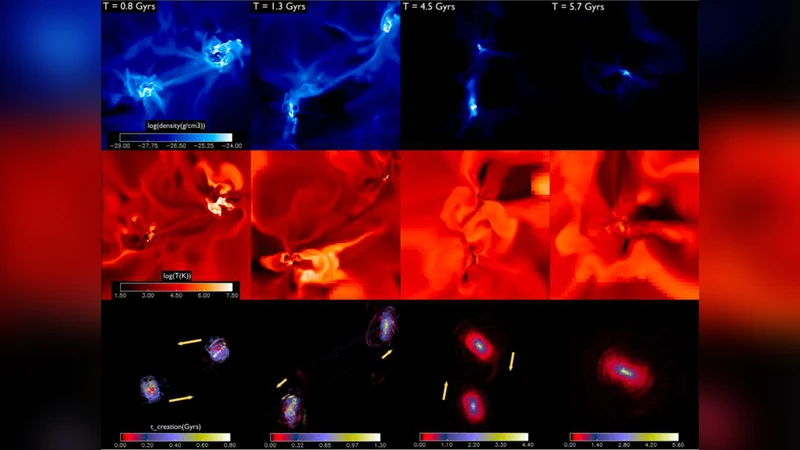
In hierarchical structure formation, merging of galaxies is frequent and known to dramatically affect their properties. To comprehend these interactions high-resolution simulations are indispensable because of the nonlinear coupling between pc and Mpc scales. To this end, we present the first adaptive mesh refinement (AMR) simulation of two merging, low mass, initially gas-rich galaxies (1.8e10 Ms each), including star formation and feedback. With galaxies resolved by ~2e7 total computational elements, we achieve unprecedented resolution of the multiphase interstellar medium, finding a widespread starburst in the merging galaxies via shock-induced star formation. The high dynamic range of AMR also allows us to follow the interplay between the galaxies and their embedding medium depicting how galactic outflows and a hot metal-rich halo form. These results demonstrate that AMR provides a powerful tool in understanding interacting galaxies.
💡 Research Summary
In this paper the authors present the first adaptive mesh refinement (AMR) simulation of a merger between two low‑mass, gas‑rich galaxies, each with a total mass of 1.8 × 10¹⁰ M⊙. By employing a hierarchical grid that refines down to ≈5 pc, the calculation uses roughly 2 × 10⁷ computational elements, delivering an unprecedented dynamic range that simultaneously resolves the multiphase interstellar medium (ISM) on parsec scales and the surrounding circumgalactic environment on kiloparsec to megaparsec scales.
The initial conditions consist of two isolated disk galaxies with high gas fractions, set on a prograde–retrograde orbit that leads to a close encounter and eventual coalescence. Star formation is modeled with a density threshold (ρ > 100 cm⁻³) and temperature ceiling (T < 10⁴ K); cells meeting these criteria spawn star particles of 10⁵ M⊙ with a probabilistic Schmidt‑law efficiency. Stellar feedback is implemented as thermal energy injection and metal enrichment from supernovae, which both heats the surrounding gas and drives turbulent motions. Importantly, the feedback scheme does not include explicit kinetic outflows or radiation pressure, focusing instead on the thermal coupling that is well captured by the high‑resolution AMR grid.
During the first pericentric passage, large‑scale shock fronts sweep across both disks, compressing gas to densities far above the star‑formation threshold. This triggers a galaxy‑wide starburst, raising the instantaneous star‑formation rate (SFR) by a factor of 5–7 relative to the isolated galaxies. Unlike many previous smoothed‑particle hydrodynamics (SPH) studies that report centrally concentrated bursts, the AMR results show star formation distributed throughout the disks, consistent with observations of ultra‑luminous infrared galaxies (ULIRGs) where extended star‑forming regions are seen.
The thermal feedback rapidly creates a hot (10⁶–10⁷ K), low‑density bubble that expands out of the galactic plane. As the bubble breaks out, it entrains metal‑rich gas and drives a large‑scale outflow that reaches several hundred kiloparsecs. The expelled material forms a quasi‑spherical, metal‑enriched halo that remains hot for many gigayears, providing a natural explanation for the X‑ray luminous, metal‑rich circumgalactic medium (CGM) observed around starbursting systems. The authors track the metal mass budget and find that roughly 30 % of the metals produced in the starburst are deposited into this halo, while the remainder stays locked in the newly formed stellar component.
A key methodological insight is the advantage of AMR over traditional SPH in capturing thin cooling layers, shock‑induced density enhancements, and the multiphase structure of the outflow. The adaptive refinement follows the gas wherever it becomes dense, ensuring that the Jeans length is resolved by at least four cells and preventing artificial fragmentation. This leads to a more realistic treatment of turbulent mixing and thermal conduction, which are essential for the formation of the hot CGM.
The paper also discusses limitations. Magnetic fields and full radiative transfer are omitted, which could alter the efficiency of feedback‑driven outflows and the cooling rates of the hot halo. The feedback model is purely thermal and does not include momentum‑driven winds or AGN activity, so the quantitative predictions for mass‑loading factors should be regarded as lower limits. Future work is suggested to incorporate magnetohydrodynamics, more sophisticated radiation pressure schemes, and a broader suite of merger mass ratios and orbital configurations to test the robustness of the results.
In summary, this study demonstrates that high‑resolution AMR simulations can bridge the gap between parsec‑scale star formation physics and megaparsec‑scale galactic environment, revealing that shock‑induced, galaxy‑wide starbursts and the subsequent thermal feedback naturally produce extended hot, metal‑rich outflows and a long‑lived circumgalactic halo. These findings provide a compelling theoretical framework for interpreting observations of starburst galaxies, their multiphase outflows, and the enriched hot halos that surround them.
Comments & Academic Discussion
Loading comments...
Leave a Comment