Towards an MDD Based Framework for Self Adaptive IoT Applications Development
As technology and communication advances, more devices (and things) are able to connect to the Internet and talk to each other to achieve a common goal which results in the emergence of the Internet of Things (IoT) era. It is believed that IoT will bring up a limitless number of applications and business opportunities that will affect almost every aspect of our life. Research has already been conducted to investigate the challenges that obstruct the realization of IoT along with the promising solutions that pave the way for the acceptance and enabling of IoT. Among the research areas that is of a great importance to making IoT paradigm possible is the presence of a unified programming framework that masks the heterogeneity of the involved devices of the IoT platform. Such a framework guides system developers throughout the IoT application development process. In this paper, we investigate the IoT concept and its high level architecture in general and focus more on the application development aspect. We believe that IoT applications are highly dynamic in nature and thus need to be engineered with the self adaptive and autonomic concepts in mind. Therefore, our proposed IoT software development lifecycle was based on the IBM architecture blueprint for autonomic systems. To cater for the runtime dynamic and heterogeneity aspects of IoT applications, we adopt the MDD paradigm for our proposed development framework. We highlight the core requirements of a resilient development framework that accommodates the necessary concepts and processes for a successful IoT application.
💡 Research Summary
**
The paper addresses two fundamental challenges in the development of Internet‑of‑Things (IoT) applications: device heterogeneity and runtime dynamism. To cope with these issues, the authors propose a development framework that combines Model‑Driven Development (MDD) with the IBM autonomic computing blueprint known as MAPE‑K (Monitor, Analyze, Plan, Execute, Knowledge).
The introductory sections review the rapid expansion of IoT across domains such as healthcare, smart homes, and industrial automation, and note that despite many proposed high‑level IoT reference architectures, there is no universally accepted stack. The authors emphasize the necessity of a middleware layer that abstracts physical devices (sensors, actuators, RFID tags, etc.) and provides protocol translation, data aggregation, and security functions, typically via a gateway positioned between the device layer and cloud services.
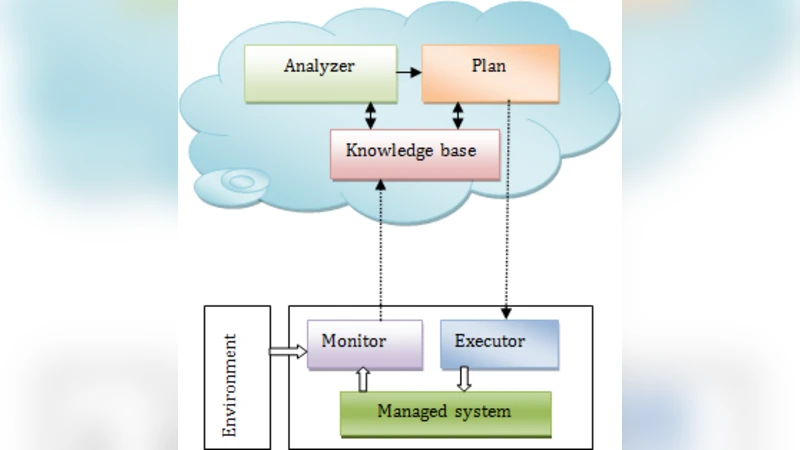
In the background, the paper contrasts internal versus external approaches to self‑adaptation. The external approach, exemplified by IBM’s autonomic architecture, separates adaptation logic from the core application, improving reusability and maintainability. A feedback control loop (the MAPE‑K cycle) continuously observes the system (via sensors), analyses the collected data, decides on corrective actions, and executes them through effectors. The knowledge base stores system state, policies, and models that guide the loop.
Related work surveys several IoT development platforms (DiaSuite, HYDRA, IoT‑A, Oracle’s IoT reference, Microsoft Azure). While these solutions provide service‑oriented middleware, semantic interoperability, or cloud‑centric tooling, none explicitly integrates autonomic self‑adaptation with a model‑driven engineering process.
The core contribution is a conceptual framework composed of three major parts:
-
Managing System – Implements the distributed MAPE‑K loop. The authors propose locating the Monitor and Execute components on a local gateway to reduce latency and bandwidth consumption, while the Knowledge component resides in the cloud for global policy management and long‑term learning.
-
Managed System – Represents the physical devices and their virtual counterparts. The framework supplies an interface for registering devices, defining their capabilities, and binding them to business processes through platform‑independent models.
-
Environment – Encompasses any external actors or contextual information that can influence adaptation decisions (e.g., user preferences, regulatory constraints, ambient conditions).
Five quality attributes are identified as mandatory for a successful framework:
- Generic – The framework must be applicable across diverse verticals without extensive re‑engineering.
- Ease of Use – Developers should be able to model systems using high‑level DSLs or UML and rely on automated code generation, lowering the entry barrier.
- Extensibility – New device types, communication protocols, or adaptation policies should be addable as plug‑ins.
- Customization – The organization of the feedback loop (centralized, hierarchical, or fully distributed) can be tailored to specific organizational or performance requirements.
- Testability – Each MAPE‑K phase should be independently simulatable and verifiable; the authors reference existing autonomic testing frameworks and design patterns (Observer, Strategy) to support this.
Methodologically, the framework adopts MDD: developers create platform‑agnostic models (often expressed in a domain‑specific language) that describe devices, services, and adaptation policies. A model‑to‑code transformation engine then generates the necessary middleware glue code, device drivers, and cloud components. This approach promises reduced development time, higher consistency between design and implementation, and easier evolution when the underlying hardware or protocols change.
The paper concludes with a discussion of future work, noting that the current contribution is primarily architectural and requirement‑driven. Empirical validation—through performance benchmarks, real‑world deployment on heterogeneous hardware, and formal definition of the MDD toolchain and MAPE‑K interfaces—is required to demonstrate practicality. Nonetheless, the proposed combination of autonomic feedback loops with model‑driven engineering offers a compelling blueprint for building resilient, self‑adapting IoT applications.
Comments & Academic Discussion
Loading comments...
Leave a Comment