A probabilistic cellular automata model for the dynamics of a population driven by logistic growth and weak Allee effect
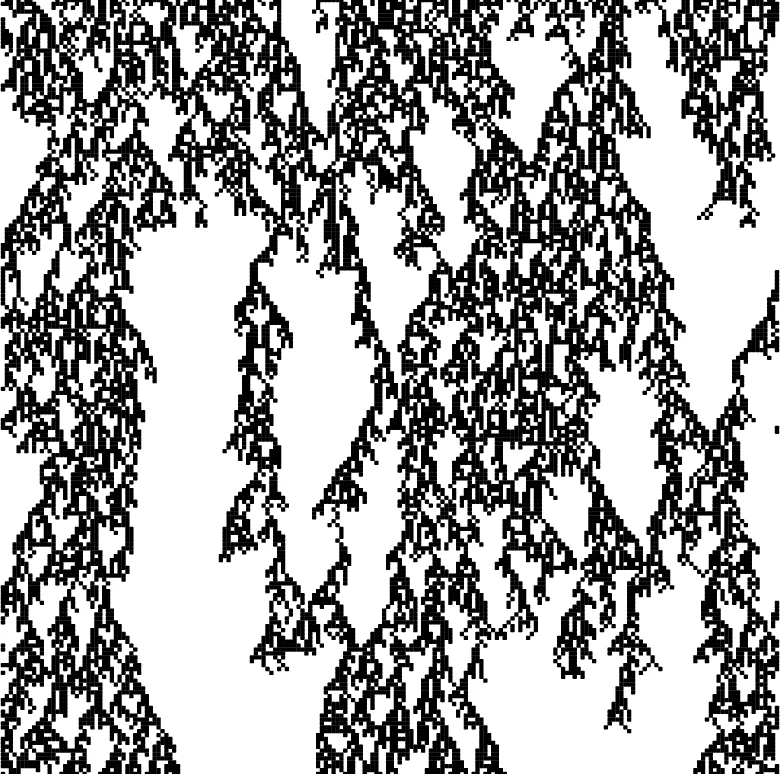
We propose and investigate a one-parameter probabilistic mixture of one-dimensional elementary cellular automata under the guise of a model for the dynamics of a single-species unstructured population with nonoverlapping generations in which individuals have smaller probability of reproducing and surviving in a crowded neighbourhood but also suffer from isolation and dispersal. Remarkably, the first-order mean field approximation to the dynamics of the model yields a cubic map containing terms representing both logistic and weak Allee effects. The model has a single absorbing state devoid of individuals, but depending on the reproduction and survival probabilities can achieve a stable population. We determine the critical probability separating these two phases and find that the phase transition between them is in the directed percolation universality class of critical behaviour.
💡 Research Summary
This paper proposes and thoroughly investigates a novel probabilistic cellular automata (PCA) model designed to capture the spatial dynamics of a single-species population with non-overlapping generations. The central aim is to unify two fundamental ecological phenomena—logistic growth limitation and the weak Allee effect—within a simple, spatially explicit computational framework.
The model, termed “p 254–q 72”, is a one-parameter mixture of two elementary one-dimensional cellular automata rules. Its microscopic transition probabilities are carefully crafted based on ecological intuition: spontaneous generation from empty sites is forbidden; survival and reproduction probabilities are reduced to a value p in both crowded neighborhoods (modeling logistic competition) and in isolated conditions (modeling the weak Allee effect, where low density hampers fitness); and survival is guaranteed (probability 1) in optimally sized neighborhoods. The parameter p effectively represents the average individual fitness or survival strength.
A first-order mean-field approximation, which neglects spatial correlations, yields a cubic map for the population density evolution. This mean-field equation can be recast into a standard discrete-time model combining logistic growth and a weak Allee effect, explicitly linking the PCA parameter p to ecological parameters like intrinsic growth rate r, carrying capacity K, and Allee threshold A. The mean-field analysis predicts a first-order phase transition at a critical point p0 ≈ 0.321, separating an absorbing phase (extinction) for p < p0 from an active phase (stable population) for p > p0.
The core of the paper is the detailed numerical analysis of the model’s true critical behavior, which accounts for spatial fluctuations. Using large-scale Monte Carlo simulations and finite-size scaling techniques, the authors determine the precise critical point to be p* ≈ 0.381, which is higher than the mean-field prediction. They then extract the critical exponents governing the scaling of the population density (δ), and the correlation lengths in time (ν∥) and space (ν⊥ or z). The measured values (δ ≈ 0.161, ν∥ ≈ 1.75, z ≈ 1.55) are shown to be consistent with the established exponents for the (1+1)-dimensional Directed Percolation (DP) universality class.
This finding is significant because it places the extinction-survival phase transition of this ecological PCA model within a well-studied universality class in statistical physics. The DP universality class is hypothesized to govern continuous phase transitions from an absorbing state in systems with a single order parameter, short-range interactions, and no additional symmetries—conditions satisfied by many simple population dynamics models. Thus, the paper provides a concrete computational example supporting the “DP conjecture” in theoretical ecology.
In summary, this work demonstrates how a simple, rule-based spatial model can integrate key ecological mechanisms. It highlights the limitations of mean-field theory near critical points due to spatial correlations and offers robust numerical evidence that the model’s critical behavior belongs to the Directed Percolation universality class. The study serves as a bridge between mathematical ecology and statistical physics, showcasing the utility of PCA models for exploring universal features in spatially structured population dynamics.
Comments & Academic Discussion
Loading comments...
Leave a Comment