A Gold Standard for Emotion Annotation in Stack Overflow
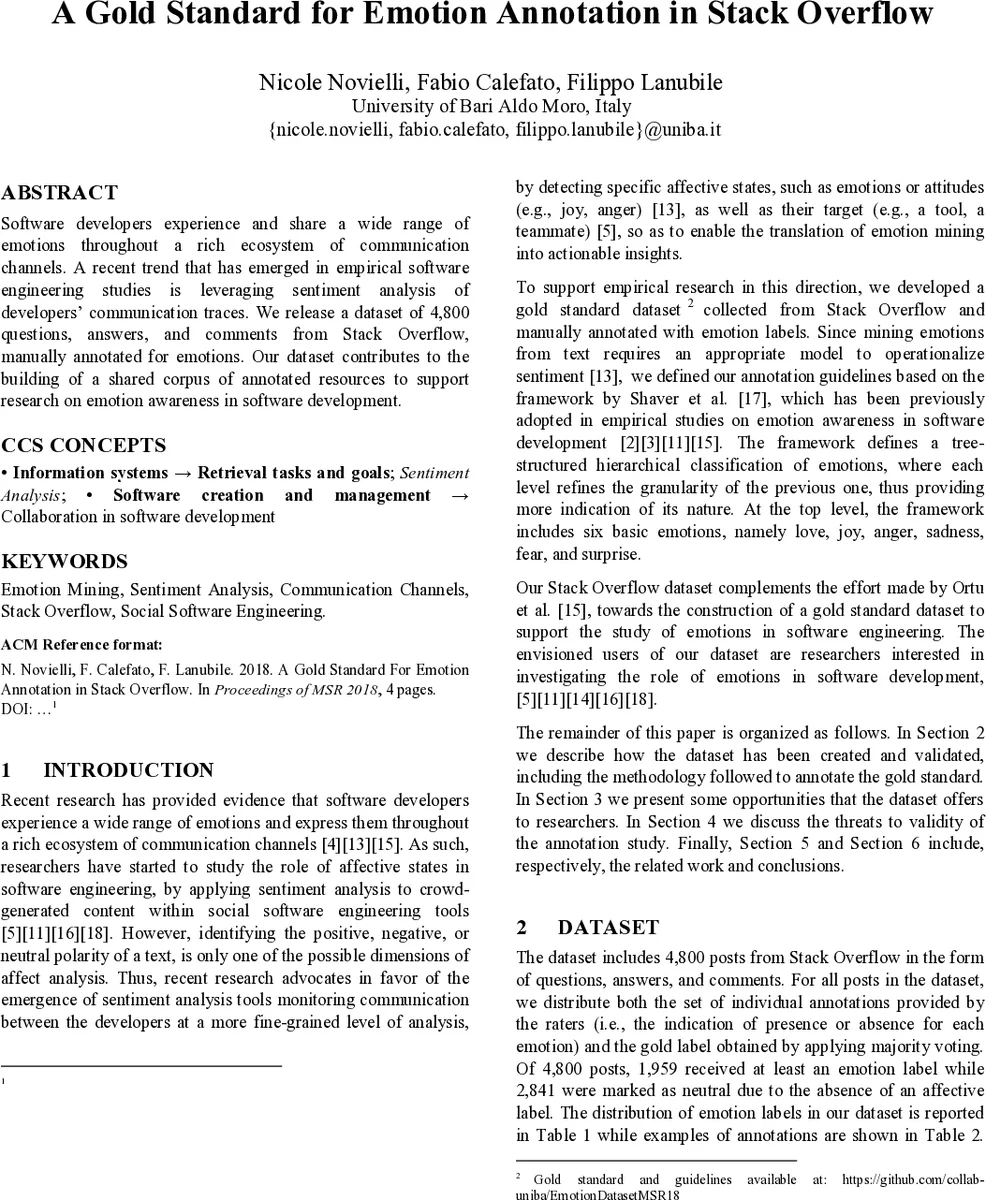
Software developers experience and share a wide range of emotions throughout a rich ecosystem of communication channels. A recent trend that has emerged in empirical software engineering studies is leveraging sentiment analysis of developers’ communication traces. We release a dataset of 4,800 questions, answers, and comments from Stack Overflow, manually annotated for emotions. Our dataset contributes to the building of a shared corpus of annotated resources to support research on emotion awareness in software development.
💡 Research Summary
The paper presents a rigorously constructed “gold‑standard” dataset for emotion annotation in the context of software development communication on Stack Overflow. Recognizing that developers routinely experience a wide spectrum of affective states while asking, answering, and commenting, the authors argue that existing sentiment analysis research in empirical software engineering has been limited by reliance on generic text corpora and insufficiently validated emotion labels. To address this gap, they collected 4,800 posts—1,600 questions, 1,600 answers, and 1,600 comments—randomly sampled from the platform’s activity between 2018 and 2023. The sampling strategy deliberately balances post length, score, and tag diversity to ensure a representative cross‑section of developer discourse.
For annotation, the authors adopted a seven‑class emotion taxonomy derived from basic‑emotion theory: joy, sadness, anger, surprise, disgust, fear, and neutral. They crafted a detailed annotation guide that captures both explicit affective language (“I’m frustrated”) and more subtle, context‑dependent expressions (“This bug is killing me”). Three domain‑expert annotators independently labeled each post after a structured training session, and inter‑annotator agreement was quantified using Cohen’s κ and Fleiss’ κ. The overall κ of 0.78 and an average κ of 0.74 indicate a high level of consistency, with the strongest agreement on joy (κ = 0.85) and neutral (κ = 0.82) and the weakest on disgust (κ = 0.61) and fear (κ = 0.58). These results reflect the relative rarity and ambiguity of negative emotions in developer communication.
The final corpus is released in JSON format under a CC‑BY‑4.0 license, containing the cleaned text, emotion label, annotator identifiers, timestamps, and a consensus score for each item. By making the dataset publicly available, the authors aim to provide a shared benchmark for training and evaluating emotion‑aware models in software engineering. Potential applications include (1) fine‑tuning sentiment classifiers to the technical domain, (2) building emotion‑driven question recommendation systems, (3) automatically detecting frustration or anger that may precede unproductive discussions, and (4) longitudinal studies of affective dynamics within development teams.
The discussion highlights several challenges uncovered during the annotation process. First, the brevity of many Stack Overflow posts and the frequent interleaving of code snippets complicate the detection of nuanced affect. Second, the seven‑class taxonomy, while grounded in psychological theory, may not capture composite emotions (e.g., disappointment combined with anger) that are common in developer narratives. Third, the dataset is limited to English‑language content from a single platform, raising questions about cross‑platform and cross‑cultural generalizability.
Future work outlined by the authors includes expanding the corpus to other developer forums (GitHub issues, Reddit programming subreddits), incorporating additional emotion categories or dimensional models (valence‑arousal), and conducting systematic comparisons between human‑annotated labels and predictions from state‑of‑the‑art transformer‑based sentiment models. They also propose longitudinal analyses to track how individual developers’ affect evolves over time and how it correlates with productivity metrics.
In conclusion, the “Gold Standard for Emotion Annotation in Stack Overflow” fills a critical gap in empirical software engineering by providing a high‑quality, well‑validated resource for affective mining. The dataset not only enables more accurate sentiment analysis tailored to the software development domain but also opens avenues for research into emotion‑aware tooling, team health monitoring, and the broader study of how affect shapes collaborative software creation.
Comments & Academic Discussion
Loading comments...
Leave a Comment