On Pareto Joint Inversion of guided waves
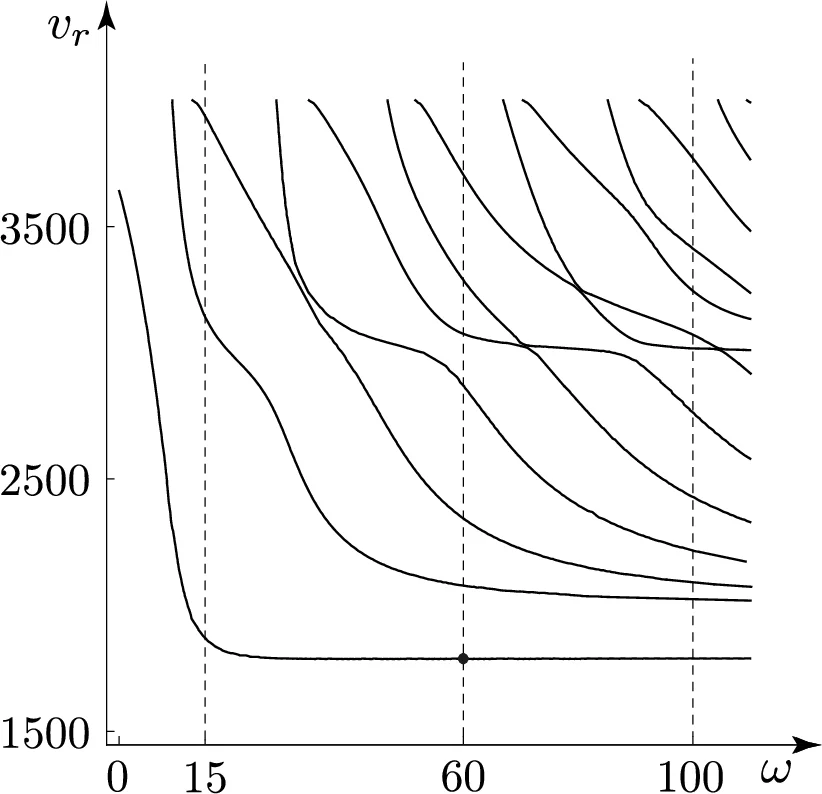
We use the Pareto Joint Inversion, together with the Particle Swarm Optimization, to invert the Love and quasi-Rayleigh surface-wave speeds, obtained from dispersion curves, in order to infer the elasticity parameters, mass densities and layer thickness of the model for which these curves are generated. For both waves, we use the dispersion relations derived by Dalton et al. (2017). Numerical results are presented for three angular frequencies, 15 Hz, 60 Hz and 100 Hz, and for two, five and seven modes, respectively. Comparisons of the model parameters with the values inverted with error-free input indicate an accurate process. If, however, we introduce a 5% error to the input, the results become significantly less accurate, which indicates that the inverse operation, even though stable, is error-sensitive. Correlations between the inverted elasticity parameters indicate that the layer parameters are more sensitive to input errors than the halfspace parameters. In agreement with Dalton et al. (2017), the fundamental mode is mainly sensitive to the layer parameters whereas higher modes are sensitive to both the layer and halfspace properties; for the second mode, the results are more accurate for low frequencies.
💡 Research Summary
The paper presents a novel inversion framework that simultaneously utilizes dispersion curves of Love and quasi‑Rayleigh guided surface waves to recover the elastic constants, densities, and thickness of a layered elastic half‑space model. Building on the Pareto Joint Inversion (PJI) concept, the authors treat the two dispersion relations—derived by Dalton et al. (2017)—as separate objective functions (f₁ = Dᵣ² for quasi‑Rayleigh, f₂ = Dₗ for Love) and seek solutions that minimize both simultaneously. This multi‑objective approach addresses the non‑uniqueness inherent in single‑wave inversions by exploiting the complementary sensitivity of the two wave types.
To solve the multi‑objective problem, the authors employ Particle Swarm Optimization (PSO). PSO’s population‑based global search capability is well suited for the highly non‑linear, multimodal nature of the dispersion equations. Each PSO iteration generates a candidate solution, which is evaluated against both objective functions; the resulting Pareto front is updated with any non‑dominated points. The Love‑wave dispersion relation is a real‑valued 2 × 2 determinant, while the quasi‑Rayleigh relation reduces to a 2 × 2 determinant that can become complex. The authors avoid complex arithmetic by substituting sin(i x)=i sinh(x) and cos(i x)=cosh(x), thereby keeping all calculations in the real domain.
Numerical experiments are conducted at three angular frequencies (15 rad s⁻¹, 60 rad s⁻¹, 100 rad s⁻¹) using, respectively, the first 2, 5, and 7 modes of each wave type. Two data scenarios are examined: (i) error‑free synthetic phase velocities and (ii) velocities perturbed by ±5 % to simulate measurement noise. For the noise‑free case, the Pareto fronts are essentially rectangular, indicating that the quasi‑Rayleigh objective can be driven very close to zero while a wide range of Love‑wave misfits remains. This reflects the stronger constraint imposed by the quasi‑Rayleigh data. Histograms of the Pareto‑optimal parameter sets show tight clustering around the true model values, especially for layer thickness (Z) and densities (ρᵤ, ρ_d). The fundamental mode is most sensitive to layer properties, whereas higher modes increasingly involve half‑space parameters, confirming earlier findings by Dalton et al.
When 5 % noise is introduced, the Pareto fronts broaden and the recovered parameters deviate noticeably from the true values. Layer elastic constants (C_u₁₁, C_u₄₄), density ρᵤ, and thickness Z exhibit errors often exceeding 10 %, whereas half‑space parameters (C_d₁₁, C_d₄₄, ρ_d) are comparatively more stable but still show appreciable drift for higher‑order modes at the highest frequency. The sensitivity analysis demonstrates that the inversion is stable in the sense that a solution still exists, yet it is highly error‑sensitive; small perturbations in the input velocities propagate into significant parameter uncertainties, especially for the shallow layer.
The study concludes that Pareto Joint Inversion, combined with PSO, effectively integrates complementary wave‑type information, reduces non‑uniqueness, and yields accurate parameter estimates under ideal conditions. However, the method’s performance degrades sharply with realistic measurement errors, highlighting the need for robust data preprocessing, error modeling, and possibly the incorporation of additional constraints (e.g., H/V spectral ratios) to stabilize the inversion in practical applications. Future work should focus on extending the framework to multi‑layered models, exploring alternative multi‑objective optimizers, and developing systematic strategies for quantifying and mitigating the impact of data noise.
Comments & Academic Discussion
Loading comments...
Leave a Comment